MOST GEORGIANS know Sonny Perdue from his time as the state’s 81st governor from 2003 to 2011 and as the United States Secretary of Agriculture from 2017 to 2021. Today the former veterinarian may have his favorite job of his career: Since 2022 he’s served as the chancellor of the University System of Georgia (USG), leading 26 public higher education institutions around the state. “The trajectory of someone’s life, to a large degree, depends on their level of education. As we help people invest in themselves through education, it just increases their chances of personal prosperity, both for them and their family,” Perdue says. “When you see the graduation walks across the stages and the confidence these students have, it’s a thrill.” There’s lots to be proud of: In fiscal year 2024, the USG awarded an all-time high of 76,571 degrees. We spoke with Perdue to hear more.
“I believe that the university system is really the power that drives the economy through talent.” —SONNY PERDUE
Photograph by Audra Melton
How is the University System of Georgia preparing students for the evolving job market?
We don’t know what [the] jobs of the future are, that’s why we’re trying to prepare students for critical thinking, problem-solving, problem identification, and how to create and apply the knowledge that they’ve gained at a university to the public sector. It’s all about creating a talent pipeline. We do that through everything from certificates to PhD degrees. Some examples are in AI, but not just in our research institutions. For example, Middle Georgia State University is offering a BS in applied artificial intelligence this fall. That’s really going to help address [needs in] Georgia’s key economic sectors such as agriculture, aerospace, logistics, and healthcare. Georgia State University has a new AI master’s program. Logistics is a huge component of the Georgia economy, and our state colleges have formed a new cooperative academic arrangement in supply chain and logistics to address the job creation in those sectors. Finally, we know about the demand for nurses, and we are continuing to emphasize nursing recruitment and education. We’re proud of the quality of our NCLEX (National Council Licensure Examination) pass rates and our approximately 95 percent graduate completion rate. Those are just some examples of how we’re preparing students for evolving job opportunities. I laughingly tell people that we want to graduate students with a “FIO” degree—that’s “figure it out.” That’s what we’re trying to teach students to do.
Did your former role as governor prepare you for your position as chancellor?
It gave me an appreciation for the organization. I respected the University System of Georgia as being constitutionally separate, although I was intimately involved in the funding. I think the budgeting and funding part was probably the best experience. I believe that the university system is really the power that drives the economy through talent. As governor, I learned that we had to have a talent flow that met the needs of the workplace in order to recruit companies to come here. That’s why the university system, as well as the technical college system, is so important.
How closely do you collaborate with the Technical College System of Georgia (TCSG)?
When you focus on the student, it’s not competitive, it’s cooperative. We’re continually evaluating MOU articulation agreements [which facilitate the transfer of academic credits between educational institutions] with the TCSG in order to help students progress as far as they want. Some may start out not thinking they’d ever go to college, but they surprise themselves by becoming good students. They may get their associate degree [through TCSG] and want to continue. Some of them even wind up with PhDs. We are working for better transferability of credit hours into the university system.
What role do public universities play in supporting Georgia’s economy?
I’ll give you an example. When I was governor, from 2003 to 2011, various states were competing based on tax incentives and how many monetary benefits we could give. In the last few years, it’s turned into a talent competition. That’s where our higher education entities come into play. We’re the talent flow. If you ask these companies what the limiting factor is in their decisions, it’s always people and where they can get the talent. That’s why Georgia has been so successful in attracting companies; we’ve got major universities and even smaller universities turning out top talent that is easily recruited into those companies. We work with companies and the Georgia Department of Economic Development to put forth proposals about how we would work with those industries, allowing them to tailor specific kinds of courses or degrees that they need.
The cost of college is a hot-button issue. How is your team helping make it more affordable?
We’re proud of the university system’s responsibility and affordability. In fact, this past year was the seventh time in 10 years that the board has kept overall tuition fees flat for Georgia students across most of our institutions. According to data from the state auditor, since 2017, USG tuition has declined more than 24 percent after adjusting for inflation. Most people don’t realize that because they also count the cost of living, housing, and board in the cost of college. Much of [the reduction] is because of the special institution fee that was reduced by the legislature. It eliminated anywhere from $400 to over $1,000 tuition per year for students. We’re probably among the six lowest public systems in the country for tuition, and third in the [16] Southern Regional Education Board states.
How is the USG leveraging technology to help nontraditional students thrive?
We’ve got a large number of Georgians, probably over a million, who have some college but who have not completed a degree. That’s kind of sad, because you can’t put on a resume that you attended such-and-such college. Employers look for a graduation. So we’re reaching out to them. They typically have families and jobs where they can’t leave to come to campus. So we’re reaching them through online opportunities. We have over 11,000 online courses and about 439 fully online degree programs, ranging from associate to doctorate degrees. We have to meet people where they are.
“Georgia’s aviation industry is doing just fine at cruising altitude but leaders want to take it to the stratosphere…and beyond.”
-nadine Auda
Gulfstream’s G800 model has a 8,200 nautical mile range at Mach 0.85.
Courtesy of Gulfstream
Georgians have long been adept at building industry from the ground up. We’ve grown timber and agribusiness from the fertile soil, harnessed our geographic location for logistics and supply, and even showcased our natural landscapes as backdrops for film and television. But one of the state’s most exciting sectors of growth isn’t based on terra firma—it’s in the air above us.
Nadine Auda is one person betting on blue skies over Georgia. She has worked in aerospace all over North America. An engineer by trade, she has degrees from Toronto’s Ryerson University and McGill University in Montreal, where she also worked in product development for Bombardier, Canada’s largest aircraft manufacturer. She got her MBA at in Boston analyzing investment opportunities in tech and industry for private equity firms and corporate clients all over the U.S. In 2021, she moved to Atlanta to work for McKinsey & Company, the global management consulting firm.
Then a few years ago, Auda and her team noticed an increasing need for regional cargo shipping solutions and saw an opening to start their own aerospace business. While the major carriers like FedEx and UPS kept their jumbo jets moving in and out of major hubs, rising operating costs (especially fuel), pilot shortages, and a lack of infrastructure (airports and sufficient runways) were squeezing businesses that rely on air shipment to more remote, middle-mile destinations. They theorized that they could build smaller, hybrid-electric drones custom-designed around the goods being sent, particularly those that are bulky and lightweight, like food, diapers, or medicine.
“It takes a village to build a plane like this”
-nadine Auda
Auda and her team had the experience and connections to launch their startup, Rune Aero, anywhere on the continent, but they chose Georgia.
“It takes a village to build a plane like this,” says Auda. “You don’t want to innovate in a silo. If you look at Georgia, there are a lot of shops that have experience building a plane. We know local shops that have done work for Boeing and Lockheed Martin. The talent is here; the supply chain is here. Georgia has an entire aerospace ecosystem. It’s not as nationally renowned as Seattle or Los Angeles, but Georgia is pretty stealthy about its aerospace industry.”
LEARNING TO FLY
Georgia’s sky-high ambition is getting harder to miss. Each year, more than 100 million people pass through Hartsfield-Jackson Atlanta International Airport, “the world’s busiest,” and home to Delta, the country’s oldest airline and one of its largest. But many of the aircraft flying throughout the state are built here. According to the Georgia Department of Economic Development (GDEcD), aerospace products are the state’s top export, reaching $12.6 billion in 2024. It’s the second-largest industry in terms of manufacturing, producing a $57.5 billion overall economic impact. And more than 800 aerospace companies, from jumbos like Lockheed Martin and Gulfstream to small startups like Rune, currently use Georgia as a base of operations.
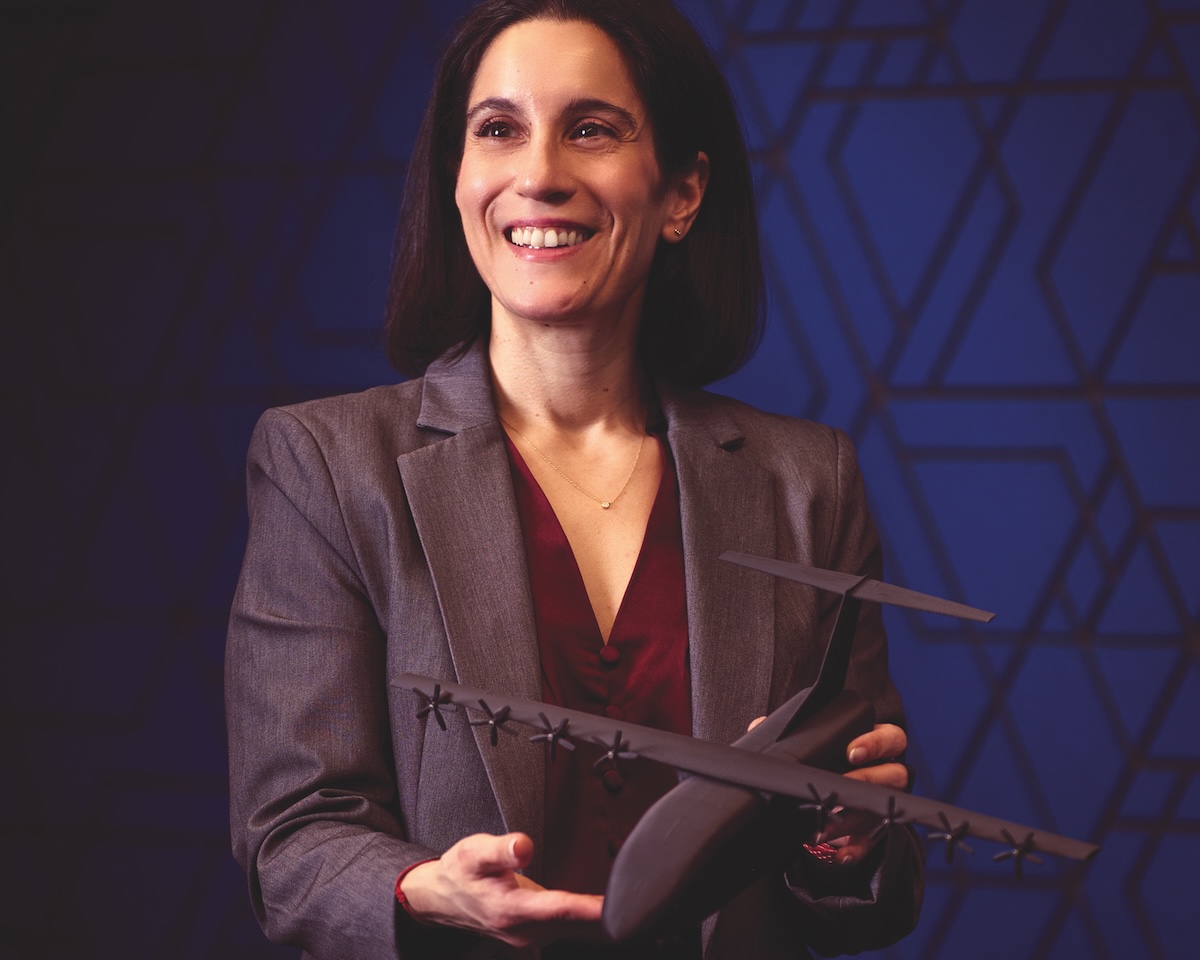
Nadine Auda holds a 3D-printed concept model representing Rune Aero’s planned full-scale cargo aircraft.
Courtesy of Eley
In recent years, the state has become much more than just a worldclass aircraft assembly line—it’s also a regional, national, and international hub of aeronautics business and advancement. For instance, along with Delta Air Lines, Atlanta is also home to Delta TechOps, one of the biggest aircraft maintenance, repair, and overhaul (MRO) operations in the country. Gulfstream is not only a leading maker of business jets, but its Savannah Service Center is also one of the largest business aviation servicing facilities in the world. Those MRO installations are fed by engine makers like Columbus-based Pratt & Whitney, plane parts fabricators like Northrop Grumman (Warner Robins), advanced electronic systems producers like L3Harris Technologies (Alpharetta), and a vast network of smaller sellers up and down the supply chain. And the jet fuel of this entire industrial apparatus is a line of skilled talent coming out of the state’s universities and technical schools.
In other words, Georgia sees aviation as more than manufacturing. Once you’ve built the aircraft, you have to operate it, service it, and maintain it, and that requires a steady flow of subcontractors, vendors, machinists, engineers, pilots, and technicians to keep these aircraft aloft and drive research and innovation to keep pace. And the state is working—through corporate-government partnerships like the Georgia Center for Innovation and the Georgia Aerospace & Defense Alliance (GADA)—to raise its composite score across all subsectors of the industry.
“Georgia’s advantage in aerospace comes down to leadership, talent, infrastructure, and execution,” says Ember Bishop Bentley, executive director of GADA, a coalition of local aerospace companies launched at Mercer University in August 2025. “We have a deep bench for the workforce supported by top-tier engineering and aviation programs, a strong technical college system, and a large veteran workforce. Pair that with global connectivity and site-ready communities that allow aerospace and defense companies to grow and compete in a pro-business climate. Together, these elements create a highly competitive, end-to-end aerospace and defense ecosystem.”
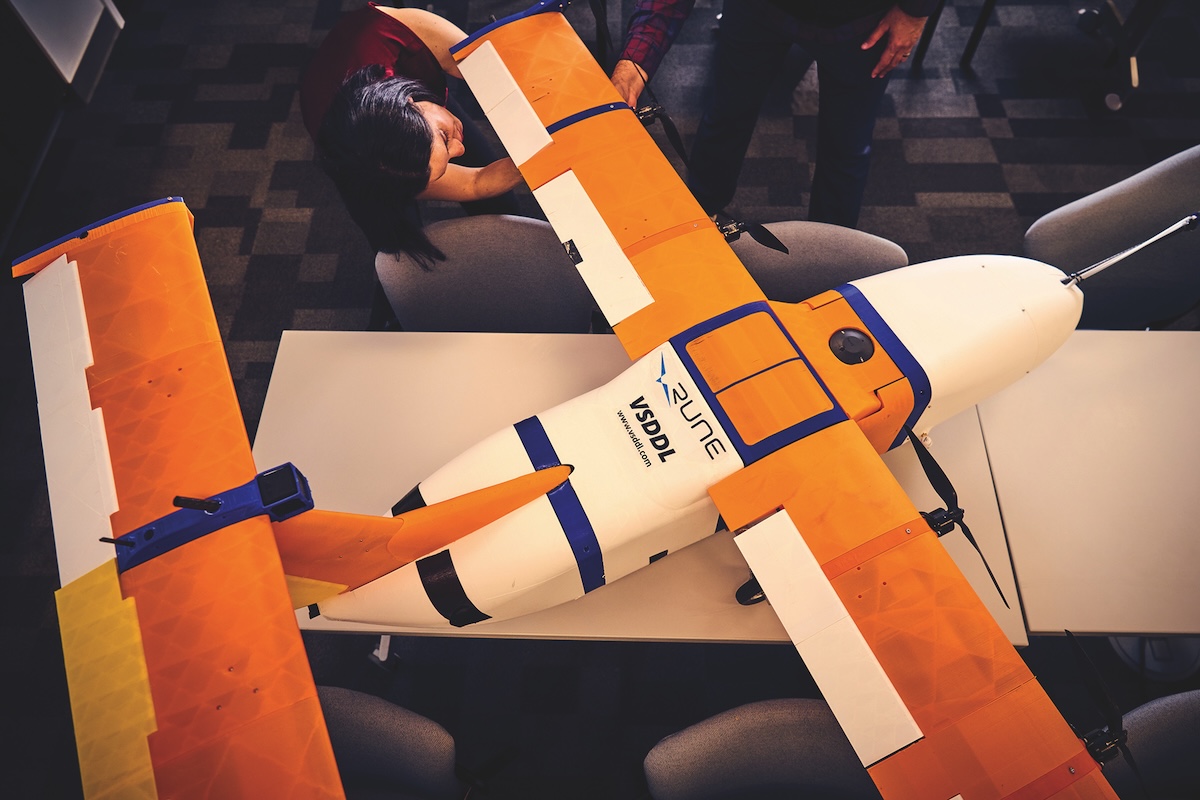
Rune Aero’s all-electric subscale aircraft is used for autonomous flight testing.
Photo Credit: ELEY
That vertical integration supports more than just commercial air travel, shipping, and logistics. Much of Georgia’s aviation industry is anchored in defense, including Lockheed Martin’s military aircraft factory in Marietta. This overlaps with the state’s emerging space and satellite tech sector, including SpaceWorks Enterprises, which focuses on hypersonic aircraft, satellites, and in-space servicing from its Atlanta headquarters, and Archer Aviation, a newer disruptor that specializes in vertical takeoff and landing craft in Covington.
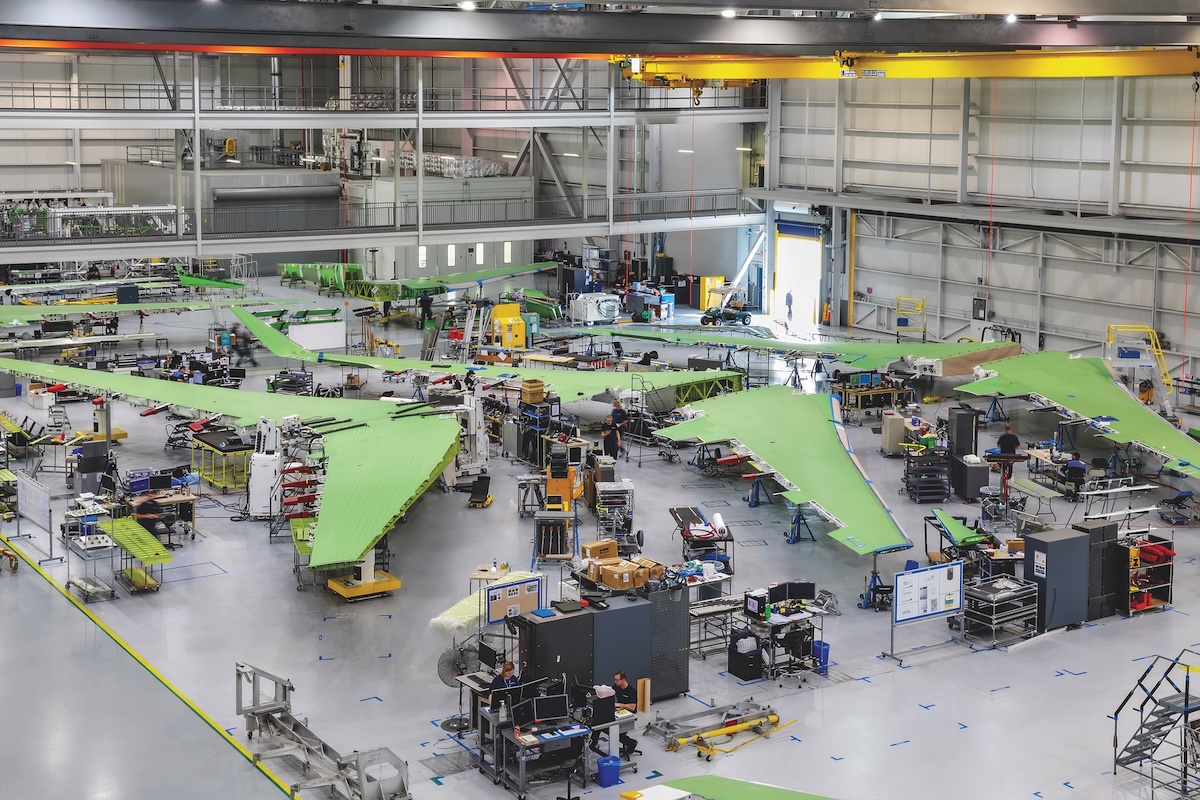
Lockheed manufacturing facility in Marietta.
Photo courtesy Lockheed
And then there’s the rapidly evolving…..there’s the rapidly evolving field of Unmanned Air Systems (UAS) piloted (remotely) by firms like Atlanta Drone Group, Atlanta’s Airbus Aerial, and start-ups like McDonough’s Versa-TOL UAS and Rune.
“There’s enough volume and growing demand here,” says Auda, referring to Rune Aero’s decision to headquarter in Peachtree Corners, Georgia. “There’s plenty of talent and mentorship opportunities. And there’s a general excitement in the industry. For a smaller start-up, it’s a great place to be. In any other city, we’d just be a drop in the ocean.”
TALENT UNLOCKED
Ask any aviation industry insider or business executive, from multinational corporations to fledgling start-ups, and they’ll tell you the primary thrust of Georgia’s aeronautics sector comes from its high-octane talent base. More than 200,000 Georgians work in positions directly or indirectly related to aerospace, and the state’s schools are turning out new pilots, machinists, technicians, designers, engineers, and administrators every day.
“There’s Plenty of talent and mentorship”
– Nadine Auda
Of course, Georgia Tech has a longstanding reputation in the field, ranked fourth in top undergraduate engineering programs by U.S. News & World Report. Tech is also credited with the nation’s best aerospace engineering undergrad and graduate programs and known for groundbreaking research in everything from testing supersonic propulsion systems to advanced navigation, communication, and flight control systems. School administrators, faculty, and researchers have long-standing partnerships with the likes of NASA, the U.S. Space Force, and Lockheed Martin, which shares space with Tech on Marietta’s Dobbins Air Reserve Base for continual research and development.
Outside of metro Atlanta, other schools have launched undergrad programs in the industry. Kennesaw State recently announced that it is partnering with nearby Lockheed Martin to offer a new bachelor’s degree in aerospace engineering, the second of its kind in the state, building off its successful minor in that field. In Athens, the University of Georgia (UGA) began offering a certificate in aerospace engineering in 2024. And while they are scattered through the state, these institutions aren’t working in silos. In fact, in December, GADA announced that Georgia Tech, UGA, Kennesaw State, and Georgia Southern University had all joined the alliance in an effort to align their programs with the goals, needs, and visions of the industry.
Lockheed Martin Aeronautics Company, Marietta, Ga.
Photo courtesy of Lockheed
Once the plane is built, someone still has to fly and maintain it. In Macon, Middle Georgia State University is one of only nine institutions in the country that offers degrees and certification in FAA-certified programs for piloting planes or helicopters, air-traffic control, and aviation maintenance. Meanwhile, the Technical College System of Georgia is preparing hangar- and factory-ready workers with two-year degrees, oneyear diplomas, and fast-track certificates in aviation maintenance, aircraft structural technology, and avionics. Chattahoochee Technical College, just outside of Marietta, initiated a full-blown aircraft manufacturing training program in 2024 that works directly with Lockheed Martin to funnel employees prepped for the assembly line on day one.
Education isn’t just a oneway runway for Georgia aviation companies. In Savannah, where Gulfstream employs 13,000 people, the company invests heavily in STEM awareness in elementary, middle, and high schools to build early awareness of the opportunities that await in aerospace. The company works with the Department of Defense’s SkillBridge program to encourage service members transitioning from active duty to consider a career in aviation. Gulfstream has even built a training center for employees with zero experience or education in the field. “Industries struggle to fill this pipeline,” says Jeannine Haas, Gulfstream’s chief marketing officer. “We’ve been making these investments in our communities, and it’s been transformational—for the company and the community where we live.”
FLIGHT-TESTED
In addition to Georgia’s robust educational institutions, the state also possesses deep industry knowledge through its veteran workforce. For instance, Lockheed Martin’s operation in Georgia dates back to 1951, when Lockheed-Georgia took residence in the Bell Bomber plant in Marietta. Area workers had shown their aptitude for producing cutting-edge aircraft, building B-29 Superfortress bombers for World War II, and Lockheed tapped into that North Georgia know-how to continue design and manufacture of the aircraft for U.S. defense.
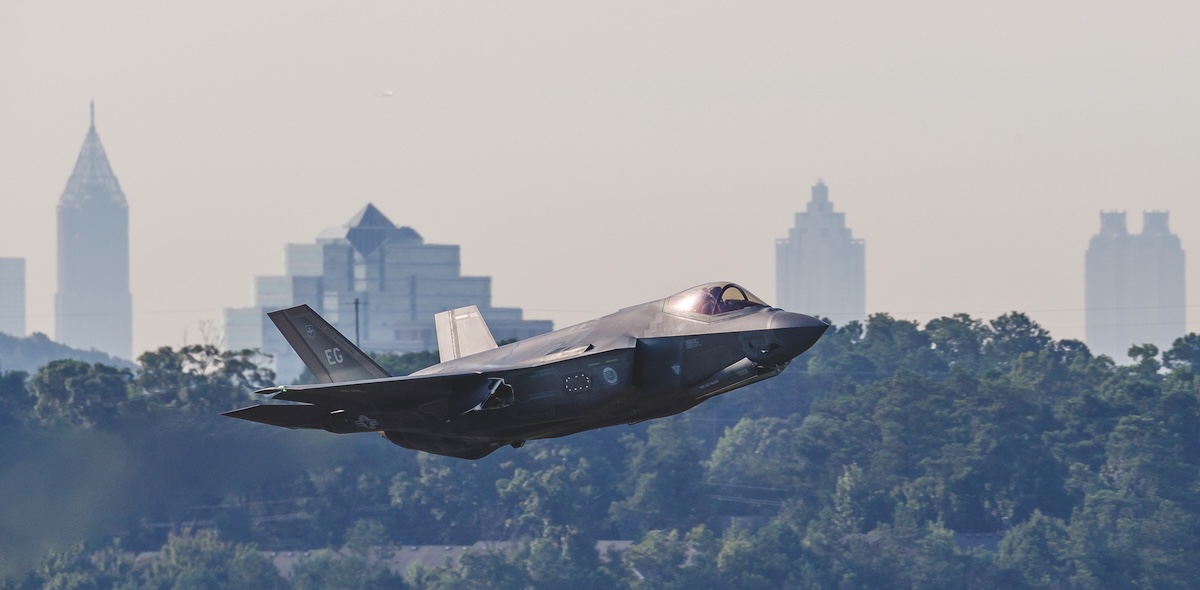
For 75 years, the plant, co-located with Dobbins Air Reserve Base, has employed generations of engineers, designers, technicians, and laborers to assemble C-130 Hercules troop transport planes, P-3 Orion turboprop anti-submarine and maritime surveillance planes, F-22 Raptor twin-jet fighters, F-35 Lightning II supersonic stealth fighters, and C-5 Galaxy military transports, not to mention countless programs that remain classified.
Students in Chattahoochee Tech’s aviation training academy.
Photo courtesy of Chattahoochee Tech.
“We’re supported by an incredible community in Georgia,” says Trish Pagan, vice president of air mobility and maritime missions for Lockheed Martin and general manager of the Marietta site. “We have incredible support from a skilled and specialized workforce. It’s not just from the universities. There is a pool of military veterans as well. I have lived outside of the Southeast, and there’s a pull to work here. People like to stay in the area, and we’re seeing growth in the pool of talent.”
Wind tunnel at Georgia Tech.
Photo courtesy of Georgia Tech
Gulfstream, which officially established its manufacturing and headquarters base in Savannah in 1967, has the same deep roots in the Georgia clay. “We have generations of people who’ve worked here,” says Haas. “We’re a company where people want to be. There’s a tremendous amount of pride.”
BLUE SKIES
Another advantage Georgia has in the world of aerospace and aviation: environment.
Gulfstream was founded as Grumman Gulfstream in Bethpage, New York, in 1958. The company relocated to Savannah in 1967 thanks to its favorable year-round flying weather, proximity to airports, available flat and vast terrain, and, outside of Atlanta, the open airspace. After all, it takes a lot of space to build, house, launch, and land these massive air – borne machines—and plenty of sky in which to test and fly them. “Access to the coast is great for flying,” says Haas. “The weather here is conducive. But more importantly, the Savannah/ Hilton Head International Airport has been a great partner.”
Gulfstream manufacturing is a sizable operation in Savannah.
Photo courtesy of Gulfstream.
As Haas indicates, Georgia’s flight friendly features have produced a network of prominent airports including Hartsfield-Jackson, Savannah/Hilton Head, Augusta Regional Airport, Columbus Airport, and Dobbins. The presence of these hubs provides infrastructure (runways, hangars, air traffic control towers, etc.) that can serve as testing grounds for aircraft, related technology, and personnel. As a result, aeronautics companies all along the supply chain choose to base operations in proximity to these airfields.
“There’s so much physical space and access to set up the warehouses and plants,” says Auda. Her company, Rune, while based in Atlanta, also works with Augusta Regional Airport, a cargo hub, to test, co-build, and innovate. “There isn’t much space available in the West and Northeast, and if it is available, it’s incredibly costly.”
These airports are also part of the larger transportation network that includes the Port of Savannah, Port of Brunswick, extensive railways for freight, and 20,000 miles of federal and state highways that provide the logistics and distribution vital to growing an aviation company. And like any other sector of Georgia-based industry, be it timber, tech, or entertainment, aviation also benefits from another element of the state’s environment: a friendly business climate.
“There’s so much physical space and access to set up the warehouses and plants.”
-Nadine Auda
This amounts to more than a low corporate tax rate, affordable costs of doing business, and a welcoming regulatory atmosphere. Through organizations like the Georgia Center for Innovation, part of GDEcD, the Georgia Aerospace & Defense Alliance, and Georgia Tech’s Advanced Technology Development Center, a consultancy for early-stage science and techbased start-ups, the state features a deliberate and synchronized partnership between government, academia, and the business community.
“Georgia’s aerospace ecosystem has evolved into a more connected and sophisticated network,” says GADA’s Bentley. “It’s marked by stronger industry-academic collaboration, increased investment from both legacy and emerging companies, a broader technology footprint, and better coordination across economic development partners.”
For example, in 2024, the Georgia Department of Transportation released its Advanced Air Mobility Blueprint, a plan produced by a group of representatives from airports, private industry, public transit, local governments, academia, and state officials that hopes to provide safe and efficient transportation via electrical Vertical Takeoff and Landing aircraft. Rune’s Auda specifically mentioned this initiative while talking about the general excitement surrounding Georgia’s aerospace ecosystem. “There are great opportunities,” she says. “We want to work with people who are doing things like that.”
FAVORABLE FORECAST
Middle Georgia State University trains and offers programs in maintenance technology.
Photo Credit: Matt Odom
While Georgia’s aviation industry is cleared for takeoff, the radar doesn’t indicate completely clear skies ahead. In business, riding on the current of constant innovation, there is a relentless drive to stay ahead technologically.
Bentley says other states, like Arizona and Texas, are drawing aerospace and defense investment with major expansions and workforce initiatives, while closer neighbors like North Carolina and Florida have been trying to ride Georgia’s tailwind by positioning themselves as attractive destinations for aviation firms. “States are actively competing to attract companies, capital, and skilled workers by highlighting talent pipelines, infrastructure, and incentive packages,” she says. “And at the same time, the broader industry is facing intense competition for skilled talent,” including that from Georgia.
Middle Georgia State Student.
Photo credit: Matt Odom
And in terms of the state growing its own aviation businesses, such as start-ups like Rune, there is a general gap in venture capital and outside investment that is hindering true growth. “Georgia has enough volume and demand, but we need to go national to access the capital to grow,” says Auda. “We need testing, talent, and funding. No one place has all three things, but Georgia has the testing and the talent.”
This article appears in the Spring 2026 issue of GaBiz.
Longtime Atlantans will remember where Cuban sandwich favorite Kool Korners stood on the corner of Fourteenth and State streets. It closed in 2008 and reopened in Birmingham a year later. Its original building was torn down and replaced by a square, brown brick construct that now houses Moe’s, a barbecue chain founded in Alabama and now based in Colorado. (It has no relation to the local Southwest grill franchise with a similar name.) Skip the soggy ribs and pulled pork, but zero in on the poultry: Pulled chicken and sliced turkey both have a subtle, perfumed smokiness and come dressed with a mix of lightly sweet tomato sauce and Alabama white sauce.
Owner Deborah Moebes’s enthusiasm for fabrics and frills is contagious. The author of Stitch by Stitch: Learning to Sew, One Project at a Time embraces community, whether stitchers are new to the needle or old pros with patterns. Her shop and “modern sewing lounge” in Westside’s Brickworks development offers classes nearly seven days a week. Learn everything from sewing pillows and totes to quilting and hand embroidery. Check out Moebes’s spirited blog and join the monthly sewing circle.