
Home 2019

Archives

After 20,000 passengers, this five-star Lyft driver has met more Atlantans than you know

Jackee White, five-star Lyft driver

Atlantans is a first-person account of the familiar strangers who make the city tick. This month’s is Jackee White, a driver for Lyft, as told to Sonam Vashi.

Before driving, I was a hairstylist—I did André 3000, Tiny from Xscape—and used to own a salon in College Park. But I had to give it up about five years ago: My heel got caught in a sidewalk, and I broke my ankle. I had to get a plate and seven screws, and I couldn’t stand for long anymore. Around the same time, I went through a bad divorce; I lost custody of my daughters and was living with my mom—basically homeless. I was depressed. I’d seen ads for Lyft but didn’t know what it was. It seemed too good to be real. One night at 3 a.m., I clicked on a Lyft ad and read about the company and the pay. The flexibility caught my attention, since I’ve always been self-employed, and I decided to try it out.

Growing up in Cascade in the ’70s and ’80s—I’m a Grady baby!—I’d always had a thing for cars. As a child, I’d play a driving game in an arcade nearby. I was always the designated driver for my friends; I don’t really smoke or drink, and I’d pick them up in my red Cutlass Supreme and take them to Skate Towne roller rink in College Park. I’ve always liked driving because I like being in control, feeling safe and being aware of what’s going on in my surroundings.

Eventually, I went to pick up my first passenger, and there was a guy standing on the corner where the app said the pin was. “You called a Lyft?” I asked him. He hesitated—“Uh . . . Yeah.”—and moved to get in the car, and, at that moment, I knew it wasn’t him. I drove past him and found the real passenger around the corner. I knew from dealing with customers all my life that his body language wasn’t right; that intuition is what made me feel like, Maybe I can do this. I took one ride after another and been doing it ever since.

“You get all kinds [of passengers]: people cheating on their partners, college students stressed about finals. It’s like Taxicab Confessions.”

I drive about 60 hours a week in my white Hyundai Elantra, usually listening to V-103, though I always ask what my passengers want to listen to. I’ll put on jazz or something else if a passenger might be insulted by lewd lyrics. My goal is to be the first female driver to make $100,000. I drive a lot: I’ve hit 20,000 passengers, and I’ve got a five-star rating! I’m just very friendly—I always fist-bump passengers, ask how they’re doing.

At night, I get a lot of corporate types looking to party at the Ivy, Johnny’s Hideaway. I’ll have Krispy Kreme donuts ready in the car for drunk club-goers. Sometimes, I make recommendations: I’ve never been to most strip clubs, but I’ve picked up so many guys from them that I can look at a passenger and tell them where they’ll want to go. White guys in suits love the Cheetah.

I’ve had challenging days—backseat drivers, annoying customers. Mostly, I’m like a bartender. People tell me their business, just like when I was a hairstylist. You get all kinds: people cheating on their partners, college students stressed about finals. It’s like Taxicab Confessions. Once, a man told me he was thinking about committing suicide; he felt like life was too hard and he didn’t have anything to live for. I just talked to him, told him to hold on, that you can’t stop in the middle of the storm. He told me that talking to me let him know there’s still good people in the world. That’s my passion. Driving’s a lot like therapy sometimes. I’ve been through a lot, but I took that pain I was feeling and put my energy into other people’s needs and wants. I got to mentor new drivers, teaching them the dos and don’ts. The company even flew me out to celebrate its IPO launch on the stock market in March. I met the Lyft founders and told them how it changed my life, gave me hope, opened the door to make a bigger income. Only thing I have to do now is just keep going, going, going. I’m gonna be driving until my wheels fall off.

This article appears in our September 2019 issue.

Commentary: Atlanta’s nighttime e-scooter ban has a major blind spot

E-scooters Atlanta nighttime ban
A pair of e-scooters in downtown Atlanta

Photograph by Myrydd Wells

One evening, about a week ago, I was walking home down a particularly dark stretch of Ponce de Leon Avenue when my well-honed feminine spidey sense kicked in. Looking over my shoulder, I saw a man walking about 10 feet behind me. When I crossed the street, he followed. Sufficiently shaken, I raced back toward the nearest well-lit intersection and watched the man disappear into a dark park.

There were only about 800 steps between me and my door, but hardly any street lamps and no route on foot I could take that didn’t involve passing the park. I surveyed my options. Luckily, I had my phone and could order a Lyft. Seven dollars and 90 seconds later, I was safe at home.

The next day, I shared my experience in a post on Nextdoor. After the usual deluge of sexist admonishments about walking alone at night, one neighbor chimed in with a suggestion. “Better to ride a scooter,” he wrote.

And I agree: it would’ve been better. My phone is littered with apps for Bird, Lime, Jump, Bolt—you name it, I’ve ridden one. I often rely on e-scooters to ferry me home after a night out on the BeltLine Eastside Trail. The idea of traversing that four-block section of poorly lit Ponce that evening would have been a hell of a lot less daunting when zipping along at 12 miles per hour, and it would’ve cost less than half what I paid for the Lyft.

The problem was, a few days prior to my run-in with the guy in the park, Atlanta Mayor Keisha Lance Bottoms announced a nighttime ban on e-scooters, digitally locking up every vehicle on the streets at 9 p.m. sharp. Ostensibly this came in response to the fact that Atlanta drivers have struck and killed four scooter riders in the past year.

Still, my Nextdoor neighbors were quick to offer other tips: Why not carry mace? Here’s a link to a pepper spray that attaches to your scrunchie—perfect for jogging! How about packing a stun gun? Or a real gun? Why wasn’t I walking with a buddy? Why would I leave the house by myself at all after dark? This depressing parade was a fitting reflection of America’s appetite for pointing the finger everywhere except where it belongs.

Just as my post quickly devolved into a morass of victim-blaming, so, too, is Mayor Bottoms’s ban a shortsighted solution to a much larger problem: Designed to prioritize cars, Atlanta’s streets lack the infrastructure necessary to ensure the safety of all road users. In both cases, we are having the wrong conversation.

It’s devastating that drivers killed four scooter riders this year. It’s also devastating that four Georgians are killed in car crashes every day. Despite the hysterical media coverage, the statistics available, albeit limited, suggest that scooters are actually about as safe per mile traveled as other modes of transportation, and the “safety in numbers” principle has clearly shown that such alternative modes become even safer as more people adopt them—even when local governments refuse to invest in sidewalks and bike lanes with anywhere near the enthusiasm they bring to funding highway expansions.

In addition to mourning those four scooter riders, let’s also consider the people who are robbed, raped and assaulted while walking the streets of Atlanta every night. While scooters obviously aren’t a complete deterrent for a determined criminal, they do offer a sense of protection for those who would otherwise be traveling their route on foot.

If we truly want to make Atlanta streets safer for everyone—drivers, scooters, bicycle riders, wheelchair users, hoverboard bros, senior citizens attempting to cross multi-lane highways to get to the store, and teen girls walking home alone from the bus stop—we should not content ourselves with Band-Aid “solutions” that only serve to punish the most vulnerable road users. What we need is more and better infrastructure: protected bike lanes, adequate lighting, more sidewalks, lower speed limits, and, sure, maybe some etiquette lessons for everyone on how to share the road. In the meantime, Mayor Bottoms’s ban just leaves one less transportation alternative for folks whose options for getting around Atlanta safely are already limited, whether they’re car-less by choice or by necessity.

The city, for its part, seems to recognize this, or at least pay lip service to the idea: Planning commissioner Tim Keane has admitted the need for more bike and scooter lanes—changes have been promised within the month—but he maintains the temporary ban will “improve” street safety immediately. He is wrong. For this resident, at least, those dark Ponce blocks were decidedly less safe that night than they would’ve been without the ban.

E-scooters are not the answer to all (or even most) of Atlanta’s transit and safety woes—many scooter companies don’t even operate in the city’s most underserved  neighborhoods, whose residents face significantly greater threats to their well-being and road safety than I do and may not be able to afford to call a cab every time they encounter a shady situation. But banning scooters at night does little to improve public safety; in fact, for women like me who relied on them to help make the last mile of our journey a little safer, it only makes things worse.

Maya Kroth is a writer in Atlanta.

18 things to do during Labor Day weekend in Atlanta 2019

What to do on Labor Day Weekend in Atlanta
Embrace your inner super hero at Dragon Con.

Photograph courtesy Dragon Con Photography (c) 2019 Dragon Con, Inc

Dragon Con
Where: Downtown Atlanta (specifically: Hyatt Regency Atlanta, Atlanta Marriott Marquis, Hilton Atlanta, Sheraton Atlanta, Westin Peachtree Plaza, AmericasMart, and 200 Peachtree)
When: August 29 through September 2
Cost:
$140 for a 5-day pass; $35-$120 for various day and multi-day passes
Details:
The five-day celebration of all things pop culture is back in full-force with panels, dance parties, gaming, workshops, and plenty of amazing cosplay. Among this year’s celebrity guests are George Takei and William Shatner (Star Trek), David Tennant (Doctor Who), Zachary Levi (Chuck), Rose McIver (iZombie), and Robert Englund (Nightmare on Elm Street). If you just want to see the spectacular costumes, the parade will be held on Peachtree Street at 10 a.m. Saturday (arrive early; it gets packed), or just grab a bite to eat anywhere near the host hotels.

Chick-fil-A Kickoff Game
Where: Mercedes-Benz Stadium
When: August 31, 3:30 p.m.
Cost:
 $67+
Details:
Three cheers for the return of college football: watch the Duke face off against No. 2 Alabama at Mercedes-Benz Stadium.

MEAC-SWAC Challenge
Where: Georgia State Stadium
When: September 1, 3 p.m.
Cost:
$10–$125
Details:
In this annual HBCU showdown at Georgia State Stadium, the Bethune-Cookman Wildcats will take on the Jackson State Tigers. The game also serves as a Battle of the Bands for the Marching Wildcats and Sonic Boom of the South, so don’t miss halftime.

What to do on Labor Day Weekend in Atlanta
Freddie Freeman

Photograph by Logan Riely/Getty Images

Atlanta Braves
Where: SunTrust Park
When: August 30 through September 2
Cost:
$16+
Details:
The Braves play all weekend long, first against the White Sox on Friday through Sunday and against the Blue Jays on Monday. Friday night features fireworks and a Freddie Freeman Funko Pop figurine giveaway, while Sunday includes a post-game concert from EDM artist Steve Aoki and Blooper backpack clip giveaway for kids.

Black Gay Pride Weekend
Where: Various locations
When: August 28 through September 2
Cost:
 Varies
Details:
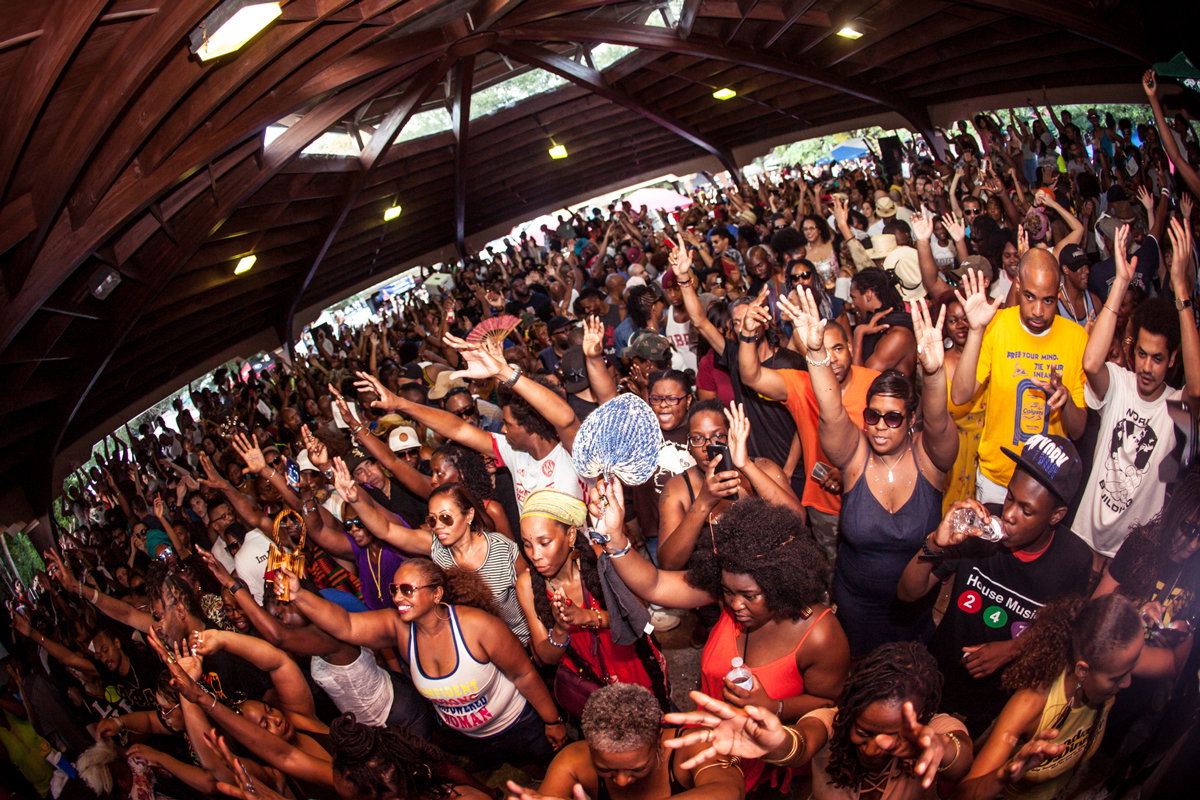
Self-dubbed the largest black gay pride celebration in the world, thousands are expected to come to Atlanta for parties, poetry slams, workshops, comedy shows, the Community Festival in Piedmont Park, and even a booze cruise on Lake Lanier.

AJC Decatur Book FestivalDecatur Book Festival
Where: Downtown Decatur
When: August 30 through September 1
Cost:
 Free
Details:
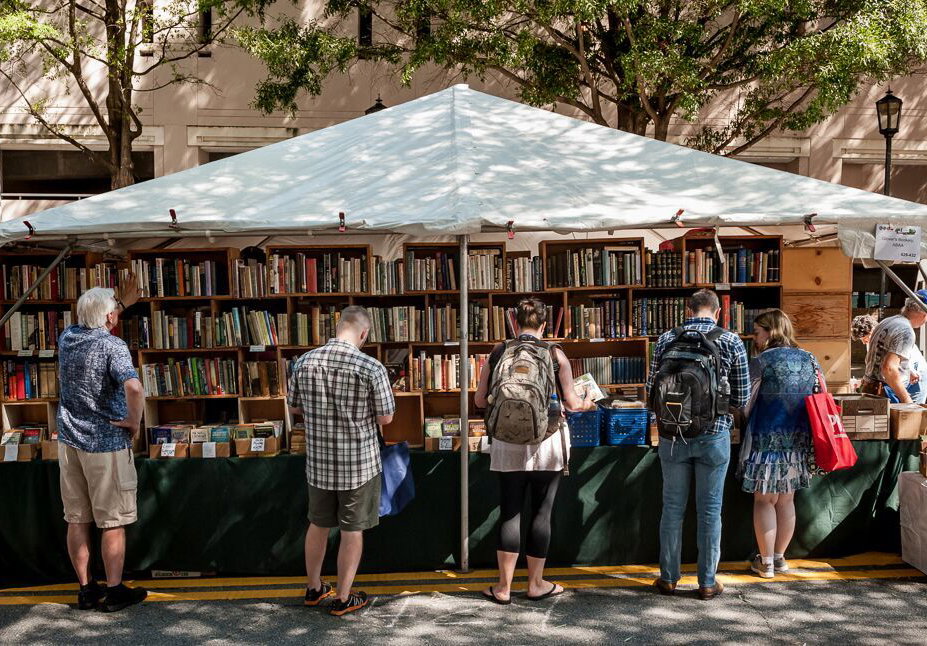
The largest independent book festival in the U.S. is back in Decatur with hundreds of acclaimed authors coming together to attend panel discussions, book signings, and writing workshops. Among this years guests: A sold-out reading from Justice Sonia Sotomayor of her children’s book; AJC journalist Jim Auchmutey, local authors Anissa Gray, Joshilyn Jackson, Jessica Handler, Patti Callahan Henry, and Susan Rebecca White; historical fiction author Philippa Gregory; Stacey Abrams; Real Queer America author Samantha Allen; and New York Times Magazine writer and Still Processing podcast host Jenna Wortham.

Taste of Soul Atlanta
Where: 10 Northside Drive
When: August 30 through September 2
Cost:
Free; some events require additional ticket
Details:
Headlined by K Camp and Chante Moore, this fest features plenty of soul and Southern food and live music. The weekend also includes a 5K race, brunch concert, wine tasting, and art exhibition.

Callaway Gardens Hot Air Balloon Festival
Sky High Hot Air Balloon Festival at the Callaway Gardens

Photograph courtesy of Callaway Gardens

Hot Air Balloon Festival
Where: Callaway Gardens
When: August 30 through September 1
Cost:
Three-day: Adult: $69.95, Child: $49.95; Two-day: Adult: $49.95, Child: $39.95; Single-day: Adult: $21.95–$29.95, Child: $11.95–$19.95
Details:
Spend the weekend riding and gazing upon colorful hot air balloons while hanging out on the beach at Robin Lake. This annual festival also features a classic car show, disc dogs, live music, a photography class, and more.

Flashback Festival
Where: Mable House Barnes Amphitheatre
When: August 31 through September 1
Cost:
$41+
Details:
Kiss 104.1 hosted the first part of this retro R&B festival on Memorial Day Weekend. Now it’s returning for part two, with performances from American Idol star Ruben Studdard, The Whispers, Evelyn “Champagne” King, Midnight Star, Cameo, and Glenn Jones.

Big Peach Sizzler 10K/5K
Where: Races begin in Chamblee and end in Buckhead
When: September 3
Cost:
5K: $45, 10K: $55
Details:
This popular race raises money for cystic fibrosis research, kicking off at the Brookhaven (5K) and Chamblee (10K) MARTA stations and ending at the Buckhead Station shopping center. Finishers get a T-shirt and a medal, and yes, it is a Peachtree Road Race qualifier.

Labor Day Pig Out
Where: Avalon (Palmer Plaza)
When: September 1, 5–8 p.m.
Cost:
Adults: $40; Kids: $20
Details:
Avalon’s Oak Steakhouse and Colletta are serving up an all-you-can-eat barbecue spread of brisket, pulled pork, chicken, mac and cheese, potato salad, cornbread, and more. The event is kid-friendly, with face-painting, a photo booth, and lawn games.

House in the Park

House in the Park
Where: Grant Park
When: September 1, 12-8 p.m.
Cost:
$10
Details:
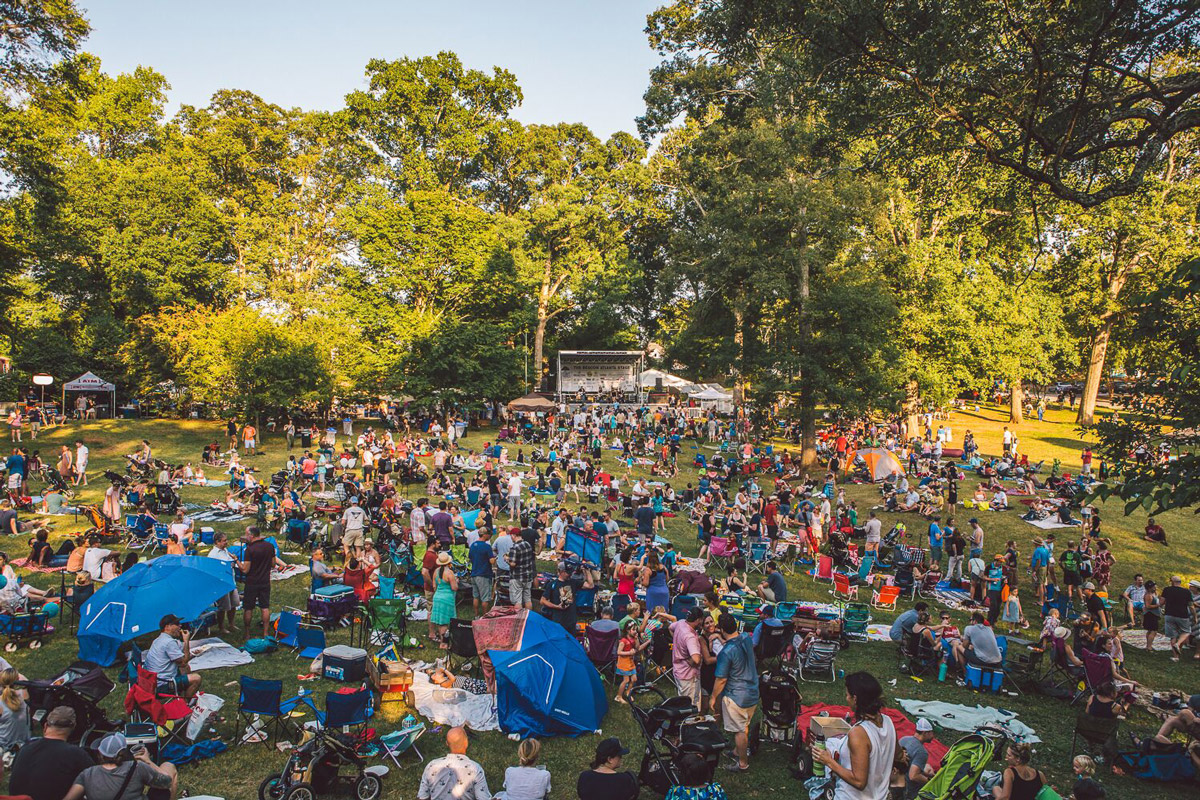
The all-day dance party, held near the rec center at Grant Park, will feature four DJs: Salah Ananse, DJ Kemit, Kai Alce, and Ramon Rawsoul. There will also be a cash bar, along with food and merch vendors.

LudaDay Weekend
Where: Varies
When: August 30 though September 1
Cost:
Varies
Details:
This annual event’s lineup, all of which benefit the Ludacris Foundation, includes celebrity golf and bowling tournaments; a celebrity basketball game; and a takeover of the Westside TopGolf.

Marietta Art in the Park
Where: Marietta Square
When: August 31 through September 2
Cost:
 Free
Details:
Back for its 33rd year, more than 175 artists from around the country are descending on Marietta Square to display their acrylic paintings, drawings, glass, pottery, sculptures, watercolor, wood carving, jewelry, and photography. Along with the pros, kids will also be able to show off their drawing talents at Chalk Spot.

Atlanta Caribbean Jerk Festival
Where: Southeast Athletic Complex in Lithonia
When: September 1, noon–10 p.m.
Cost:
$25 in advance; $35 at gate
Details:
For its 14th year, this annual celebration of Caribbean food is moving to a new location in Lithonia. Expect food tastings, Reggae and dancehall music, activities for kids, dominos, and a chef cook-off.

Noshfest
Where: Temple Kol Emeth
When: September 1–2
Cost:
 Free
Details:
The event is a celebration of Jewish culture, but food is the focus with a bagel-eating contest and plenty of food vendors, where you’ll find potato knish, corn beef on rye, chopped liver, and falafel, among other eats. Also expect live music and craft vendors.

WRFG Labor Day Blues Barbecue
Where: Park Tavern
When: September 2, noon–8 p.m.
Cost:
$18 in advance, $25 at door
Details: 
Spend Labor Day at this Piedmont Park restaurant listening to blues music from Selwyn Birchwood, Lil Joe Burton and the Atlanta Horns, Larry Griffith, and more. Barbecue and drinks will be available for purchase.

29Rooms Atlanta
29Rooms, as seen during a recent stop in Chicago

Photograph by Jeff Schear/Getty Images for IMG/Refinery 29

29Rooms
Where: The Works (1235 Chattahoochee Avenue)
When: August 29 through September 8
Cost:
$29+
Details:
The latest Instagrammable experience, this one from lifestyle website Refinery29, comes to Atlanta with photo-worthy and often thought-provoking art installations, including two from local artists.

5 Atlanta events you won’t want to miss: August 21–27

0

Grant Park Summer Shade Festival

Grant Park Summer Shade Festival
When:
August 24–25
Where:
Grant Park
Cost:
Free
Detail:
It’s year number 17 for the Summer Shade Festival. Expect the return of its 5K run, kids zone, artist market, plenty of food trucks, and more than a dozen bands. Proceeds benefit the Grant Park Conservancy.

BronzeLes Film Festival: Princess of the Row

BronzeLens Film Festival
When:
August 21–25
Where:
Hyatt Regency Atlanta
Cost:
$15 for single screening, $75–$300 for other passes
Detail:
Spotlighting emerging actors and filmmakers of color, BronzeLens is celebrating its 10th anniversary by giving almost 100 films a big-screen treatment. The five-day event will also include panels, workshops, and classes.

SagerStrong Stadium Fun Run
When:
August 25, 6:30 a.m.
Where:
SunTrust Park
Cost:
Adults $40–$50, kids $10
Detail:
Created in memory of Craig Sager, TNT’s NBA reporter known for his wacky suits who died of leukemia, the SagerStrong Foundation is hosting its first Fun Run. The 3K race is held inside SunTrust Park—yes, you actually run on the stadium’s concourses—and includes a chance to experience the ballpark behind the scenes, a T-shirt, and a Braves game ticket. Proceeds will benefit blood cancer research and the SagerStrong Foundation.

Springer Mountain Farms Southern Wing Showdown
When:
August 25, 1–5 p.m.
Where:
The Fairmont
Cost:
General admission $55, VIP $65
Detail:
Included in your ticket: food, beer, wine, cocktail samples, and, of course, wings. Produced by Taste of Atlanta, try up to 30 flavors of wings made by 15 chefs from the Southeast and 15 Atlanta chefs, including names from Canoe, Chicken + Beer, AIX, and more.

TOUR Championship

TOUR Championship
When:
August 21–25
Where:
East Lake Golf Course
Cost:
$35–$80
Detail:
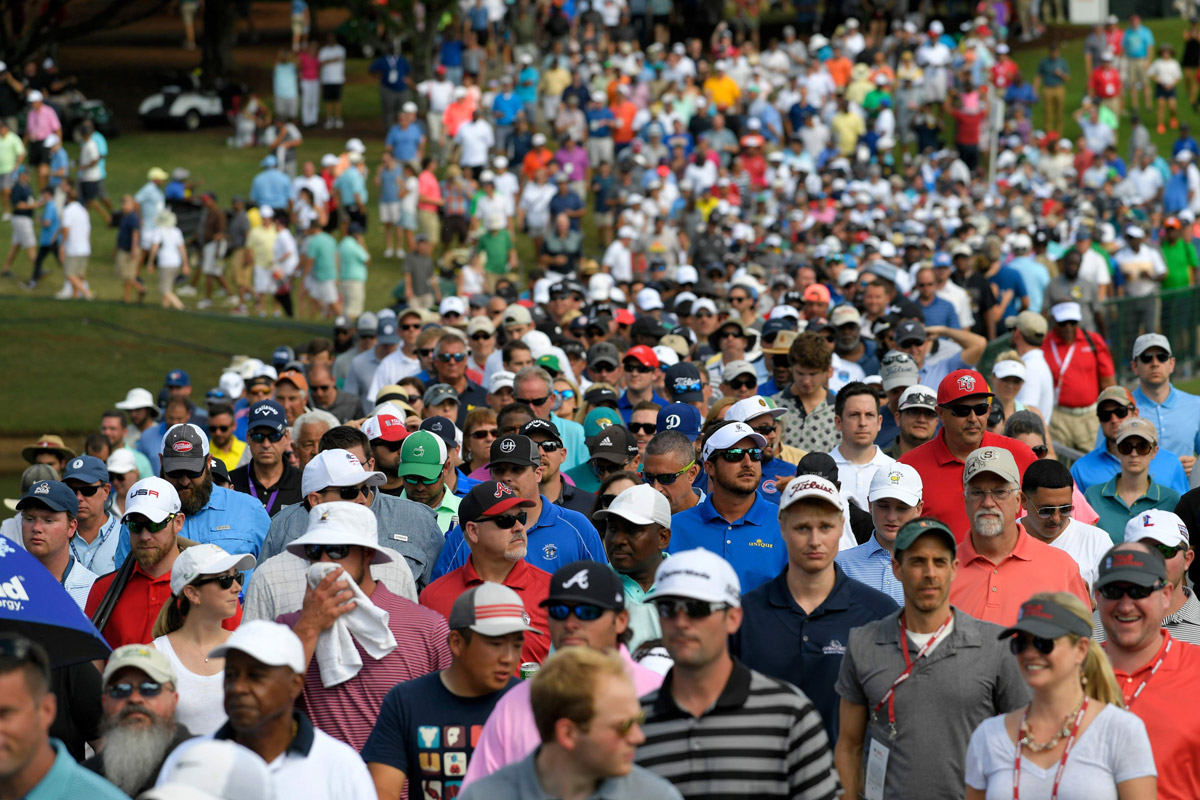
Good luck driving around East Lake this weekend. Big-name players including Justin Thomas, Patrick Cantlay, and Rory McIlroy are hitting the course’s 18 holes for a chance at a $60 million prize pool.

Effects of the APS cheating scandal still ripple through Pittsburgh. This journalism project empowered residents to tell their own story.

Pittsburgh Journalism Project
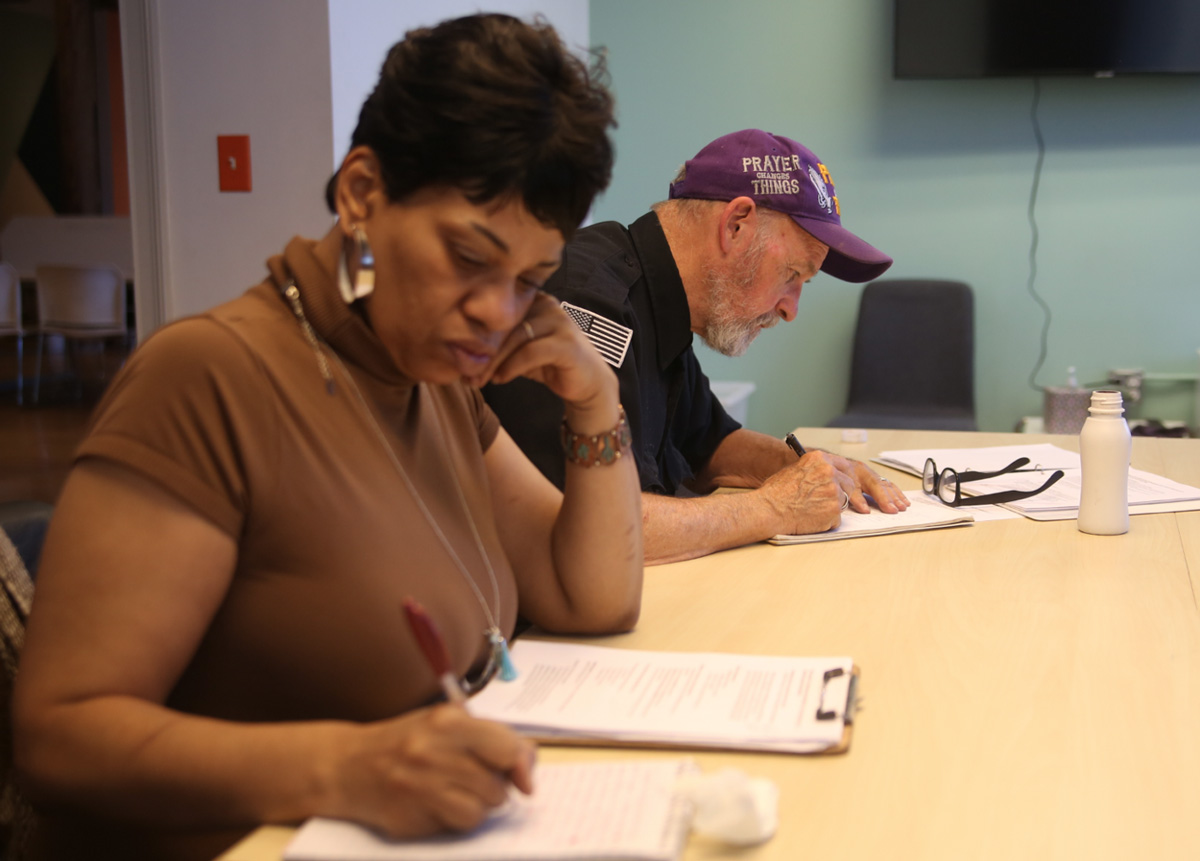
Pittsburgh Journalism Project reporters Chandra Harper-Gallashaw and William King work on their story.

Photograph by Max Blau

In a turbulent time when long-established journalistic institutions are dwindling at a breakneck pace, predominantly low-income and minority communities are especially starved for adequate—and, sometimes, accurate—media representation. Max Blau, a seasoned freelance journalist—and former Atlanta magazine staffer—who has covered social issues in many of Atlanta’s most underserved areas was painfully aware of this disparity. Last spring, with funding from the Center for Civic Innovation, Blau launched an initiative dubbed the Pittsburgh Journalism Project, which was inspired by a similar model in Chicago called City Bureau. The project’s goal was to cultivate journalists in communities that are traditionally underrepresented—or negatively represented—by mainstream news outlets. He began with the southside neighborhood of Pittsburgh, selecting three would-be correspondents from a small pool of applicants. Impressively, the PJP pilot program yielded a front-page story in the Atlanta Journal-Constitution about the aftermath of the Atlanta Public Schools cheating scandal, four years after a trial found 11 educators guilty of racketeering charges.

The 2009 scandal of has been chronicled in countless articles, TV news stories, a book, a documentary, and, soon, a Hollywood movie. But none of those, it seems, properly captured the plight of the many intown families affected by the corruption and its long-lasting effects. So says former Pittsburgh resident Chandra Harper-Gallashaw, a Georgia State University researcher and mother of four who still feels the sting of deceit after school system officials orchestrated and carried out a plot to falsify standardized test scores, which made it appear as though APS students were performing better than they actually were. “I just found out they’re doing another movie, but nobody came back to talk to the community,” she says. “Nobody asked us anything.”

In Atlanta, publications that would traditionally provide comprehensive coverage of a situation like the APS scandal have shrunk dramatically in recent years. The AJC has watched its 500-journalist employ drop to just 130 heads in the past decade, and alt weekly paper Creative Loafing axed almost all of its editorial staff in 2017. Supporting solid local journalism has never been more crucial, Blau says. “Everything that has gone wrong in Chicago, in terms of the shrinking and closing of newspapers there, has happened even more so here,” he says. “Pittsburgh had no journalists of its own.”

Instead, reporters who had little—if any—affiliation with Atlanta’s predominantly low-income and minority communities would come to Pittsburgh and other affected neighborhoods and “determine the narratives of those places,” says Blau. “Often it was legacy outlets, people who were white or from more privileged backgrounds and had access to become journalists and the means to do so.” For that reason, among others, such communities’ trust in the media has been on the decline.

Blau enlisted three bona fide stakeholders in local issues to participate in the PJP: Pittsburgh native Braddye Smith who works for DeKalb County as a supervisor and case manager for an accountability and diversion court. She also writes poetry and hopes to use her newfound journalism skills to bring positive reporting to the neighborhood. William King, a 30-year Pittsburgh resident and former college newspaper reporter, is an avowed community advocate involved in practically every local neighborhood organization. And Harper-Gallashaw, the Georgia State researcher who lived across the street from an APS school devastated by the scandal, is working on a memoir about the lasting effects of the officials’ wrongdoing.

Each Monday evening for six weeks, the trio met with Blau. They were paid to learn the fundamentals of journalism, all while crafting a story that would spotlight the fallout of misconduct that robbed students of a legitimate education and, subsequently, in many cases, a fighting chance at a successful future. Blau asked his students what kind of voices needed to be in such a report. “Then I had them learn how to go find the information, how to contact people, how to write interview requests,” he says. “I walked them through the things we do every day that they had never done before.”

Pittsburgh Journalism Project
The story earned the centerpiece on the Sunday front page of the AJC.

Photograph by Max Blau

Once the interviews, notes, and research were crafted into an article, Blau began contacting publications. The AJC scooped the story up immediately and worked with Blau to polish it for a Sunday Page A1 debut. The team’s dogged reporting—amplified with the help of Atlanta’s largest print publication—showed that wounds from the scandal didn’t fully heal as education officials were locked up or, in most cases, took plea deals. Rather, many students are still struggling to prepare for college or even for stable careers after high school. “Most of these kids don’t want to go to college because the system already failed them—they don’t trust it,” says Harper-Gallashaw.

Earning inches in the AJC, though a considerable win for the PJP pilot, isn’t the endgame for Blau and his pupils. Blau wants to see the program grow, perhaps to something of City Bureau’s stature—the Chicago operation has trained upwards of 100 journalists since its 2015 inception. And Harper-Gallashaw, now armed with a reporter’s arsenal of skills—interviewing, records-digging, storytelling, and more—hopes with her memoir to fill in the gaps left by the PJP’s story and the innumerable other write-ups on the APS scandal. “These children are forgotten,” she says. “Their families are forgotten. And their communities are forgotten.” With the journalism training, she says, “I have the opportunity to write the real story.”

Read the Pittsburgh Journalism Project’s full story: ‘We Had to Stop the Bleed’

Make way for Pippa, the rescue schnoodle capturing hearts while biking the BeltLine

Pippa schnoodle

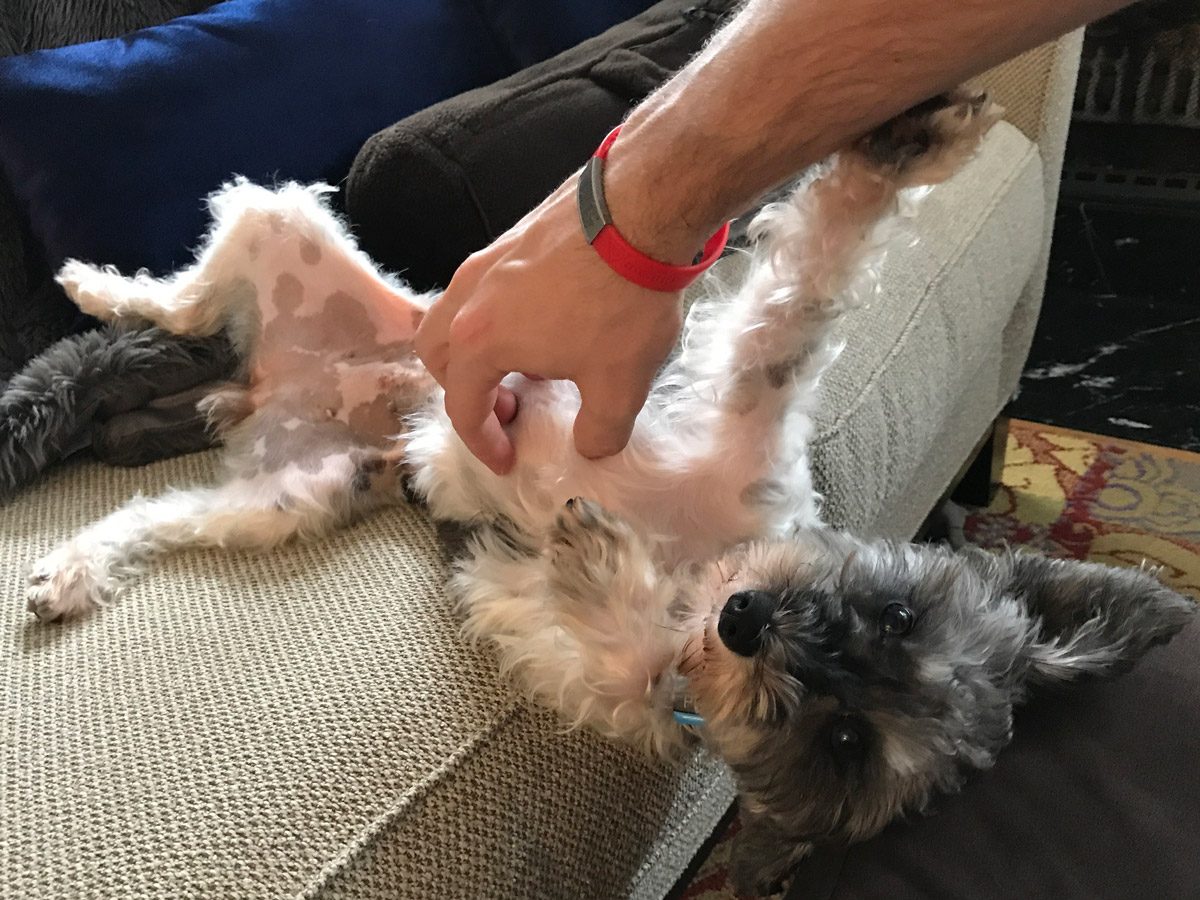
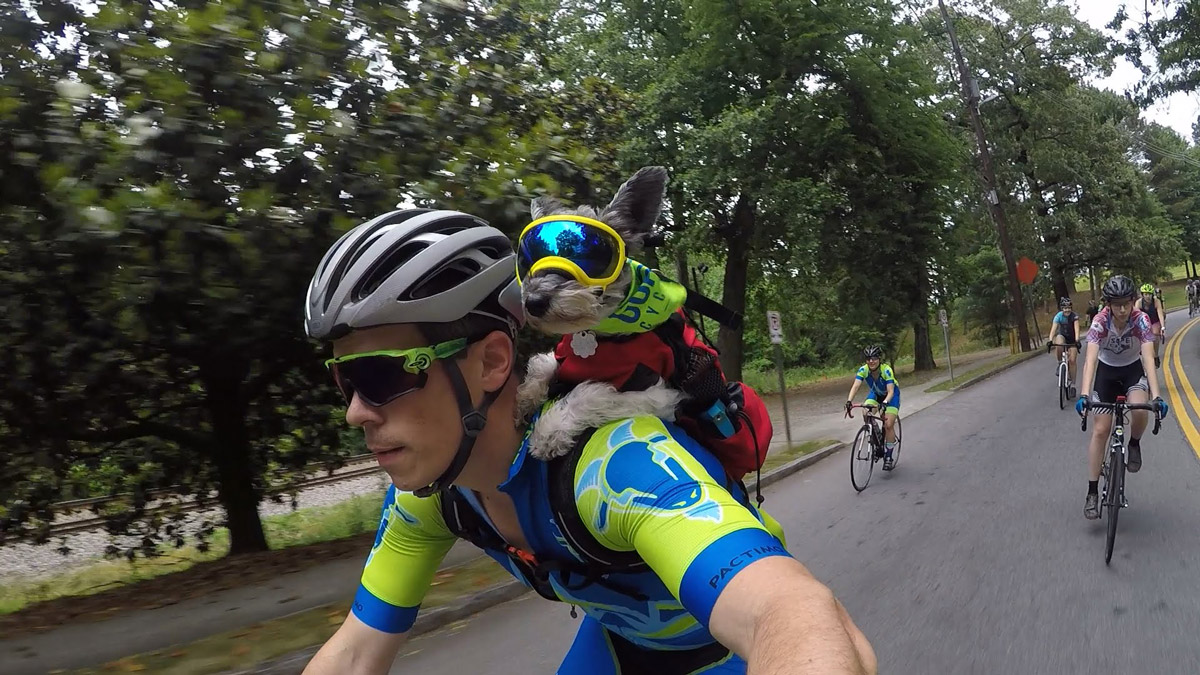
Super playful and cuddly is how Todd Steigerwalt describes his Schnoodle dog—a breed mix of a schnauzer and a poodle—Pippa. You may have seen her speed past you on the Atlanta BeltLine while riding on Steigerwalt’s back.

The unlikely cycling team came together in June 2017. Steigerwalt and his wife, Christen, were looking for the perfect canine companion.

“We live in a townhouse in Midtown. I wanted a dog I could bike ride with; it seemed like a fun idea. Her parents, who are both cyclists, suggested a dog around 10 pounds,” says Steigerwalt.

After a long search for a hypoallergenic dog on Petfinder, they found one, but it fell through. “We were really sad, but then we found Pip. Someone had actually claimed her already, but then we got a note back that they’d said she was too small,” he says.

Pippa schnoodle Pippa schnoodle

The rugged 10-pound pup, as Steigerwalt described her, was about two hours away from Atlanta at the Humane Society of the Southeast in Newnan. At the time, she was between two and three years old.

Shortly after she arrived at her Midtown home, Steigerwalt put her in a messenger bag that he had. “I was like, all right Pip, this is going to be your life,” he recalls. “She didn’t complain or squirm—we just walked around the house.”

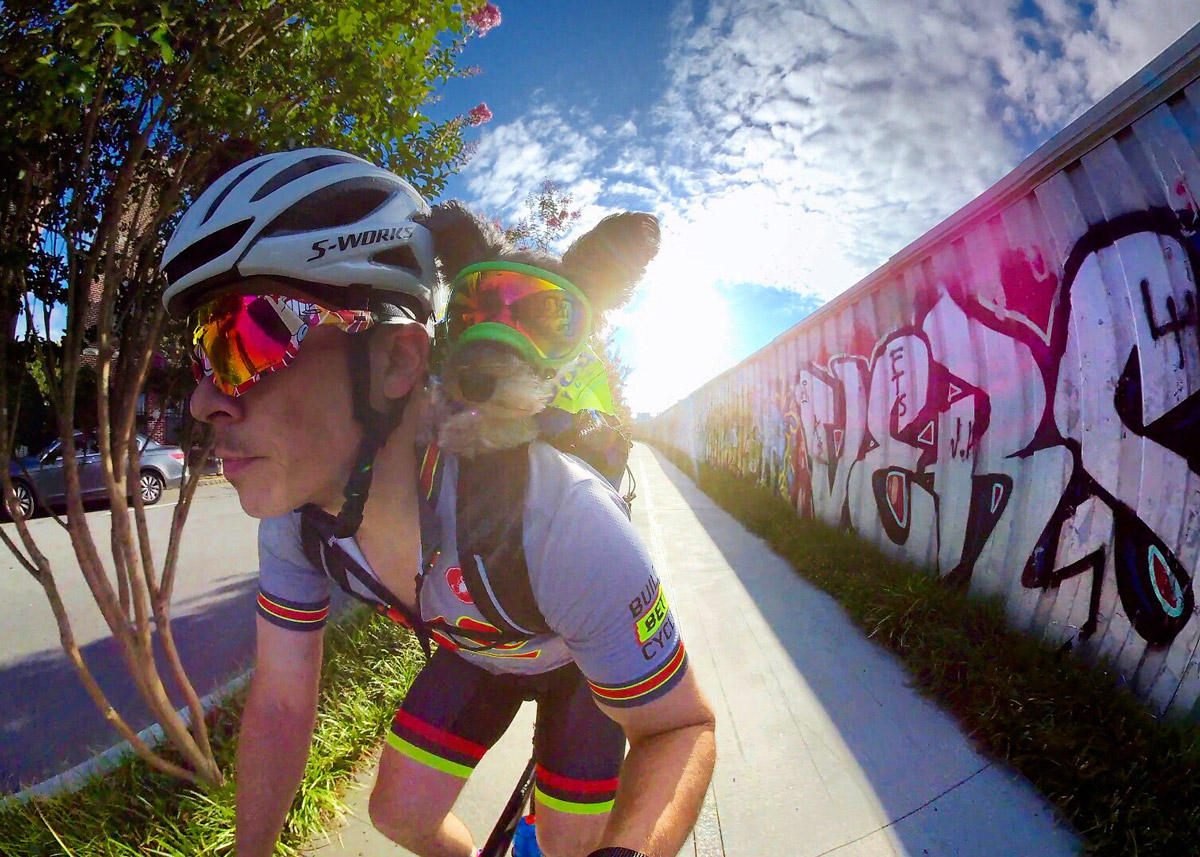
Within a month, the duo was traveling the Atlanta streets. A lifelong cyclist and triathlete, Steigerwalt purchased a small chest harness from an online retailer and took her on her first ride: a four-mile trek along the BeltLine Eastside Trail from Midtown to Krog Street Market.

“We started riding together and sticking to the park, the BeltLine, and the bike path. If I’m going downhill at 30-35 miles per hour, her paws are just flying in the wind,” he says. “She starts pedaling [in the air], and if you touch her, she gets really upset. She feels like she’s helping.”

Pippa schnoodle Pippa schnoodle Pippa schnoodle

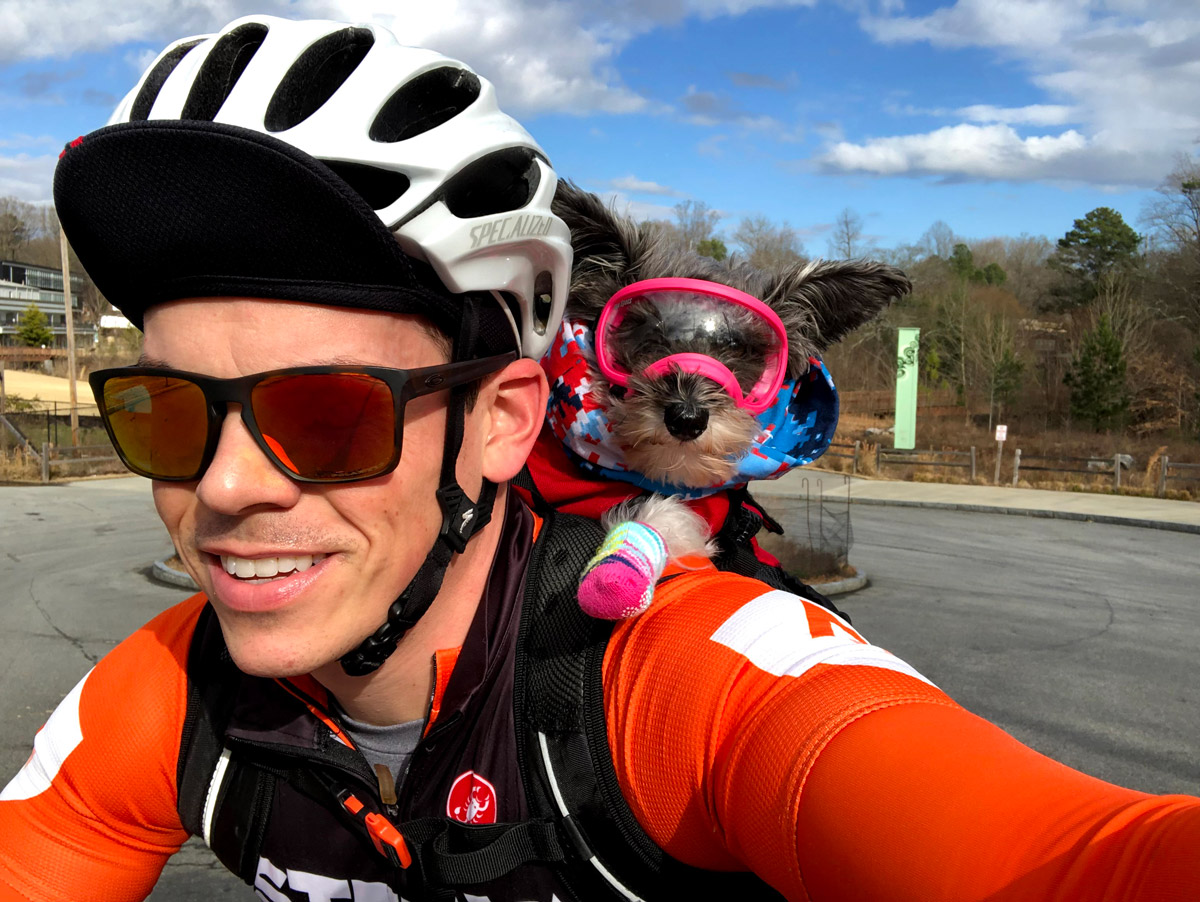
The chest harness worked for a while, but Steigerwalt started having shoulder issues—aggravated from his road-bike racing days. That’s how his current backpack setup came to be—Pippa perches upon his shoulder “like a parrot” through a K9 Sports Sac bag. Now, they ride together up to three times a week.

Pippa’s Instagram profile, a collection of her rides around the city, went from a few hundred followers to nearly 4,000 followers today following a Bicycling magazine feature.

Pippa’s adorable gear—wearing extra small goggles while inside the backpack—started capturing the hearts of people in Atlanta and beyond. He gave her treats to introduce her to the protective goggles and build trust.

“She understands now that wearing the goggles is a requirement for bike riding. But she won’t wear them any other time,” Steigerwalt says. “She gets frustrated from time to time, so I’ll stop and give her some face rubs, then put them back on.”

Pippa has sponsorships with several companies—dog goggles company Rex Specs even named their hot pink goggles after her.

Steigerwalt says he’s often asked if he has to make Pippa go on a bike ride, but he says that when he asks her to go on a ride, she gets really excited. “She runs over to me, and if I get out the goggles or the backpack, she knows what’s going on. She loves it.”

“Everybody says they love following her Instagram stories daily. That’s why I really do it. And she gets a lot of fun adventures out of it,” says Steigerwalt.

In the quiet waters of the Chestatee River, cancer survivors find peace with fly fishing

Frog Hollow Fly Fishing
Donations cover the cost of the women’s gear and experiences.

Photograph by Kaylinn Gilstrap

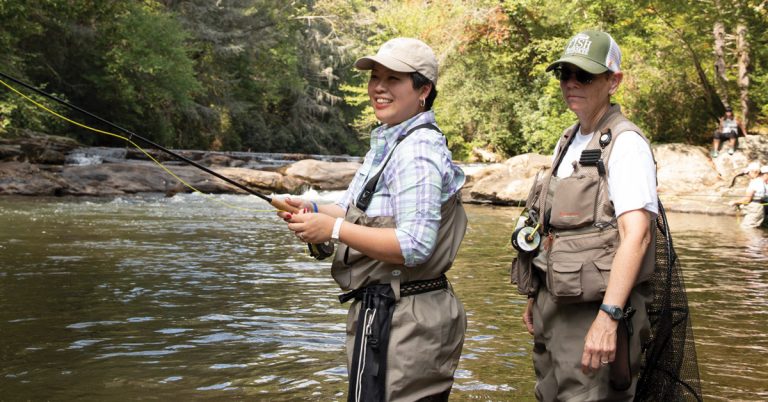
Set against the backdrop of the Chestatee River, five women, each with a fishing guide by her side, steady their feet on the riverbed and pitch back their arms. There’s a split-second, mid-air pause before their lines whip forward and are cast out, and their flies land in the current.

For each of these women at Frog Hollow Fly Fishing, a family farm and angling service just outside of Dahlonega, the normal flow of their lives was suddenly interrupted by the same diagnosis: cancer. They’ve battled stage I to stage III breast cancer and a rare blood cancer that struck one woman at the age of 26.

Norman Maclean, the author of A River Runs Through It, said it’s not fly fishing if you aren’t looking for answers to questions. The disease and its treatment have left these women with much uncertainty. But as they stand in the brisk water of the Chestatee, waders and belts cinched, hands gripping fly rods, cancer seems to recede far into the background.

Since 2002, the Georgia Women Fly Fishers have hosted Casting for Confidence, a free, annual, day-long retreat that teaches fly fishing basics to female cancer survivors. Spearheaded by Janet Piskurich, a former assistant professor of pathology and immunology at Mercer University School of Medicine in Macon, and her friend Eva Persons, the event was inspired by Casting for Recovery, a national program founded in Vermont by a breast reconstruction surgeon and fishing guide. The duo partnered with Georgia Women Fly Fishers, whose mission is to make fishing—historically a male-centric sport—accessible and fun for women. “It is an absolute joy to share my passion for fly fishing with these women,” says Jennifer Gilbert, the organization’s president, who’s participated in the past two Casting for Confidence events. Several of the program’s participants have gone on to join the club, she says.

“This is the time to release all other fears and concerns. I can attest you’ll let it all go once you see this beautiful space.”

On a sunny and brisk October morning, 14 cancer survivors arrive early and grab some coffee and a bite from the extensive breakfast spread before getting a crash course in the basics, from entomology—“match the hatch” by flipping over a rock in the river and identifying bugs to best match what’s in your fly box—to how to throw the perfect cast. Each participant receives a 30-page booklet covering key information such as knots, rods, tippet, reels, and the mayfly life cycle. The guide was written by Deb Bowen, a longtime member who died from cancer in March 2018 at the age of 61. On the front cover is a picture of Deb standing in the water with her waders on, fly rod in hand, a cap covering her hairless head, a smile on her face.

Wanda Taylor, an instructor since the 1980s who’s known as “the South’s First Lady of Fly Fishing,” is here to teach the complex art of casting. She takes the group down to the water’s edge to practice on the grass with hookless lines. The women are awkward at first and laugh at themselves as they struggle to get lines where Taylor is telling them they should go. But Taylor is a patient teacher, and before long, the fly lines begin to loop gracefully the way they should.

Jameca Barrett was 26 when she was diagnosed in 2003 as one of the youngest-ever documented cases of multiple myeloma in the state of Georgia, a cancer of the bone marrow plasma cells. She has been in remission for the past 15 years. For the Atlanta native, Casting for Confidence is a welcome break from the biannual check-ups. “Cancer [can be] a terminal illness, so you have faced one of the most frightening challenges life can bring,” Barrett says. “This is the time to release all other fears and concerns. I can attest you’ll let it all go once you see this beautiful space.”

The day isn’t about the size or number of fish caught (though a few first-timers were able to pull in some baby browns, to much applause). It’s about having time and space to reflect. The process of catching a fish and releasing it back, the women say, reflects the precious and fleeting nature of life. It is a reminder to the rest of us, Barrett says, to “take time for you. And for living, laughing, and loving.”

To sign up for the 2019 Casting for Confidence or to donate to the Georgia Women Fly Fishers, go to georgiawomenflyfishing.com.

This article appears in our August 2019 issue.

5 Atlanta events you won’t want to miss: August 14–20

0

Doggy Con

Doggy Con
When:
August 17, 10 a.m.–1 p.m.
Where:
Woodruff Park
Cost:
Free to spectate, $10 to register your dog
Detail:
This one is just adorable. Imagine dogs dressed up as “Harry Pawter” or “BatDog and Robin.” As an early celebration of Dragon Con, geek-themed, dog-centric festival will have a pet parade, costume contest, happy hour, and—a special for this year—the unveiling of Tiny Door No. 17.

Dunwoody Butterfly Festival

25th Annual Butterfly Festival
When: August 17, 10 a.m.–4 p.m.
Where: Dunwoody Nature Center
Cost: $10 for adults, $5 for children
Details: This colorful event is primarily for the kids, but even parents can’t help but smile when a butterfly lands on their finger. Walk into a tent filled with free-roaming butterflies, attend educational booths, enjoy live music and arts and crafts activities, and don’t miss the birds of prey show.

Foxeria del Sol Hatch Chile Fest

Foxeria del Sol Hatch Chile Fest
When:
August 18, 4–8 p.m.
Where:
Taqueria del Sol, Westside
Cost:
$30
Details:
Fox Bros Bar-B-Q, Taqueria del Sol, and Home Team BBQ are teaming up to serve more than a dozen hatch chile dishes and cocktails. As a celebration of the annual chile harvest from Hatch, New Mexico, this festival will raise money for Hogs For The Cause.

Khalid
When:
August 14, 7:30 p.m.
Where:
State Farm Arena
Cost:
$30–$100+
Details:
With multiple Grammy nominations, top 10 hits, and a quadruple platinum debut single, it’s hard to believe the Georgia-born Khalid is only 21. Fresh off his new album, “Free Spirit,” released in April, the R&B artist is coming to State Farm Arena alongside Atlanta’s own Clairo.

Piedmont Park Arts Festival
When: August 17–18
Where:
Piedmont Park
Cost:
Free
Details:
Itching for some new art? With 250 painters, photographers, glassblowers, sculptors, metalwork artists, and more, this festival will be a safe bet to find something that interests you. Stroll through Piedmont Park while enjoying live music and artist demonstrations.

The BronzeLens Film Festival spotlights emerging actors and filmmakers of color

BronzeLes Film Festival: Flight
Cinematographer Gabrielle Blackwood (right) and assistant director Garreth M. Daley on the set of Flight

Photograph courtesy of BronzeLens Film Festival

Nearly 11 years ago, Kathleen Bertrand and her boss at the Atlanta Convention and Visitors Bureau were discussing how to make the city a premier destination to showcase stories about people of color in film and TV. That conversation inspired Bertrand to launch the BronzeLens Film Festival, a five-day event that gives the big-screen treatment to short films and feature-length movies.

Now in its 10th year, BronzeLens’s educational opportunities and programming have welcomed emerging filmmakers and actors, says Bertrand, the festival’s executive producer, as well as established talents like Issa Rae of HBO’s Insecure and Ava DuVernay, director of Disney’s A Wrinkle in Time. BronzeLens selections have later aired on television networks and streaming services such as BET, Bounce, and Netflix. Shorts that screen at the festival are eligible for consideration for the Oscars. Last year’s festival winner, Wale, was shortlisted for the Academy Awards.

For this year’s event, Bertrand and organizers considered submissions from more than 35 countries. Here’s a peek at what you won’t want to miss.

BronzeLes Film Festival: Flight

FLIGHT

Directed by: Kia Moses and Adrian McDonald
Starring: Jermaine “Zbek” Nelson, Roheim Phillips
Runtime: 13 minutes
Though his father urges him to keep his head out of the clouds, Kemar—a young boy living in Jamaica—imagines taking a trip to the moon.

BronzeLes Film Festival: Evelyn x Evelyn

Evelyn x Evelyn

Directed by: Eric Pumphrey
Starring: Natalie Paul, Jocko Sims
Runtime: 13 minutes
Set in the mid-1950s, the film focuses on an anguished black couple after the death of their child.

BronzeLes Film Festival: Princess of the Row

Princess of the row

Directed by: Max Carlson
Starring: Tayler Buck, Edi Gathegi
Runtime: 85 minutes
Written by Alan Shawn Austin and Max Carlson, the movie centers on a 12-year-old girl who tries to look after her father, a mentally ill military veteran living on the streets of Skid Row in Los Angeles.

BronzeLes Film Festival: Bewildered

Bewildered

Directed by: Gregor Wilson
Starring: Keith David, Maria Howell
Runtime: 30 minutes
Husband-and-wife jazz vocalists—played by Platoon’s Keith David and Hidden Figures’ Maria Howell—are tested when one is diagnosed with dementia. A young musician looking after the husband in a care facility nurtures his memories and musical ambitions.

BronzeLes Film Festival: Never Land

Never Land

Directed by: Brett Smith
Starring: Malakai James, Raz Simone
Runtime: 16 minutes
A foster child escapes into his imagination and daydreams about Peter Pan’s island, Neverland—a place where all children without parents go.

BronzeLens Film Festival screenings and events will be held August 21–25 at the Hyatt Regency Atlanta, the Carter Center, and other venues. Passes start at $50 for students; awards tickets are $30.

This article appears in our August 2019 issue.

Atlanta belongs to the roaches now. We merely live here.

Why does Atlanta have so many roaches?
Please stop.

Illustration by MHJ / Getty Images

Several weeks ago, I was peacefully lying in bed drifting off to sleep when I felt a conspicuous, featherweight tickling sensation along my bare calf. I shrieked and instantly levitated, then ripped the covers off the bed. And there it was, right there on my sheets, trying to scurry back into the darkest and most sinister depths of hell from whence it came: a plump, glossy brown cockroach, antennae a-twitching.

This summer has felt like The Purge, except the villains have six legs and a thorax. Attempting to get from my car to my front door in Grant Park involves a series of maneuvers I can only describe as “speed tap dancing.” I have walked into my bathroom in the morning only to feel one scuttling over the top of my unshod foot before I even have a chance to flick the lights on. I have attempted to clean up a belly-up roach corpse, only to have it reanimate, escape the wad of toilet paper in my hand, and fly away. I’ve lived in Georgia my entire life, I spend lots of time outdoors, I’ve almost exclusively lived in very old houses, and I’ve never seen anything quite like it.

Plenty of my fellow Atlantans have, anecdotally, observed a worse-than-usual cockroach season this year. They’re dropping from the ceilings at night and landing on our faces. They’re setting up shop inside our liquor cabinets. They’re assembling armadas around our front doors. “I see them scurry through the streets at night,” Catie Leary, a downtown Decatur resident, tweeted recently. “One flew and landed on my shoulder last week. One crawled across a book I was reading, and I considered burning the book. Fear lives in my heart at all times.”

I, too, am stricken with fear.

In late July, my spirit finally broke, and I decided to dial a local exterminator. The curiously chipper employee on the other end of the line casually remarked that it’d been “a big summer for roaches” because, as she explained, Atlanta had gotten less rain than usual at this point in the season, forcing the creatures to seek hydration inside. According to the National Weather Service, July did indeed bring less rain than average—a mere two inches compared to last year’s eight. June, on the other hand, was up three inches from last year.

Later, when I asked Arrow Exterminators whether they’d seen an increase in roach-related calls, they said they had not. Orkin said they didn’t have specific data that could confirm my suspicions, but that an increase in roaches could be attributed to the wetter-than-average months early in the season—“plus, at this point in the year, many cockroach species have reached maturity and are more active because they are looking for a mate,” added Chelle Hartzer, an entomologist and technical services manager for Orkin, to my complete and utter disgust.

Equally horror-inducing: it turns out both of them might be right. Brian Forschler, a professor and researcher of entomology at the University of Georgia, says that too little rain will cause treeholes and other outdoor harborages to dry up and force roaches inside, while too much rain will drown out their harborages and, well, force roaches inside. In recent months, Atlanta’s had both. “There’s plenty of rational reasons, with the rainfall patterns we’ve had this year, that you’d see an increase,” Forschler says. This is especially true for the Smokey Brown cockroach, which, of the 120 roach species in Georgia, is one of seven that closely aligns itself with human dwellings—and the only one that can fly. “So,” I ask Forschler, “those are the worst ones?” He laughs. “That’s pretty subjective, but I’ll agree with you.” (Other common Atlanta roaches include the brown roach and the American roach, both of whom tend to thrive in urban environments and live in sewers and pipes. Since they like cities and Smokey Browns like trees, we have lots of both. Lucky us!)

Forschler says Smokey Brown roaches often pass through homes while migrating from hardwood tree to hardwood tree—like, for instance, the oak tree that towers over my front yard, the pecan tree in my backyard, or any of the other hundreds of hardwood trees surrounding my neighborhood. In other words, I and most other Atlantans unwittingly reside in Smokey Brown Valhalla.

“If you live in a pine lot, you’re not going to see Smokey Brown cockroaches as regularly around your house,” says Forschler. “But if you have hardwood trees, you’re going to—there’s just no way around it.” Most of the time, Forschler adds, you might spot a lone roach or two on its way to its next treehole, a humble nomad simply passing through these parts, not looking for any trouble. “But if you have the right conditions around your house,” he adds, “they’re going to stop and hang out, and maybe stay there for generations.”

As for getting rid of them? Not as simple as blitzing your house with pesticides, as it turns out. “You need to figure out what kind you have,” Forschler says. Treatment methods will vary based on the species and their respective habits. Regardless of the species, Forschler says that bug bombs are largely a waste of money, and while traditional baseboard spraying will kill a few, the multigenerational families of roaches hunkering down in your eaves or walls won’t be hugely affected. For dealing with Smokey Browns, Forschler recommends bait. “The bait has a slow-acting ingredient, so the animal doesn’t die until it gets back to the harborage, poops out some of it, and dies, so it provides a poisoned food substrate to everyone else who’s hanging out at the harborage,” he says.

I am fleetingly comforted by the thought of sending a compromised cockroach unknowingly marching back to wreak havoc upon its own den of horrors like a Trojan horse. Then, Forschler rocks me out of my brief moment of serenity: “Remember, Gray, if you see them in your house, it probably means that you’ve got ’em somewhere in a wall void.” At this point I consider putting the call on mute, crumpling to the floor, and wailing inconsolably for several hours. But Forschler offers me some small solidarity: “I don’t think there’s a house in Georgia that hasn’t had signs of a Smokey Brown cockroach infestation in the walls at some point in time.”

Sleep tight, Atlanta.

Follow Us

69,386FansLike
144,836FollowersFollow
493,480FollowersFollow

NEWSLETTERS