


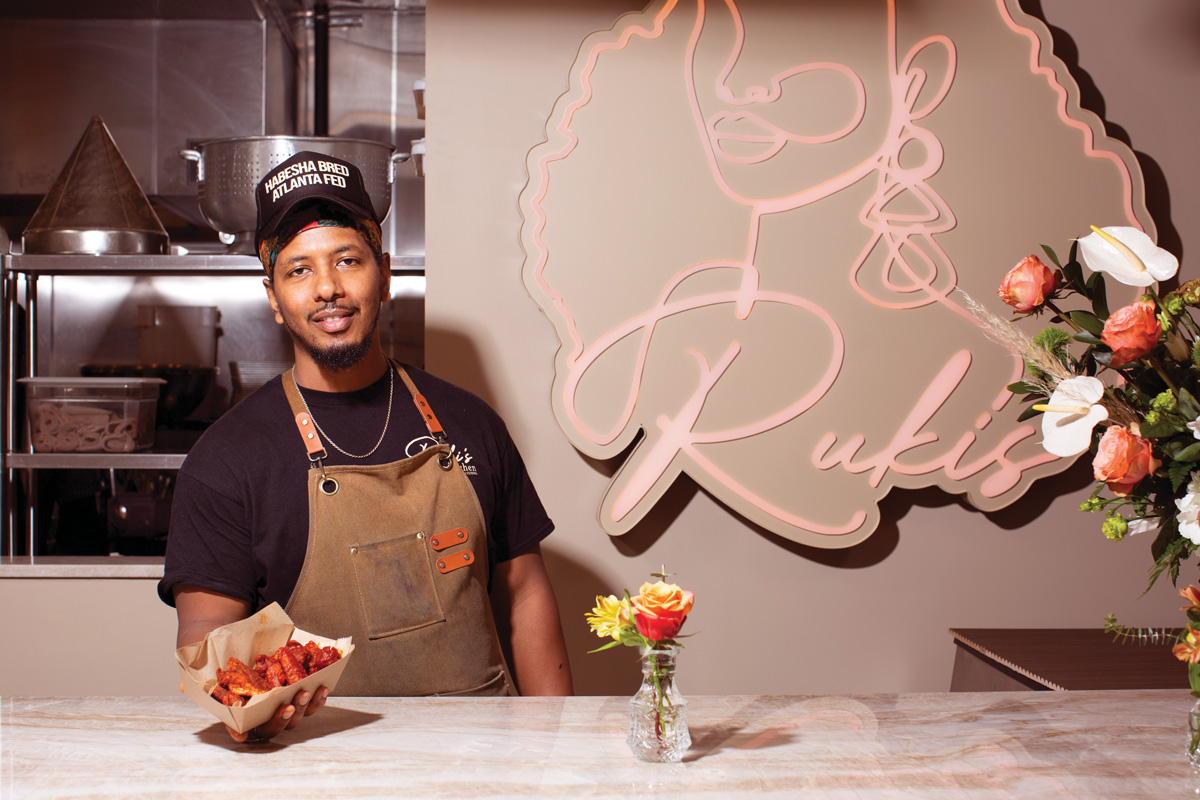
 When was the last time you perused an Ethiopian menu and spotted lemon-pepper wings? I’m guessing never. Unless, that is, you already know about Ruki’s Kitchen, a fast-casual spot for Ethiopian dishes, with a few Atlanta inflections.
First debuting as a food stall at in East Atlanta Village in 2022, then transitioning to a popup at venues across the city, including Sceptre Brewing Arts in Oakhurst, in 2024, Ruki’s Kitchen graduated earlier this year to brick-and-mortar status at the Terminal South complex in Peoplestown, near the Beltline’s southside trail.
Ruki’s Kitchen is the passion project of chef/owner Ali Lemma, a Georgia-born son of Ethiopian parents whose childhood was divided between Atlanta and Ethiopia. Encouraged by friends and family to focus his career on Ethiopian cuisine, he turned to his mother for recipes and guidance. This third incarnation of Ruki’s Kitchen is a charmer, located in the Terminal South complex. While a food stall, it seems more like a tiny bistro with cream-colored quartzite countertops, bar stools with nutmeg-colored cushions, wooden pendant lights in the shape of mesobs (Ethiopian handwoven baskets used to store injera, or flatbread), a rosy neon silhouette of a woman’s face, and flowers on two-top tables along the banquette opposite the eatery.
The menu ($12 to $22 per item) is divided into three sections: Tibs Combos and Platters (steak, salmon, chicken, or veggie options served with injera or a lovely turmeric basmati rice); Veggie Sides (collards, lentils, cabbage, or sauced injera pieces mixed with veggies and spiked with jalapeño); and Doro Wing Specials (Kategna Dry Rub or Habesha lemon pepper wet). The wings are all-natural and non-GMO, so they may appear puny to some, but an order of 12 is a decent-sized meal.
The Tibs dishes are sauteed with your chosen protein and fragrant Ethiopian spices and/or marinades, plus sliced onions, garlic, and tomato. Ethiopia’s distinctive berbere blend of spices is aromatic, complex, and often spicy, with chile powder, garlic, ginger, basil, korarima (Ethiopian cardamom), and assorted fragrant herbs and seeds.
The tangy injera is sometimes part of a dish but can be ordered as a trio of chubby rolls on the side. Tear off a piece and use it to scoop savory goodness into your mouth or pop it into the kisser of a dear one, as is Ethiopian custom.
This article appears in our May 2026 issue.