
Home 2023

Archives

Review: Spend a very happy hour at Whoopsie’s

Review: Whoopsie's
Whoopsie’s cafeteria-style snack tray is a staple on a menu that changes by the day.

Photograph by Martha Williams

Take me to a minuscule bar with clever low-budget decor, shove a one-page menu under my nose that doesn’t look like typical pub fare, and I am sure to fall in love before even tasting anything. Whoopsie’s, recently opened in Reynoldstown, checks all the boxes, playful and serious in equal proportion: a sparse 40 seats, lots of thrift-store finds and reclaimed furniture, lights turned way down low. From the exuberant restroom mural—by painter William Downs—to the assorted botanicals pressed into lacquered tabletops, everything about the place indicates an appreciation for local artistry.

The first time I ventured in, on the early side and barely hungry, I plunked my elbows down on the padded bar and watched as Tim Faulkner—a force in Atlanta’s cocktail world, who opened this place with chef Hudson Rouse—mixed drinks with deep concentration. Faulkner and Rouse, the chef-owner of Avondale Estates’ Rising Son, met while working at Octopus Bar in East Atlanta, where Faulkner still pulls an occasional shift. The two friends share a distaste for their industry’s compulsions and commercialism. They may profess their love of imperfection, but their team effort here is impressive, the tightness of their focus formidable.

Review: Whoopsie'sThe pair had already put a deposit on another location south of East Atlanta Village but decided to forfeit it when the erstwhile Hodgepodge Coffee at Moreland and Hosea Williams closed, freeing a much more desirable spot on an always-packed stretch of road. Whoopsie’s opens at 5 p.m. to catch the flow of rush-hour traffic, extending a warm welcome to those needing to take a breath before heading home. It stays open until midnight, dispensing classy cocktails, low-intervention wines, and a small number of uncommonly serious comfort dishes.

I’ve always been impressed by Rouse as a fun, savvy Southern chef who works without histrionics. He grows vegetables on his farm in Rockdale County and gets most of his meats from Stone Mountain Cattle. At Whoopsie’s, his tiny menu is divided into “cold,” “hot,” and “proteins,” and the portions are ultragenerous. Many of the dishes could easily feed two, including Rouse’s cafeteria-style snack tray (deviled eggs, pickles, chowchow, delightfully thick and unfussy pimento cheese, various terrines) and daily specials such as a classic slab of prime rib au jus with horseradish sauce, a hearty porchetta with salsa verde, supercrisp chicken thighs sprinkled with Maldon salt, and, on Sunday, whole poached or roasted fish.

Even though the techniques are sophisticated (cheesy French-style pommes aligot instead of mashed potatoes, seasonal salads dressed with Champagne vinaigrette, hasselback sweet potatoes, can’t-put-them-down tostadas from Maricela Vega’s Chico), nobody is trying to make things too pretty. The kitchen is thrifty, using the previous night’s protein to create the sandwich of the day. The desserts are either some form of boozy ice cream with cookie crumbs and fresh fruit or a variation on the kind of icebox pies Rouse grew up with. What I love about Faulkner’s drinks, meanwhile—tuxedos, amaretto sours, daiquiris du jour—is how exquisitely balanced and minimally garnished they are. (That and the wonderfully nerdy ice program, which involves giant shards broken with a hammer.)

Review: Whoopsie's
A Midori sour, the kind of classy, well-balanced cocktail mixed by Tim Faulkner.

Photograph by Martha Williams

At Whoopsie’s, the kitchen has the manifest gift of simplicity. The mood is sexy yet unfussy. The wine list reaches deep into eccentric selections, with some specials written on a blackboard and a rare devotion to half-bottles and splits. In their mid-40s, both owners have been at the receiving end of the hospitality industry long enough to make good times a priority; they’re comfortable in their own skins as badass dudes who like to party, but also love to create an orderly universe that’s responsive to the needs of the clientele. Faulkner and Rouse are particular where it matters to them, relaxed about everything else. Every hour at Whoopsie’s feels like happy hour.

This article appears in our June 2023 issue.

Review: La Semilla is for everyone

La Semilla review
La Semilla’s plant-based offerings—tacos, Cubanos, crunch wraps, and gloriously garnished cocktails—seduce the eyes before they start on the palate.

Photograph by Martha Williams

Any given evening, most of the with-it young clientele sitting down to dinner at La Semilla aren’t full-time vegans. But that’s a large part of the draw at this new Latin restaurant on a hot stretch of Memorial Drive: It’s for everyone. And everyone appears to be eating here. Every table is full. The noise level is just right—cheerful, not deafening. Your interest is piqued, your instincts are rewarded—if you follow them through the tall doorway, set off by garlands of large green leaves painted onto the brick. If you don’t have reservations, there may be a couple of seats at the bar.

A short sentence on the menu mentions the restaurant’s plant-based food, but your eyes may skip right over it to focus on delightful items such as queso, empanadas, Cuban sandwiches, and tamales. Your first, gloriously garnished cocktail is strong enough to suppress any lingering questions. La Semilla’s owners, Sophia Marchese and Reid Trapani, aren’t trying to fool or convert anyone. “Everybody is on their own journey” is their motto. They’ve been together for 10 years, the last five of them devoted to embracing and promoting a plant-based, anti-inflammatory diet, which they decided to take up for health reasons. (Studies have suggested that vegan or vegetarian diets may reduce inflammation, thereby lowering the risk of some chronic diseases.) As culinarians, they became known for their platform Happy Seed, which held pop-ups at places such as A Mano and Buena Vista, and which has reached full flower here.

La Semilla reviewWhat feels unique about La Semilla, which the young couple started “from the gravel up” in a new building, is the joyous vibe. It’s the kind of place where the pair and their contemporaries can let loose. Trapani as the chef, and Marchese as the general manager and creator of the rock-star beverage program, have gotten rid of the stereotypes associated with boring vegan restaurants. There’s just enough information on the menu for customers to manage gluten intolerance and allergies; most of the dishes feel otherwise uncomplicated.

Marchese is of Cuban descent, and Trapani has family roots in Italy; both have traveled to the Yucatán and throughout South America. La Semilla’s dishes seduce the eyes before they start on the palate, with lion’s mane mushrooms, jackfruit, cauliflower, and squash standing in for a previous generation’s bland textured vegetable proteins. Crunchiness and creaminess, often missing from the vegan experience, are present throughout: for instance, in a delightful potato- and cashew-based queso blanco, served as a starter with good tortilla chips. The brilliant croquetas de jamon and the “cubarrito”—with picadillo and fried plantains in it—could sway even a Cuban grandmother. The bread and the sliced cheese in the pressed Cubano may be outsourced vegan products, but the sandwich as a whole is as fresh and tasty as those in Miami.

It’s easy to accept at face value the heirloom beans with sofrito, the street corn, and the rotating tacos made with fresh tortillas—but I especially enjoyed the mystery shrouding items such as the sikil p’ak (a thick, dark-red toasted-pumpkin-seed salsa from the Yucatán) and the easy-to-share crunch wrap, a takeoff on the fast food favorite consisting of a medley of fresh vegetables, seitan, and nacho cheese sauce encased in a crisp dough. For dessert, two options, neither disappointing: a caramelized-plantain ice cream “split” or pumpkin fritters with cajeta and espresso sea salt.

La Semilla reviewFrom talking with the owners, I learned a thing or two about their pleasant-tasting, nut-free butter and their chicken, a product called Daring, made of soy and not too many other ingredients. I heard their passion for healthy cuisine free of animal products. What was foremost on my mind as I ate at La Semilla, though, is how satisfying the sensory experience was. I watched the bartenders assemble elegant rum- and tequila-based cocktails and pour biodynamic wines. With a shimmering Oaxacan mai tai in one hand, the other holding a spear of yuca drizzled in cheese sauce, I happily watched fellow diners sharing plates of nachos, available after 9 p.m. and loaded with queso, pasilla salsa, morita cream, and more. I might’ve gone back to meat the next day, but I’m glad for the seeds of change planted by a restaurant that makes it easy to envisage a different way of eating.

This article appears in our May 2023 issue.

Review: Kamayan ATL serves Filipino feasts fit for sharing

Kamayan ATL review
The Kamayan pop-up was famous for its communal feasts—known in the Philippines as kamayan, in which food is spread across the table on a bed of banana leaves.

Photograph by Martha Williams

The first Filipino restaurant in Atlanta, the long-gone Ms. Honeybear, hid at the back of a crummy strip mall on Memorial Drive near Stone Mountain. It was there that I developed a fondness for lumpia (fried spring rolls) and halo-halo (a shaved-ice dessert akin to an extravagant parfait) as well as the amazing ube—a purple tuber much in use in the cuisine of the Philippines. In subsequent decades, the only representations locally were the marvelous Mabuhay grocery on Jonesboro Road and a few other short-lived holes in the wall.

Then came Estrellita, which opened in Grant Park in 2020—and Kamayan ATL, the magical pop-up enterprise launched by Mia Orino and her partner in cooking and in life, Carlo Gan. Born and raised in Manila, Orino came to the U.S. to attend college at Georgetown University, where she majored in political science. Her hopes to become a lawyer eventually morphed into a passion for community activism; she still owns a business in Washington, D.C., that helps survivors of domestic violence find employment. In Atlanta, she and Gan began throwing feasts the way Southerners throw cookouts. The communal meal known as kamayan—usually served on banana leaves, without utensils—tied her to her heritage in a place where people have been eating together by hand since the precolonial era.

I never attended the pop-ups, which took the form of prepaid kamayan feasts in venues around town, but always meant to. Then came the pandemic, which made me a bit anxious at the prospect of eating at a table with a bunch of strangers. But there’s nothing to worry about at the brick-and-mortar restaurant Orino and Gan recently opened in Asian Square on Buford Highway, a place now adored by me and a zillion other food obsessives (in Atlanta and beyond: Last year, even before the restaurant opened, Orino and Gan were James Beard Award semifinalists in the Emerging Chef category). There, they serve a regular a la carte menu most nights of the week, in addition to hosting regular kamayan-style meals.

Kamayan ATL review
Mia Orino and Carlo Gan

Photograph by Martha Williams

At one recent such event, individual tables of various sizes—for two, four, six, eight diners each—occupied the relaxed, faintly beachy dining room. Cut-up tropical fruit (like star fruit and dragon fruit), cute ube muffins, two different kinds of rice (including a fried garlicky one presented in half of a fresh pineapple), sauteed pancit noodles, shrimp crackers, cubes of crisp pork belly, riblets—all and more were already laid out on each table. As soon as everyone was seated, a parade of grilled skewers, huge prawns, fried pompano, pork rolls, and various lumpias made its way around the room. Of the almost incapacitating two-hour meal, I especially remember a wonderful mess of blistered green beans seasoned with what tasted like citric acid and, toward the end, an entrancing eggplant and coconut curry served in a clay pot. Diners are welcome to take home their leftovers. (Follow @kamayan_atl on Instagram to find out about upcoming dates.)

The regular menu is just about as exciting, with many of the aforementioned dishes served in individual portions. Lechon, the roasted suckling pig frequently outsourced by restaurants, is cooked in-house at Kamayan, appearing in guises such as a succulent leg, a rolled-up belly cooked in the style of porchetta, even crunchy slices of pig ear on a plate of sizzling sisig with organ meats and a fried egg. Kare-kare (creamy beef and peanut stew) and a rotation of other comfort dishes alternate on a menu that changes often. “I like to keep things interesting,” Orino told me.

Kamayan ATL reviewThe restaurant doesn’t serve alcohol yet—a liquor license is in the works—but canned sodas, including a Filipino one flavored with calamansi, are available; so is housemade ginger tea, usually kept in a big percolator by the door. Friendly staff bring the food to your table after you place your order at the counter, and retrieve cutlery and sauces from a small table set aside for that purpose. Always ask for Orino’s ube flan or her halo-halo—with layers of ice cream, shaved ice, fresh fruit, sweetened red beans, and sticky sauces.

This article appears in our April 2023 issue.

Review: Palo Santo is the “sexiest scene in town.” But how’s the food?

Palo Santo ReviewLong associated with Indigenous rituals of purification, palo santo (“holy stick”) comes from Bursera graveolens, a scrubby species of tree that grows throughout Central and South America. Like frankincense and myrrh, to which it is related, it has an intoxicating aroma thought to dispel negative energy and promote well-being—which is also the promise of Palo Santo (955 West Marietta Street Northwest), a chic new Mexican restaurant near the King Plow Arts Center. Those of us who write about food often focus on seeking out informal little joints and unheralded treasures. But, since it opened in September, I’ve heard Palo Santo described frequently enough as the “sexiest scene in town” to wonder if we’re overlooking diners’ desires for another kind of restaurant: one that dazzles its audience with a big show, creating a kind of collective, near-religious culinary experience.

At first glance, the pieces seem to be in place. There’s a fervor in the mostly young people who gather here, dressed to the nines and clamoring for a spot on the rooftop, or in a brilliantly proportioned dining room—not too big, not too small—that’s lit with a flair for drama. The giant disk of hammered copper behind the bar, the undulating fixtures like hula skirts made of thin agave fibers, the cozy midcentury-modern furniture: All work their magic to humanize an otherwise industrial space. With the dancing flames of a wood-fired grill visible in the small kitchen, the stage is set for delight.

Palo Santo Review
At one end of the dining room, a wood-fired grill turns out dishes like roasted cauliflower.

Photograph by Martha Williams

The chef is Mexico City native Santiago Gomez, who rose to prominence in Miami, where he worked at Nobu before launching his own buzzy spots. His menu at Palo Santo is attractive, and most dishes look gorgeous. My favorite by far, a mushroom rice a server described to me as “in the style of a paella,” strikes just the right note of elegance, frizzled on the bottom and gorgeously creamy on top with delightful bouquets of tiny wild mushrooms. I also enjoyed the carne asada, slices of seared rare hanger steak scattered with vibrant herbs; it comes with a split bone marrow slicked with salsa molcajeteada. A whole head of cauliflower—slowly roasted on a string above the wood fire and topped with miso caramel and shredded leeks—is a fun dish for a table to attack with razor-sharp knives all the way to its crunchy, near-raw core.

Palo Santo ReviewBut it feels like Gomez isn’t so much trying to crystallize the unique flavors of Mexico as weaken them for the sake of the audience’s presumably timid tastebuds. The richness of corn, the burn of chili peppers—neither manifests here. There’s something generic about dishes such as limp, lightly grilled shrimp and sliced avocado over tlacoyos, and tender octopus a la talla with a few diaphanous slices of watermelon radish. Patatas bravas, tossed with a pale chile de arbol mayonnaise at the bottom of a deep wooden bowl, have a wimpy taste and texture.

The housemade blue corn tortillas and tlayudas are particularly puzzling. They’re thin as cardboard and about as tasty, barely registering on the palate whether served with grilled branzino; used as a frustrating vehicle for scooping a wonderfully fresh and chunky guacamole seasoned with black volcanic salt; or layered with raw tuna and avocado in fussy little tostadas.

Palo Santo Review
The bar produces daringly garnished cocktails such as the Madre Selva.

Photograph by Martha Williams

Palo Santo’s jewel-toned cocktails are well-made, though, and daringly garnished: Dehydrated pineapple balances above the glass for the Madre Selva, with La Luna mezcal, Aperol, and spiced honey; giant slices of grapefruit dipped in black salt cap a wondrously strong paloma boosted by grapefruit cordial. There’s even a serious mezcal cart circulating between the tables. If you climb the steep staircase leading to the rooftop, you’ll find a thumping scene combining clubby, Miami-style glamour (DJs on the weekends) with casual bites. On the whole, Palo Santo is a lot of fun—but hard to take seriously as a culinary enterprise, despite the whole team’s best efforts to convince us otherwise.

This article appears in our March 2023 issue.

Review: Lao pop-up So So Fed brings the funk

So So Fed
Crying Tiger (sua long hai)

Photograph by Martha Williams

Related to Thai but not as hot, imbued with a unique funk derived from fermentation and the use of fish sauce, Lao food is typically eaten by hand with sticky rice rather than looser jasmine rice. Until recently, it may have seemed hard to find in Atlanta—but it’s been hiding in plain sight. Little Bangkok, on Cheshire Bridge Road, serves standard Thai fare, but its Lao owners have been known to host the occasional Lao dinner. At yearly festivals at the Buddhist temple Wat Buddha Bucha in Decatur, you can find treats such as grilled sausages, spicy jerky, and bamboo stuffed with pandan-flavored sticky rice hawked all over the grounds.

In 2018, fans of the cuisine welcomed a more consistent outlet with the opening of the street food restaurant Snackboxe Bistro in Doraville; its owners, Thip Athakhanh and Vanh Sengaphone, have recently added another location in Duluth. But the most mindblowing Lao food I have had so far is now served by Molli Voraotsady of the pop-up So So Fed, which lately has taken up residence Sunday and Monday nights at the East Atlanta restaurant Ok Yaki.

Voraotsady dedicates her food to her grandma Nouphone, the unconventional matriarch who essentially raised her while her refugee parents worked. Though the menu changes weekly, Voraotsady maintains a fidelity to the foods of her childhood; outside of sourcing produce from the Grant Park Farmers Market when she can, she hasn’t felt the need to mess around with tradition.

So So Fed
Joshua Fryer mixes romantic cocktails to complement Molli Voraotsady’s soulful Lao cooking

Photograph by Martha Williams

Perhaps the most luxurious and best dish on the menu is the Crying Tiger (sua long hai), consisting of sliced rare sirloin, spicy toasted rice, and blistered Crack in the Sidewalk Farmlet shishito peppers, and served with chili-flecked nam jim jeow sauce. I’ve adored everything I’ve had, from shatteringly crisp yaw cheun—veggie egg rolls with cabbage, wood-ear mushroom, glass noodles, and house sweet chili sauce—to Lao salad (a local haul of whatever’s in season; when I visited, it included mixed greens, watermelon radish, alfalfa sprouts, hard-boiled eggs, peanuts, cilantro, and marigold petals). The spicy, minced-meat salad laab appears in various incarnations, including a meatless fried-mushroom version with galangal, cilantro, mint, toasted rice powder, fish sauce, and lime; I’m not sure how traditional it is, but it’s a stunner.

I also love the caramelized pork (braised belly and shoulder, boiled egg, soy sauce, ginger, garlic, and bay leaf); the pliant, bright carmine jerky and its spicy sauce; and the several versions of papaya salad, including one so spicy it made me cry and a milder one topped with shrimp chips. I would never think of ending the evening without ordering the sugar toast (khao jee van), “grandma’s favorite,” with challah, European butter, sugar, and a cup of hot coffee for dunking.

So So Fed
Shrub Royale with persimmon, turmeric, and black pepper

Photograph by Martha Williams

Voraotsady runs an impeccably calm and professional kitchen with only two assistants. Her partnership with Joshua Fryer, the creative former bartender/manager at 8Arm, is one of well-matched talents: I call them the Lady Gaga and Bradley Cooper of the restaurant world. (The name of the restaurant, a play on Jermaine Dupri’s Atlanta-born So So Def label, also brings to mind the genius of music.) Fryer’s drinks are as romantic as they are flavorful. The Nashville native majored in international politics and Asian studies and meant to go into academia but pivoted to cooking. Now, he makes different shrubs every week (I had a mesmerizing ginger one with house-fermented persimmon and sparkling wine) and coaxes magic out of ingredients such as juiced butternut squash, passion fruit liqueur, pear and chestnut orgeat, arrack, and even Nescafé. Mekong sours (gin-based, with lime, fish sauce, Thai basil, and Thai chilis), jackfruit coconut daiquiris, and other creations will dispel any misgivings you may have about elaborate bartending.

So So Fed reminds me a bit of Talat Market—equally as poised, original, and bound for success. I want to shout hooray for Laos, the “land of a million elephants” and terrific, funky cuisine.

This article appears in our February 2023 issue.

Review: Tio Lucho’s brings contemporary Peruvian to Poncey-Highland

Review: Tio Lucho’s
At Tio Lucho’s, Arnaldo Castillo incorporates Southern ingredients into Peruvian dishes like ceviches

Photograph by Martha Williams

As a relative latecomer to the world of pop-ups and their aftermaths, I have recently seen the light and embraced—with a perhaps naive enthusiasm—the many creative pathways being blazed by young chefs. Less expensive than food trucks and not as tightly regulated, pop-ups allow them to connect with more seasoned entrepreneurs. A few lucky (or ambitious) ones transition to semipermanent residencies or, in the best of cases, find investors to back them up. Arnaldo Castillo, now the proud owner of a handsome new restaurant in hopping Poncey-Highland, is an excellent case in point.

Born in Peru, Castillo immigrated to the United States with his parents as a six-year-old. He never went to cooking school but embraced a classic restaurant career, moving from kitchen to kitchen. Castillo credits former boss Hector Santiago, of the now closed tapas bar Pura Vida, for helping him prioritize local, seasonal ingredients and sincere cooking.

Becoming executive chef at Sean Brock’s Minero in Ponce City Market, a passionately Mexican restaurant that nixtamalizes its own tortillas, then leaving to launch La Chingana, an around-town successful Peruvian pop-up, showed how far Castillo was willing to go to become his true self. In partnership with Howard Hsu of Sweet Auburn Barbecue across the street, he’s now opened the splashy Tio Lucho’s, a contemporary Peruvian showcase named after his dad, also a chef—who, in a sad twist of fate, died two weeks before it opened. Tio Lucho’s fits right into a neighborhood that is exploding with gourmet options, including Fishmonger and a new location of Jinya Ramen Bar.

I have never been to Peru, but I have eaten in a number of Peruvian restaurants in our northern suburbs. Dishes such as ceviches with choclo (toasted, large-kernel Peruvian corn, reminiscent of corn nuts), papa a la huancaína (potatoes covered in spicy cheese sauce), and lomo saltado (stir-fried steak over french fries) introduced me to a multicultural cuisine influenced by Chinese and Japanese immigrants. At Tio Lucho’s, Castillo offers attractively cheffy but not foolish versions of the same dishes in frequently stunning presentations. For example, the velvety lomo saltado—perhaps the best-known Peruvian dish—has been tenderized Chinese-style with baking soda and egg whites and comes with rice as well as fries.

Review: Tio Lucho’s
A quinoa salad is packed with superfresh ingredients

Photograph by Martha Williams

Raw fish marinated in citrus juices appears in many forms: ceviches (frequently red snapper from the Gulf) beautifully garnished with crisp local radishes and choclo; simpler and saucier tiraditos, made with tuna or grouper; and an especially intense and refreshing leche de tigre—historically leftover marinade, here a terrific creamy mixture with all sorts of seafood bites, seafood stock, ginger, garlic, and Peruvian aji and rocoto peppers, served in mason jars with crab hushpuppies on the side.

Castillo pays respect to the South wherever he can. His anticuchos de corazon, a street food usually consisting of grilled beef heart, is made with deliciously tender pork hearts from local pigs, interspersed with fried yuca. Causa, typically a cold layered dish of whipped Andean potatoes, avocado, and proteins, is mounded like an adorable little cake with, in one version, a distinctive layer of chicken salad bound with mayonnaise on top. There are Sea Island peas, sweet potatoes, and microherbs aplenty on many a plate with delightful accents of blood orange oil, trout roe, or distinctive corn varieties.

Review: Tio Lucho’s
Causa, a cold potato dish

Photograph by Martha Williams

Pisco sours, served in short-stem glasses with a Peruvian flag drawn on their surface, are a big thing here. Several varieties of pisco, a high-proof grape-based Peruvian distillate, show up in other cocktails such as the fun, easy-to-drink chilcano, with lime and ginger ale. Whether eating under a slick wooden ceiling resembling waves or on a large patio surrounded by lush plantings, one can hang out and fantasize about traveling to one of Peru’s popular beaches. Other perks: attentive service, seasonal menu rotations, and dishes that can be enjoyed by vegetarians and vegans, including plentiful salads and a mushroom ceviche.

This article appears in our January 2023 issue.

Review: Dining at Mujo is pure joy

Review: MujoFew of us will ever own a yacht, fly on a private jet, or vacation on a billionaire’s island. But some of us—provided it matters enough—may be able to save a few hundred dollars for an extraordinary meal that provides a lasting memory, and can change the way we think about food. In my life, I haven’t had many such experiences, where the physical setup, exquisite service, and talent and originality of the chef have all come together to create pure joy, making me aware of how much restaurants mean to me. I’m happy to say that Mujo—easily the most refined spot to open in Atlanta in more than a decade—is luxury dining at its creative best.

Without the pandemic, it would probably have been impossible for Federico Castellucci—whose family’s empire includes the Iberian Pig, Cooks & Soldiers, and the Johns Creek location of Sugo—to gather all the pieces into place to create this one-of-a-kind restaurant. Castellucci’s tastebuds had been set on fire by a visit to Tokyo’s Sukiyabashi Jiro—the 10-seat restaurant immortalized in the documentary Jiro Dreams of Sushi—then to several of New York’s top spots. The concept he came up with for Atlanta aims to be more than a traditional sushi restaurant, Castellucci told me: “I wanted to bring back fine dining.”

It took some doing to convince his family of his ambitions, then to persuade chef J. Trent Harris to move from New York. Part of the team at Manhattan’s transcendent Japanese restaurant Shuko—a must for sushi fans with money to spend—Harris previously spent six months working in Japan at the world-famous Sushi Ginza Onodera. A chef of his caliber would more than likely have stayed put in New York, but the pandemic situation—and Castellucci’s deep commitment—drew him south. Launching in 2020 as a pop-up out of Cooks & Soldiers, Mujo put down permanent roots in 2022 as a 15-seat, chef-curated, modern omakase restaurant serving Edomae-style nigiri sushi—a historic process dating back to an era when preserving and mellowing fish before depositing it on a finger of rice was invented.

Mujo
Mujo maitre d’ Katy Reese

Photograph by Martha Williams

The minute I was welcomed at the door by maitre d’ Katy Reese—impeccable in a Sid Mashburn suit—and led into a small room where darkness and light each play a part to focus the attention, I was entranced. Putting my hands on a naked counter smooth as a baby’s bottom (a single piece of unfinished cypress, freshly sanded every evening after service) reminded me less of Japan, where I often dined on the cheap, than it did of the single best (and most expensive) sushi experience I’ve had: Masa, chef Masa Takayama’s Michelin-rated omakase restaurant in Manhattan’s Time Warner Center.

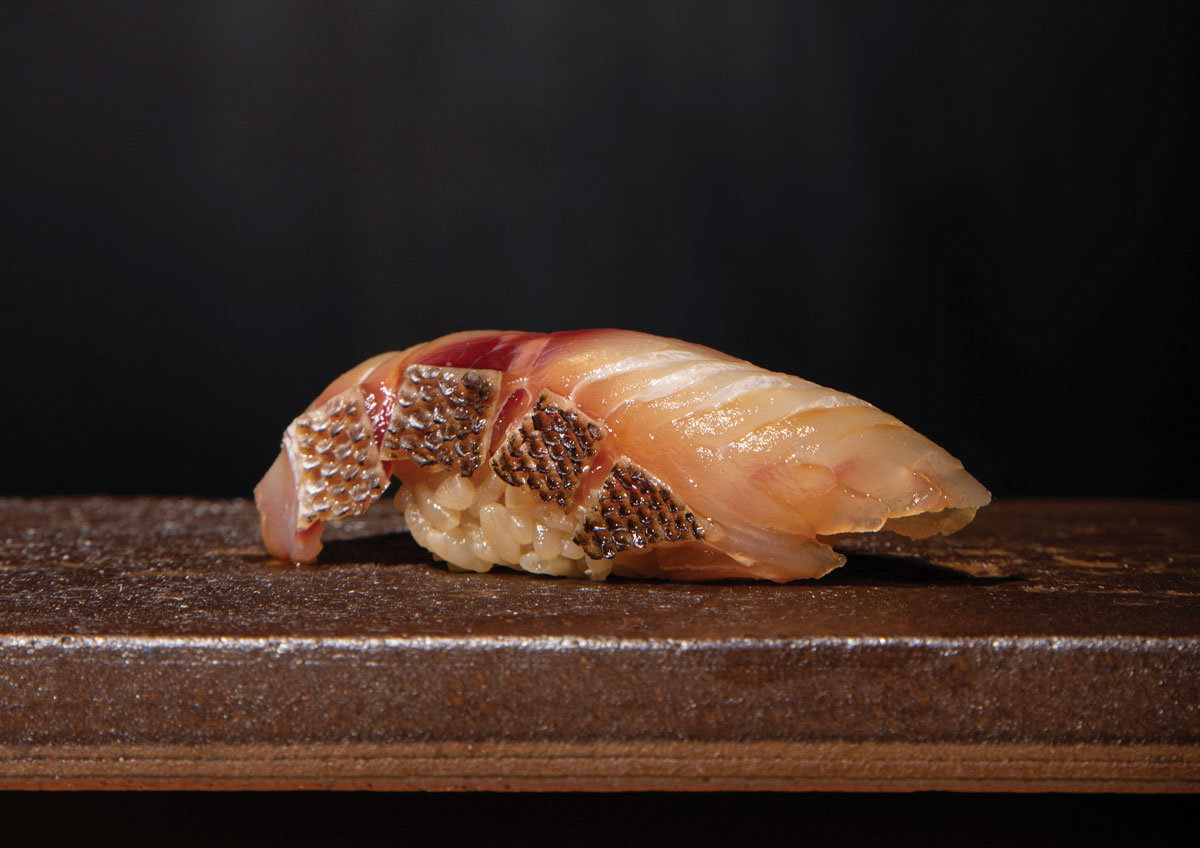
A typical meal at Mujo consists of three or four small kitchen dishes (braised octopus, truffled egg custard, dashi broth with white kimchi and chives) followed by exactly 10 pieces of nigiri sushi orchestrated by a chef who will lead you from light (red sea bream, golden-eyed snapper) to progressively richer (horse mackerel, lean bluefin tuna, fatty tuna, sea urchin) treasures of the sea. Seasonal items such as threeline grunt, fully mature winter yellowtail, prized pike mackerel, and monkfish liver pop up on a menu in constant evolution.

In true Edomae style, most of the fish is carefully aged/cured (between four and nine days) to let its texture relax and its umami develop fully. The catch has been exsanguinated and its nerves severed by a needle run down its spine. Often overlooked by sushi bros who want to brag about their toro (fatty tuna) and uni (sea urchin) consumption, the texture and temperature of the rice is crucial: Mujo seasons its brilliant rice with akazu red vinegar, then transfers it instantly into flat wooden boxes to keep it in its optimal state. Don’t even try to ask for your sushi without it: “It would be like ordering a pizza without the crust,” Harris says.

Review: Mujo
A typical meal at Mujo consists of three or four small kitchen dishes, followed by exactly 10 pieces of impeccably sourced, immaculately prepared nigiri sushi.

Photograph by Martha Williams

Respect for the chef’s craft demands that you use your hand rather than chopsticks to bring the small nigiri wonders—best eaten within seconds, while the rice is still warm—to your lips. Often, I found myself incapable of a sustained conversation, fully immersed in silky textures and tastes I couldn’t have imagined. Careful slits, magic dustings of fresh herbs or seaweed, the way a fish was turned to present its delicate veins or beauteous skin—all of this fascinated me. Careful attention by members of the minuscule serving staff, such as the ceremonial wiping of any traces of fish off my personal trivet between bites, had me under a spell all the way to the end.

Supplements such as caviar service or hairy crab from Hokkaido are available, and the meal ends with a small dessert (e.g., roasted sesame ice cream with miso caramel) followed by a mignardise and a gift of Japanese incense in a glass tube. Wine, champagne, and sake pairings can be coordinated by the sommelier, and there’s a tiny bar reserved for diners to begin or prolong their evening. Reservations for the precious seats are released at the beginning of every month. Plan to spend at least $300 per person, but remember that this isn’t about the money. Enlightenment and pure pleasure will be your reward.

This article appears in our December 2022 issue.

Review: One Flew South lands gracefully on the BeltLine

One Flew South
New menu features include a make-your-own deviled eggs “experience”

Photograph by Martha Williams

Landing at Terminal E, formerly Hartsfield-Jackson’s international terminal, always feels special. Even when the time isn’t right to hop a seat at the bar at One Flew South—for me and many travelers, the best airport restaurant in the country—my heart always beats faster when I spy this sacrosanct spot. Opened in 2009 by Duane Nutter and Todd Richards, both seasoned chefs who met at the Four Seasons, the restaurant aimed to take the stress out of traveling. It also garnered recognition from the James Beard Foundation for its excellent service and acted as a launching pad for Black culinary talent—not just Nutter and Richards but also Tiffanie Barriere, whose phenomenal cocktails made her famous, and Cedric McCroery, who succeeded Nutter as chef. The then unknown Allen Suh, meanwhile, provided sushi. “Why sushi?” I asked Richards. “Because we were close to Korean Air,” he told me.

The same crew, minus Nutter and Barriere, is reunited in the brand-new location of One Flew South on the BeltLine, where it has replaced the laudable but ultimately unsuccessful Hazel Jane. A huge photographic mural of lush trees on the back wall, the same as at the airport, visually ties together both restaurants, though this dining room has a warmer emotional feel. In both places, McCroery points out, the world walks by.

I love the patio but often head for the sushi counter inside, where Suh, assisted by an intense 17-year-old high school student who has to take two buses after school to report for the job, creates little marvels with premium raw fish. What he accomplishes within the genre is terrifically sophisticated. I almost never order rolls at sushi restaurants, much less a spicy tuna roll, which usually serves as a catch-all for mediocre fish. Suh calls his version a “hot tuna roll,” with velvety maguro spiced with shichimi oil contrasting with crunchy English cucumber, perfect vinegared rice, and togarashi spice. The gorgeous salmon roll comes wrapped in white seaweed with Vidalia onion and avocado. A beautifully cut sea bream sashimi with white watermelon kimchi, a nigiri-style lean bluefin tuna aged nine days in the Edo style, and even adorable miniature Rice Krispie treats topped with a dollop of University of Georgia caviar demonstrate the progress the talented Suh has made over the years.

One Flew South
The new location of One Flew South shares a visual motif with the airport original: a verdant photographic mural

Photograph by Martha Williams

On the main menu, items such as McCroery’s short ribs (Sichuan-spiced, but cut in the style of Korean kalbi and surrounded by tiny croquettes of fried coconut rice), hot “drunken” chicken on mochi waffles with an egg on top and plum chutney on the perimeter, and bourbon miso black cod with creamy grits are representative of the South-meets-Asia genre Richards and his crew have developed. Dishes such as coffee-rubbed lamb riblets with fig puree and collard green ramen, both hits at the airport, have found another home on the BeltLine. One fun item created for the new restaurant is a make-your-own deviled eggs “experience,” in which customers stuff mashed yolks, crispy shallots, bacon jam, tuna poke, and even caviar ($50!) into eggs that have been cut across the short side to accommodate more fillings.

At 51, Richards, a college dropout and musician who has opened 20-odd restaurants including a soul food counter in Krog Street Market and the recently closed Lake & Oak Neighborhood BBQ in East Lake, told me that he is “finally becoming” the chef he wants to be. He cares as much about the mental health of his employees as he does about their cooking. “We chefs, we are artists,” he said, communicating the vulnerability and intensity their work entails. Now that his employees don’t have to go through security and he can bring in ingredients he couldn’t have delivered at the airport, the kitchen can focus on using sophisticated techniques such as smoking tiny black sesame seeds or making its own chili oil. Born and raised in Atlanta, McCroery has a particularly Southern way of bringing heat into typically mild Japanese dishes. He told me he’s proud of the way he has developed his own voice after replacing Nutter.

I am not impressed with the restaurant’s signature cocktails, or the beverage program in general, but I recognize a good vesper when I see one. I also wonder whether typical BeltLine users have it in them to pay top dollar for creative sushi. I am, however, fully committed to participating in the energetic vibes of this magic ribbon of concrete, sitting side by side with my dining companions so as not to miss the view of folks who are far more active than my schlumpy self.

This article appears in our November 2022 issue.

Review: Capella Cheese is ambitious and delicious

Capella Cheese
Raymond Hook managed the cheese counter at gourmet grocery Star Provisions when it opened in 1999.

Photograph by Martha Williams

I have a superpower. I can look at a ginormous display of cheeses and tell you, without fail, which ones are past their prime and which will taste like plaster. And when I met Raymond Hook—at Star Provisions, where he launched the cheese program in 1999—I knew I was in the presence of an exceptionally gifted individual, one who understands that it is not only where you buy your cheese that matters, but also how that cheese is managed throughout its life. Hook’s return to Atlanta after a long absence, and his opening of Capella Cheese in Armour Yards—a fulfillment of his dreams and one of the most ambitious specialty shops I have seen anywhere—are delicious news indeed for a city that sometimes struggles to be taken seriously as a beacon of sophistication.

Capella—the brightest star in the constellation of Auriga, thought to depict a charioteer holding a she-goat—is an apropos name for a place where discerning cheeseheads and newbies alike can follow the lead of a stellar purveyor of inspiring food. A debonair 58-year-old of Choctaw and Chickasaw descent, Hook grew up in the town of Norman, Oklahoma, where his parents ran a restaurant with a small cheese counter—and where Hook found his path in life preordained. An early decision to become a vegetarian influenced his career; at the time, Hook didn’t think he’d be able to work with meat, so rather than become a chef, he entered a hotel management program in Las Vegas, then moved on to the food mecca of San Francisco.

A chance encounter with a friend of Anne Quatrano brought him to Atlanta, where he helped open Quatrano’s gourmet market Star Provisions, building a community of fans in the process. Seeking a larger playing field, Hook returned to San Francisco, where he worked as a salesperson for a large distributor; he also began writing a monthly column about cheese for Colman Andrews’s website the Daily Meal. He never really gave up on Atlanta. “People in this town love high-quality cheese,” he told me recently, standing in the middle of his sleek new shop—which opened, to great anticipation, in early July.

Capella Cheese
Bettelmatt cheese from the Italian Alps.

Photograph by Martha Williams

Every morning at Capella, Hook peruses his temperature-controlled caves and decides what is at the peak of perfection. Bought mostly from European suppliers and the best of the best among American producers, cheeses here include bluer-than-blue Valdeon from Spain; huge wheels of creamy yet delightfully pungent Gorgonzola dolce; real alpine cheeses from the Jura mountains; Uplands cheeses from Wisconsin and Rogue River Blue from Oregon; and a huge inventory of bloomy-rind cheeses such as French Camembert in thin wooden boxes and Trillium triple cream from Indiana. One of the strongest attractions is the mozzarella program, including still-warm (if you show up at the right time) bocconcini and luscious burrata made on-site by Brittany Billups, who developed her skills at Eataly’s New York store.

I may have asked to smell the Camembert before buying it—it was perfect—but I mostly rely on Hook’s intimate knowledge of the cooperatives and family farms with whom he does business. Everything is properly labeled with its provenance and producers. If you once had a Manchego that tasted like earwax or an objectionably stinky Taleggio, that doesn’t mean you won’t be won over by the same style of cheese here, where it’s sourced and aged properly.

Thanks to ever-present samples, I have reacquainted myself with creamy goat cheeses and English clothbound aged cheddars. I discovered insanely good buffalo-butter crackers to snack on (called tozzetti, they’re from the Italian producer Casa Madaio); bought a better version of truffled brie than I thought was possible; and marveled at the presence of Indian paneer, Portuguese quince paste, and panforte prepared locally by the Georgia Sourdough Company according to Hook’s recipe. I tend to miss the weekly shipments of Poilâne bread, which sell out in an instant (shame on me as a Parisian!). I have also been relieved by the fact that not everything is an unaffordable luxury product.

In addition to the cheeses, Capella sells brilliant charcuterie, including ham from certified acorn-fed Iberico pigs, smooth prosciutto that passes through a Lamborghini-red Berkel hand slicer, and fennel-scented hard sausage packaged with a flush of nitrogen that keeps it from touching anything plastic. Rare spices, fruity olive oils, compatible wines, and a couple of daily sandwiches reinforce the bond between customers and store, and Hook’s mission—“to bring the best to people”—will soon include ecommerce.

This article appears in our October 2022 issue.

Review: Fishmonger is one of the city’s most exciting recent openings

Fishmonger Review
With a charming collection of sidewalk seating, Fishmonger joins a burgeoning restaurant district on North Highland Avenue.

Photograph by Bailey Garrot

One of the few blessings bestowed by the pandemic is the acceleration of hybrid business models in the hospitality industry. Much to my relief, interminable coursed meals have precipitously declined; eschewing the kind of performative cuisine that keeps you pinned to your seat for long stretches, with foolish formal service as the only source of entertainment, chefs are turning their focus to more spontaneous and casual experiences. If there were such a measure as PPM—that is, pleasure per minute—surely Nhan Le and Skip Engelbrecht’s new Poncey-Highland restaurant would outrank many of its highly rated peers.

At once a seafood market, cafe, and raw bar, Fishmonger (674 North Highland Avenue) lands on a street that’s fast becoming a gourmet magnet, steps from other newcomers Jinya Ramen Bar, East Pole Coffee, and the Peruvian restaurant Tio Lucho’s. Unlike Le and Engelbrecht’s other restaurants (the recently closed 8Arm, the late-night stop Octopus Bar), the new joint doesn’t serve mostly hipsters. A mature, moneyed clientele materializes on a daily basis, making Fishmonger more like the much missed Lusca in South Buckhead—alas, too ritzy for the young and too informal for the rich—than it is like the partners’ more raucous, bar-driven joints. With less than 800 square feet, walk-in cooler included, there’s no place to store alcohol on the premises, and Fishmonger will staunchly remain BYOB, facilitated by the presence just down the street of one of the best bottle shops to open in Atlanta in years, the fresh and fashionable but extremely serious Elemental. (Editor’s note: The partners have recently announced plans for a second location in the Pratt Pullman District.)

Fishmonger Review
New Orleans–style peel-and-eat shrimp

Photograph by Bailey Garrot

Formerly an architect’s studio behind the Plaza Theatre, Fishmonger’s white brick storefront doesn’t waste an inch of space. A community table and a couple of narrow ledges accommodate those who wish to snack on peekytoe crab and avocado toast, slide a few oysters down their gullet, or enjoy the marvelous blackened grouper sandwich with herb salad and pickled onion that has fast become the restaurant’s signature dish. Outdoors, one can picnic around the cute trailer—the bed of a converted Toyota pickup—parked streetside. A few flimsy garden tables and chairs and a solid bench plunked under a young tree inserted in a patch of rocks have transformed a little stretch of North Highland into the kind of micropark one finds in places such as New York or San Francisco. I’ve sat there lost in the creamy beauty of a chowder whose flavorful fumet is replete with shrimp, clams, bay scallops, Yukon Gold potatoes, and gorgeous chunks of fish.

Chef-partner Bradford Forsblom, a graduate of the Culinary Institute of America, has to be clever about managing inventory in the minuscule kitchen. The core menu includes a cute Gulf shrimp salad with dill and fried shallots on a sesame roll; an extraordinarily fresh shrimp cocktail served flat on a plate; gloriously messy New Orleans–style peel-and-eat shrimp in an oily, spicy bath; one of the best and most tender Caesar salads in Atlanta, with Calabrian chilis, anchovy dressing, and lovely little clumps of marinated flying fish eggs; and a justly popular sourdough bagel (from Evergreen Butcher & Baker) with cream cheese, cured salmon, fried onions, and herbs. A daily crudo and a few rotating specials add variety to the menu.

Fishmonger Review
A spicy blackened grouper sandwich has quickly become one of Fishmonger’s signature dishes

Photograph by Bailey Garrot

Fishmonger Review
Oysters are all sourced from the South, including some from Kimball House’s Florida oyster farm

Photograph by Bailey Garrot

You can also take something home to cook yourself. I love to watch the cutting of big fish—wahoo, mahi mahi, grouper, fluke, tilefish—supplied by colorful purveyors such as Wes Brings You Fish, an older gentleman who runs his catch up from Florida in a beat-up truck with a big-ass cooler in it. Some of the fish is sold prepped and seasoned, ready to throw on the grill or under the broiler. Tinned fish such as Patagonia’s Spanish paprika mackerel can be purchased or eaten on the spot, and little tubs of chickpea salad and German potato salad are available in a reach-in cooler that’s also stocked with great sodas.

The tiny selection of oysters (all from the South, some from Kimball House’s new Shiny Dimes oyster farm in the Florida Panhandle) may not be consistently well detached from their pearly shells, but they are always delightful. I prefer them naked rather than made pretty with citrus foam, strawberry, and wasabi tobiko. Try not to show up when Fishmonger has run out of fish prior to the end of the day on Sunday—purposefully, as it’s closed Mondays—but plan on having a long-term relationship with a business that has no equal in the city.

Meet your supper
In addition to composed plates and grab-and-go fare, Fishmonger offers fresh cuts of seafood. A sampling:

Fishmonger Review
Queen Snapper

Photograph by Bailey Garrot

Fishmonger Review
Strawberry grouper

Photograph by Bailey Garrot

Fishmonger Review
Golden tilefish

Photograph by Bailey Garrot

This article appears in our September 2022 issue.

Follow Us

69,386FansLike
144,836FollowersFollow
493,480FollowersFollow

NEWSLETTERS