
Home 2026

Archives

How Georgia is leading the way in technology, from AI to Fintech

0

Explore This Special Report

State of Technology is a special report exploring Georgia’s technology industry through six sectors driving innovation across the state: artificial intelligence, health tech, data centers, cybersecurity, software development, and fintech. Featuring illustrations by Jamie Cullen, this report examines the companies, innovators, and trends shaping Georgia’s technology economy. Use the table of contents below to navigate each section.

“Any sufficiently advanced technology is indistinguishable from magic,” science fiction writer and inventor Arthur C. Clarke once wrote. He’s not wrong.

For many people who don’t work in technology fields, new innovations feel like wizardry—creating solutions to problems that the general population hasn’t even conceived of yet. Machine learning engineers building algorithms to train artificial intelligence, visionaries creating life-saving medical devices, software developers dreaming up new efficiencies, and blockchain engineers keeping financial transactions secure are part of the innovation ecosystem that has put Georgia on the map.

But no matter how magical these advances may seem, there’s human motivation and ingenuity behind all aspects, which means there’s also a pipeline and support system for developing that talent. The state’s top universities, technology incubators, job creation programs, and public-private partnerships focused on giving innovators the resources they need all make growth possible. The numbers tell the story. According to the Georgia Department of Economic Development, more than 14,300 technology companies and 165,000 employees call the state home, a testament to the culture of innovation. Here, we explore six tech-forward industries shaping Georgia.

Illustration of Georgia's technology industry featuring artificial intelligence, cybersecurity, fintech, health technology, software development, and data centers.
Georgia’s technology industry is driving innovation across artificial intelligence, cybersecurity, fintech, software development, health technology, and data centers.

Illustrations by Jamie Cullen

Artificial Intelligence

New Frontier

AI is here, there, and everywhere in Georgia business

By Tony Rehagen

Artificial intelligence, or AI, has always felt like the distant future. But while consumers have wavered between wariness and eagerness for the faraway day when machines do our thinking, the AI revolution has been quietly happening all around us.

In fact, few technologies are as pervasive as machine learning, which impacts every Georgia industry from fintech to health tech and software development. Entire cybersecurity startups, like Atlanta’s Ironscales, are built on generative AI apps to prevent phishing and financial fraud, while much of the state’s recent data center boom (including Amazon’s announcement of an $11 billion investment in Georgia to expand infrastructure and support AI) is driven by corporations’ AI integration.

Astro, JE Dunn Construction's Spot agile mobile robot.
Astro, JE Dunn Construction’s Spot agile mobile robot.

GREGORY MILLER

Obviously, the growing presence of all these other digital industries has made Georgia fertile ground for firms and startups focused on AI. In March, crypto and AI data center company Core Scientific announced that it was expanding its footprint in Dalton. Athens-based Vertice AI recently launched its AI-powered Vertice Acquire solution to help credit unions increase membership. Meanwhile, in Atlanta, enterprise AI agent company Sema4.ai followed up on a $30.5 million venture-capital backing with the release of its full-stack workflow platform to help businesses run and operate AI agents at scale. In the consultancy realm, Atlanta-based sustainable-design consulting firm Cove recently started Cove Architecture, a full-service, AI-powered architecture practice.

AI is even making inroads into the realm of manufacturing. In 2023, Kubota Manufacturing broke ground on a $190 million expansion in Gainesville to produce frontend loaders for tractors without a single human welder. Even 40-year-old JE Dunn Construction has brought on a Spot Agile Mobile Robot, nicknamed Astro, to monitor sites and capture data through the company’s info-tech offshoot, Aptitude.

However, Aaron Stebner, codirector of Georgia Artificial Intelligence in Manufacturing and a professor of mechanical engineering and materials science in engineering at Georgia Tech, says that the futuristic visions of completely autonomous factories dotting Georgia’s industrial parks are still well in the future.

“Most of what I’m seeing is open, broad adoption of AI assistance for things like writing, image creation, marketing, accounting, and matching job descriptions in the hiring process,” says Stebner. “Getting to the lights-out factory that self-optimizes is still decades away.”

Even so, Stebner says that the more forward-thinking firms who are breaking ground on new facilities are doing so with a mind to that automated future when no lights and no humans are needed in factories.

“At the research level, we’re right at the tipping point of component AI (a machine with a couple of sensors) growing into AI for an entire factory of machines making things,” he says. “We still don’t have that single app that spans a system scale. That’s the frontier.”


AI Oversight

Georgia lawmakers didn’t pass any of the bills introduced this session to address AI ethics and crime, but they could resurface when the Legislature reconvenes next year.

AI bills to watch:

  • House Bill 147: Sponsored by Representative Brad Thomas (R-Holly Springs), the bill calls for the Georgia Technology Authority to keep an inventory of how AI is being used by every state governmental organization. The inventory, which would be published on a public website, is intended to increase transparency of the rapidly evolving technology and help prevent potential abuses.
  • Senate Bill 37: Sponsored by Senator John Albers (R-Roswell), the bill also proposes creating an AI inventory of state and local government uses with the goal of giving Georgia a foothold in developing AI in businesses as well as government.

Study committees poised to launch in the coming months:

  • The Senate Study Committee on Artificial Intelligence and Digital Currency: Also sponsored by Albers, the committee will be tasked with crafting new rules and regulations on AI development, with a focus on how the technology could strengthen cryptocurrency security.
  • The Senate Impact of Social Media and Artificial Intelligence on Children and Platform Privacy Protection Study Committee: Created in a resolution sponsored by Senator Sally Harrell (D-Atlanta), this committee seeks to craft rules for how social media platforms can engage with children through AI-powered marketing tools.

Work Smarter

AI is redefining business with new applications almost daily, and now we can add staffing to the list.

PromptOwl, the world’s first AI staffing agency, partners with businesses to design, build, and deploy custom AI “digital workers” trained for specific business roles. These agents operate within PromptOwl’s AI Workplace platform, handling complex data analysis 24/7, managing customer service inquiries with perfect recall, or optimizing intricate operational workflows.

“The real power is maximizing human potential,” says PromptOwl Chief Growth Officer Stacey Schneider. “AI agents manage the grunt work so people can focus on strategy, creativity, and delivering real impact—often at lower cost.”

The results are compelling: According to Schneider, clients can realize nearly $4 in value for every dollar invested in AI agents within the first year.

“Implementing these agents is like finally turning the lights on after drifting in the dark ages,” she says.

Jen R. Coltrin

↑ Back to Contents


Health Tech

Clean Bill of Health

Georgia’s health tech sector thrives

By Heidi Fedak

When Arun Rai recently visited his doctor at Emory Healthcare, the head of the Georgia State University (GSU) Center for Digital Innovation saw firsthand the advances emerging from the health tech sector.

“One of my doctors uses ambient listening,” Rai says. “When you go in and talk to them, it encodes the whole conversation in an AI format, putting it into different categories. It’s changing not just the patient-physician relationship but the quality of the interaction, as well.”

And that, Rai says, is what the state’s thriving health technology sector is all about: creating innovations that enhance the patient experience, increase accessibility, drive efficiency, and improve the quality of care.

Health Apps
Sharecare offers tools to help individuals manage their health.

PHONES: ISTOCKPHOTO.COM; APP: COURTESY SHARECARE

Maria Thacker Goethe, president and CEO of Georgia Life Sciences, agrees.

“Whether it’s expanding telemedicine, streamlining data for better decision-making, or developing new medical devices, the focus remains on ensuring that all Georgians—regardless of location or socioeconomic status—have access to high-quality healthcare.”

There are plenty of opportunities to make that happen, thanks to a “robust and growing” healthcare technology industry, says Robin Hackney, chair of the Technical Association of Georgia Digital Health Society Board. The state has more than 250 companies in its digital healthcare ecosystem (including large, established companies like NextGen Healthcare, Sharecare, Greenway Health, and Ciox Health) and a vibrant startup community (with Loyal, Rialtic, and MedTransGo).

“Beyond that, Georgia offers a powerful mix of academic institutions, top-tier tech talent, and a business-friendly climate that continues to attract and grow companies across the health tech spectrum. This mix creates a healthy pipeline of ideas, talent, and investment, positioning Georgia as a national leader in health IT,” Hackney says.

It also creates opportunities for collaboration. And that, both Hackney and Rai say, is what sets Georgia apart in the industry. As the head of GSU’s Center for Digital Innovation, Rai and his team have worked with hospitals, companies, the government, and other organizations to transform patient care, improve clinical processes, and design predictive analytics.

“We’ve looked at streamlining workflows and coordination,” Rai says. “We’ve used data analytics and artificial intelligence to better understand and anticipate managing challenging patient conditions. We’ve looked at how new digital tools can be integrated into very different settings. And we’ve looked at health literacy in underserved populations around the world.”

Not coincidentally, those are some of the top priorities of health tech around the state as well as the nation: the expansion of telehealth and remote patient monitoring, artificial intelligence, healthcare payments, and consumer-facing digital health tools, Hackney says.

“Together, these trends show how Georgia’s healthcare tech ecosystem is not just keeping up with national movements—but actively shaping how innovation is applied across diverse settings and populations.”

“We truly believe we are on the cusp of something truly transformative,” Rai says. “And I think Georgia is right at the heart of this.”


Connecting the Dots

  • No one likes to get a shot, but they are a necessary part of some medical treatments. Atlanta-based Micron Biomedical is on a mission to make that a thing of the past. Thanks to its innovative microneedle patches, even needle-phobic patients can receive necessary interventions without a painful stick. CEO Steven P. Damon tells us more.
  • Micron’s dissolvable microneedle patches have been seen as a game-changer. What needs are you solving with this technology? The short answer is access. The “button” allows for pain-free administration [by yourself or a caregiver], eliminating or greatly reducing the cold chain and sharps waste. All of the above advantages over needles/injections allow for greater, broader, and more convenient access to important and sometimes lifesaving vaccines. Imagine receiving vaccines in the mail or picking them up at the pharmacy. In the case of pandemics and epidemics, imagine being able to get vaccines delivered into remote villages in Africa where they don’t have access to doctors or refrigeration for shipping. [We have improved] access for everyone globally.
  • How does it compare to traditional injection methods in terms of efficacy, cost, and accessibility? Clinical trials, published in The Lancet, have shown our efficacy as better than or equal to intramuscular (seasonal flu) and subcutaneous (measles and rubella) injections. Our estimated cost at scale is expected to be similar to injections. We are currently scaling up our commercial manufacturing capabilities.
  • Are there any new partnerships, clinical trials, or global initiatives in the pipeline? We have planned another Phase 2 study for measles and rubella this year, funded by the Gates Foundation. We planned a Phase 1 rotavirus trial this year, funded by the CDC. We are working on pandemic flu, Covid, monkeypox, and other undisclosed diseases. Other later-stage pharma trials are planned for the year.
  • Are there any new applications for your microneedle platform beyond vaccines that we should be watching? Half of our pipeline is dedicated to therapeutics. Since they are partnered with pharma and undisclosed, we don’t get to discuss them, but the technology works as well for therapeutics as it does for vaccines. Imagine receiving a weight loss or diabetes drug in the mail and self-administering with our little button instead of a needle.
  • Why is Georgia the right place for Micron’s headquarters? We spun out of Georgia Tech. But the reasons we are still here are many, including the great universities and related talent. The Micron team is the reason we are having success with our technology. They are passionate about our mission for a positive Georgia, national, and global health impact.

— Jennifer Bradley Franklin

↑ Back to Contents


Data Centers

Data Driven

Georgia sees a two-fold increase in data center development

By Heidi Fedak

The third time’s the charm for data-development company QTS. With two established data centers spanning a combined 150 acres in Atlanta and Suwanee, the Kansas-based business has again set its sights on Georgia, constructing a third facility on some 600 acres in Fayetteville.

QTS is not alone. Earlier this year, Amazon Web Services announced plans to invest around $11 billion to expand its cloud-computing infrastructure in Georgia, and DataBank is building its fifth and sixth data processing and storage facilities just outside of Atlanta in Lithia Springs.

The investments in the state are not surprising. A January report from land resource company LandGate shows that data center development in Georgia has doubled since 2020, and metro Atlanta is a major hot spot.

“Georgia has firmly positioned itself as a dynamic leader in the data center industry, with infrastructure and sustainability initiatives that not only attract investment but ensure long-term growth,” says LandGate CEO Yoann Hispa.

That growth, which started in the early 2010s and exploded post-pandemic, has reached a tipping point. In late 2024, real estate services firm CBRE said that Atlanta had become the country’s top market for data center leasing activity, edging out perennial leader Northern Virginia.

What sets Georgia apart? Plenty, says Larry Williams, president and CEO of the Technical Association of Georgia (TAG). The state provides what data development companies need to succeed: a favorable business environment, a high-quality talent pipeline, a robust and evolving infrastructure, and an easily accessible location.

Data giant QTS
Data giant QTS is building data centers in the shadow of downtown Atlanta.

QTS: COURTESY QTS

Today, more than 85 data centers, employing some 23,000 people, call Georgia home. And that creates tremendous positive economic impact for the state. The QTS Fayetteville campus alone is projected to create between 800 and 1,000 permanent jobs and contribute more than $1 billion in state and local taxes over the next 15 years.

As the market evolves, so, too, will the approach, Williams says. Data centers in the state could soon be reaching for the clouds, both figuratively and literally. With limited land supply and growing digital demand, these earthbound data clouds will have to stretch vertically to continue growing in urban areas.

“Given the limited availability of large land parcels in Atlanta, we’re anticipating a strategic shift toward vertical development—maximizing capacity with smaller physical footprints,” Williams says.

Growth will extend beyond Atlanta, too, with development in Augusta, Macon, and Savannah, “where connectivity, land availability, and affordable operational costs make expansion feasible,” a TAG Infrastructure Society white paper states.

Sustainability will be key to this business boom. Data centers consume considerable resources, including power and water. To ensure success, companies are turning to alternative energy sources and working to increase their efficiency. QTS, for example, is committed to sourcing carbon-free energy, signing long-term contracts for solar- and wind-generated energy in Georgia and beyond.

“In general, and especially in Georgia, data centers are becoming more and more efficient,” Williams says. “The amount of computing power is rising, and the amount of energy consumption or demand to do that is lowering.”


Bank on It

  • The data center boom has officially hit Georgia, and DataBank is at the forefront, with six centers in Atlanta. The company recently won the prestigious Golden Globee Award for its Universal Data Hall Design, a modular architecture capable of supporting a range of workloads from traditional enterprise to next-gen AI. Here, DataBank COO Joe Minarik shares how the company is committed to building smarter, not just bigger.
  • What is the significance of Georgia in your national data center strategy?Georgia, particularly metro Atlanta, is a rapidly emerging data center hub and plays a critical role in our national footprint. It’s a strategic market that has seen explosive demand in recent years due to favorable policies and infrastructure, and it offers us the opportunity to address demand in a high-growth region that’s still underserved in terms of hyperscale and edge-ready facilities.
  • What innovations are driving your growth? Edge computing has evolved from a niche concept into a real, deployable need as latency-sensitive applications continue to grow. At the same time, the push on technology across the board is creating continual demand because nearly everything consumers and businesses interact with today runs through data centers. From the apps on your phone and appliances in your home to streaming platforms, banking systems, insurance workflows, and even home mortgages, there’s a technology layer behind it all, and that layer lives in data centers. AI, especially, is putting entirely new pressures on data center design, especially around power and cooling, and creating new infrastructure needs. Underlying it all is the imperative to build sustainably.
  • How do you balance high-performance infrastructure with sustainability, especially with growing scrutiny on data center energy use? There’s a lot of noise out there about data centers’ energy usage. Power is an infrastructure issue. Data centers power everything. Yes, we consume power, but it’s because we’re supporting the digital life everyone depends on: streaming, working, learning, and building more AI models. The difference is, we’ve spent decades learning how to use that power more efficiently, and as an industry, we’re actually helping drive energy prices down. Utilities rely on sustained, predictable loads to operate efficiently and cost-effectively, and data centers provide that stability, helping reduce volatility in the grid and allowing energy providers to run their systems more smoothly. That, in turn, benefits consumers whose usage is often more unpredictable and cyclical. We’ve been early and active investors in clean energy, and the data center industry as a whole has long been among the first to drive real investment into clean energy because, frankly, we had to, and in many cases, we have paved the way for other industries to follow.

Jennifer Bradley Franklin

↑ Back to Contents


Cybersecurity

Digital Defense

Georgia is one of the nation’s elite cybersecurity hubs

By Tony Rehagen

By its very nature, cybersecurity is a secretive sector of business. With bad actors, both here and abroad, constantly searching for vulnerabilities in systems and networks, it’s more than understandable that companies aren’t eager to broadcast how they’re safeguarding data and information.

Illustration representing cybersecurity protecting digital systems, networks, and data.
Cybersecurity safeguards the digital systems, networks, and data that power Georgia’s technology economy.

ILLUSTRATIONS BY JAMIE CULLEN

Even so, it’s been hard to hide the exponential growth of Georgia’s cybersecurity industry in recent years. In fact, with the U.S. Bureau of Labor Statistics reporting a projected 33 percent growth in information security analyst jobs between 2023 and 2033, you might say the state is cybersecurity’s worst-kept secret.

One reason for Georgia’s cyber success? A concentration of tech companies, especially those that deal in fintech. According to the Georgia Department of Economic Development, Atlanta has experienced a 15 percent growth in tech jobs over the past five years.

“Cybersecurity is wrapped up in the field of digital technologies,” says Greg King, associate vice president for economic development at Georgia Tech, who sets up partnerships between academia, industry, and Atlanta’s startup community.

“There are a lot of digital tech companies here, and anytime you have robust digital activity, there’s a demand to keep that information secure.”

As a result, the state is home to more than 75 cybersecurity firms that generate an estimated $2.6 billion annually. One of those, SecureWorks, was acquired by global systems security giant Sophos in February 2025 for $859 million.

In addition, King points out, many of the big corporations, tech-related or otherwise, that headquarter or base major operations in Georgia have built out their own systems security departments. For instance, Nike opened a new Technology Center in 2023 in Atlanta’s West Midtown area to not only house its supply chain and logistics operations but also serve as its new East Coast cybersecurity center for the entire company. Last year, Fortune 500 company NCR (formerly National Cash Register) split off NCR Voyix, also based in Midtown, in part to handle its fraud and identity prevention operations.

But two hours east in Augusta is the nexus of Georgia’s cybersecurity advantage—where the Georgia Cyber Innovation & Training Center is taking the unprecedented step of a public-private partnership to help small businesses bolster their systems.

“Most larger companies have the resources to hire people and providers to do the work that needs to be done, though that still doesn’t make them bulletproof,” says Eric Toler, the Center’s executive director. “But for small businesses, local governments, and school districts, it’s not a fair fight to go up against the criminal proxies of nations like Iran, Russia, and China.”

The Center is partnering with Georgia Tech on a pilot program that provides assistance visits to smaller companies, where college students can perform a questionnaire assessment and provide no- and low-cost recommendations to make them more efficient and secure.

“We think we can work with other universities to expand this model across the entire state,” says Toler. “It’s an affordable way to protect all of Georgia and give these students unmatched experience.”

“There are a lot of digital tech companies here, and anytime you have robust digital activity, there’s a demand to keep that information secure.” — Greg King


Next Gen

  • Georgia leads the nation in the development of cyber talent and research; 10 colleges and universities have earned designations as a National Center of Academic Excellence (CAE) in either Cyber Defense (CD) or Research. Here, Tammy O’Brien, dean of the Augusta Tech School of Business, Cyber, and Design, talks about nurturing the next generation of tech talent.
  • Cybersecurity is increasingly important in today’s digital world. What sets the Augusta Tech Cyber Institute program apart? Our curriculum is designed to provide hands-on intensive training that prepares students for the workforce. By engaging in practical, real-world projects, students learn vital skills in creating, defending, and repairing technology. This approach ensures that they are not just learning theory but also applying their knowledge in practical ways.
  • What are some of the degrees students can earn? Augusta Tech offers associate degrees in cybersecurity, networking specialist, cloud computing and solutions, computer programming, and computer support. Within these degrees are many technical certificates of credit that can assist with strengthening specific skills or prep them to take certain industry certifications. We’ve also added an Academic Network Security Operations Center (SOC) to our training, which provides a scaled, enterprise network environment to gain cyber skills in preparation for a quick and ever-changing industry.Students are finding employment with organizations such as Fort Eisenhower, Unisys, ADP, the Savannah River Site, Plant Vogtle, TaxSlayer, Microsoft, Southern Nuclear, the public-school systems, and Piedmont Augusta Hospital, to name just a few.
  • What are some of the biggest challenges facing the cybersecurity industry? Finding and keeping employees who are knowledgeable enough to hit the ground running and who can actively learn to keep up with the constant changes and threats in IT. If you think about the technology that was used just a few years ago and compare it to the changes we have seen since, it is astonishing. The introduction of AI has also exposed areas of vulnerability and unknowns in IT, and businesses are having to learn to work with the new knowledge.

Jen R. Coltrin

↑ Back to Contents


Software Development

Solutions by Design

Software development puts Georgia on the tech-dev map

By Heidi Fedak

Ask the director of Georgia State University’s Center for Digital Innovation to describe the state’s role in the world of software development, and his answer is simple: “You know Silicon Valley, right? Well, Georgia’s the Silicon Peach,” says Arun Rai, the Howard S. Starks Distinguished Chair in GSU’s J. Mack Robinson College of Business and Regents’ Professor of Computer Information Systems. “And it’s rapidly growing.”

According to the Georgia Chamber Foundation’s Future of Workforce Report (Q4 2024), software developers already comprise 6.5 percent of the state’s professional, scientific, and technical service industry. That number is expected to rise by 37 percent, making software development one of the state’s top-growing professions by 2032.

Software development
Software developers are driving innovation through coding, application design, and digital solutions across Georgia’s technology sector.

ILLUSTRATIONS BY JAMIE CULLEN

It’s also an extremely powerful one. More than just a segment of the tech industry, software development is key to understanding the state’s technology landscape because it both undergirds and intersects the other tech categories across the state, Rai says. It drives advances in everything from cybersecurity to operations technology.

“You can think about software development as building the roads, sort of like the foundational core that makes computers work. And then on top of that, you have more sophisticated or different types of functionality,” he says.

Atlanta, where the development scene first took root, is home to a robust digital ecosystem, including tech titans like NCR, Honeywell, Microsoft, Google, and Cisco; midsized development companies like Soltech and HatchWorks AI; and entrepreneurs like those emerging from Atlanta Tech Village.

It branches out from there. Software-development efforts have spread throughout the state, driving innovations in logistics (Savannah), healthcare (Alpharetta and Augusta), and cybersecurity (Augusta and Columbus). Across the state, developers are transforming how business gets done around the world, creating electronic health records, designing programs to optimize operations, and changing how bills are paid and payments processed (digital wallets).

The trends they’re driving include the rise of AI-powered assistance (including AI agents and copilots), building in the cloud so companies have flexibility when it comes to computer power and storage, introducing microservices that break down complex processes into more manageable ones, providing low-code and no-code solutions, and strengthening cybersecurity.

This ongoing evolution helps companies and organizations drive economic viability and growth.

Take family-owned retailer Bealls Inc., for example. Faced with disconnected, inefficient systems that were affecting the bottom line, the company turned to Atlanta-based Manhattan Associates to unify and streamline its processes. Manhattan used its proprietary microservices-based architecture to integrate Bealls’s order management, loyalty program, and fulfillment processes into one centralized system, simplifying store fulfillment, enhancing guest services, and reducing operational costs across 650 stores in 22 states. The endeavor reduced the retailer’s split shipments by 17 percent, cut fulfillment costs, and improved first-fill rates by 90 percent.

“Software development undergirds and intersects the other tech categories across the state.”

“Within months, we’ve completely upgraded our systems, empowering the business and laying the foundation for further growth,” says Karen Beebe, Bealls’s chief technology officer.


Building Tomorrow

Georgia-based development companies—and their leaders—have their eye on the future. Here are three to watch.

  • Phone It In: Atlanta-based SaaS (software as a service) startup Callbird aims to close the gap between a company’s sales team and an interested potential customer. Instead of a would-be client needing to fill out a “learn more” form, this enterprise allows them to click a button and immediately chat—via face-to-face video—with a salesperson. No more waiting to hear back or potentially losing a sale.
  • For the Assist: Who couldn’t use a little help getting things done? Georgia-founded Belay is an AI-empowered team that can help with virtual assistant duties, accounting, and marketing tasks. Clients work with real humans—from CFOs to administrative assistants—with streamlined efficiency thanks to the company’s proprietary AI platform.
  • Digital Watchdog: Every parent wants to keep their kids safe, but the digital world adds an extra level of unpredictability—and danger. Enter Bark Technologies. The company offers a parental control app to guard online privacy and limit harm, plus a customizable kids’ phone with built-in text and social media monitoring. In 2024 alone, the company analyzed nearly 8 billion messages across apps, social media platforms, email, text messages, and more.

Jennifer Bradley Franklin

↑ Back to Contents


Fintech

Banking on Innovation

Georgia pushes the limits of fintech, from payments to cybersecurity to AI

By Michael Jacobs

Georgia is counting on innovation, education, and expertise to maintain its place among the world leaders in financial technology.

The state has earned the nickname “Transaction Alley” because Global Payments and other companies operating in Georgia process roughly 70 percent of all payments in the U.S. Georgia has more than 260 fintech companies that employ 42,500 workers.

GreenlightPaymentApp
Greenlight’s debit card for kids has powered the Atlanta startup to a billion-dollar-plus valuation.

COURTESY GREENLIGHT

“We know this industry inside and out, and that is going to give us a competitive advantage to stay in front,” says Larry Williams, CEO and president of the Technology Association of Georgia (TAG), an Atlanta-based nonprofit that drives innovation among Georgia’s technology community.

Williams sees big opportunities in digitizing business-to-business transactions, most of which still use checks and manual processes. Meanwhile, the quest for ever-faster payments creates a need for better cybersecurity.

“As the good guys get faster, the bad guys are going to continue to get fast too,” Williams says.

The onset of truly instant payments brings the risk of instant theft and fraud, says Glen Sarvady, managing principal for 154 Advisors and lead author of the TAG Fintech Society’s 2024 ecosystem report.

He and Robert Daniel, the fintech catalyst at Georgia Tech’s Advanced Technology Development Center (ATDC), agree that the increasing speed creates a need for agentic artificial intelligence in such areas as customer support, fraud prevention, and account approval.

“That’s where a lot of people are pushing their innovation buttons right now,” Daniel says.

Sarvady is interested in the use of stablecoins, a fixed-value cryptocurrency, to solve the problem of slow, expensive international payments. He notes that TTV Capital, an Atlanta fintech venture capital firm since 2000, has invested in Higlobe, an out-of-state company in that field.

Atlanta-based Greenlight, one of TTV Capital’s eight unicorns (startups valued at more than $1 billion), has gained recent attention by partnering with U.S. Bank and smaller institutions after it attracted more than 6 million customers. The “debit card for kids” has been lauded for teaching money management and the power of saving to minors.

ATDC and Atlanta Tech Village are nurturing more of those startups.

“I see lots and lots of that energy,” Sarvady says. “I see lots of ideas coming to market.”

The Georgia Fintech Academy works with industry partners to develop programming and curriculum mixing fundamentals and experiential learning at 26 University System of Georgia institutions. The academy also has a two-year associate’s degree program, and Kennesaw State University offers a master’s.

Founded in 2019, the academy achieved its mandate to fill 5,000 early-career positions by 2025.

“Our students are being challenged to think about things in innovative ways,” says Laura Gibson-Lamothe, the academy’s executive director. It also is working on continuing education for industry veterans.

Sarvady says Georgia faces challenges from Ohio and Utah. Ohio is aggressively recruiting companies at industry conferences. Utah’s strong fintech ecosystem added the University of Utah’s Stena Center for Financial Technology in 2023, its answer to the Georgia Fintech Academy.

Ultimately, success could be the downfall for fintech in Georgia and elsewhere, Sarvady says.

“At some point in the future, the whole notion of fintech could just go away because it’s going to be everywhere, ingrained into every experience that you have.”


Follow the Money

According to Dr. Nick Suppiah, fintech program director at Kennesaw State University (KSU), the region’s fintech companies process more than $2 trillion annually.

KSU offers the only master’s in fintech degree in the state and the only one in the country that focuses on digital payments. More than 90 students are currently enrolled, and 26 graduated in May.

“The payments industry will continue to evolve rapidly, and KSU’s program is designed to keep graduates at the forefront,” Suppiah says.

Why is Georgia such a key player in fintech?

Atlanta is home to more than 260 fintech companies, including industry giants like Global Payments, Elavon, Fiserv, and NCR Atleos. More than 70 percent of U.S. payment card transactions are processed by companies with a major presence in Georgia. Additionally, the state benefits from a strong talent pipeline, supported by leading universities and industry-focused programs, and a collaborative ecosystem that brings together businesses, academia, and state initiatives.

Why create the MS-Fintech program?

The turning point was when our industry partners highlighted how a majority of those who worked in the field did not have any formal training in fintech, let alone payments. This gave us an opportunity to be a part of not just helping shape the future of digital payments but also providing a unique career pathway to our students.

What is next in the world of fintech?

Key trends shaping the future of fintech digital payments include:

  • Real-time payments: Instant payment systems are becoming the norm, driven by consumer demand for speed and convenience.
  • AI and machine learning: These technologies are revolutionizing fraud detection, personalized financial services, and operational efficiency.
  • Open banking and digital wallets: Apple has opened up its NFC technology, allowing developers to offer in-app NFC transactions independent of Apple Pay and Apple Wallet and intensifying competition.
  • Virtual cards and behavioral biometrics: Virtual cards are transforming B2B payments, and advanced biometrics are improving security and user experience.
  • Sustainable and ethical finance: There is growing emphasis on responsible innovation, with fintech aligning more closely with consumer values around sustainability and ethical investing.
  • Expansion of alternative payment methods: Buy Now, Pay Later (BNPL) and pay-by-bank solutions are gaining traction, especially among younger consumers and in new industry sectors.

Jen R. Coltrin

↑ Back to Contents


See this entire feature in GaBiz Summer 2025 here.

From storytime to skill sets: how Georgia businesses are building the future workforce

0

At first glance, a link between beer and literacy appears a bit of a stretch, and Matt Stevens admits it. The senior director of community impact for Creature Comforts Brewing Company spends much of his time explaining the connection.

Stevens starts by recounting how he was hired eight years ago to focus solely on the Athens-based business’s philanthropy.

“Our founders launched Creature Comforts 11 years ago with the understanding that business can be a force for good in the world,” he says. “There was especially a desire for the community of Athens to be demonstratively better off. But back in 2014, I don’t think anybody knew what that would look like.”

What his colleagues did know was that they wanted to match the company’s philanthropic resources with community priorities. So rather than becoming known for tackling food insecurity, cancer research, or any number of worthy causes, they decided to support what the locals saw as the area’s most pressing needs.

In 2021, after gathering an advisory council of area leaders from government, education, and nonprofits, and holding focus groups with school leaders, teachers, and librarians, one priority stood out: literacy. “At the time, just 19 percent—one in five—of third graders were reading on level,” says Stevens. “But we thought it was possible to see a 60 percent improvement.”

The Athens-Clarke County area wasn’t, and isn’t, the only part of the state with low literacy scores. In 2022, the National Assessment of Educational Progress showed that only 32 percent of Georgia fourth graders were reading at or above proficiency levels. In 2024, that number was down to 30 percent.

“Generally, we were pretty stagnant in third-grade reading for the last 10 to 11 years,” says Joy Hawkins, executive director of the Governor’s Office of Student Achievement. “We took a dip and now are inching back up to 31 percent.”

Improving students’ literacy isn’t just a matter of improving education, Hawkins adds. The skills of reading, comprehension, vocabulary, and fluency ripple across every aspect of life, including the workforce.

“Literacy is the baseline,” she says. “If a child can’t read proficiently by third grade, it’s very hard to ever catch up. Even with word problems and math equations, you have to be able to read, so if students are struggling in fourth grade, it’s a double whammo. That’s why the metric of reading on level is so important.”

Skills for Now, Skills for Later

TestGorilla, an HR support program that offers skills-based testing to find the most qualified candidates, produced a well-documented article on the connection between early education and its impact on the workforce. With information cobbled from 28 research studies, it showed that investing in early childhood education (ECE) initiatives pays off in two key areas: return on investment and a stronger hiring pool.

According to the National Forum on Early Childhood Policy and Programs, every dollar invested in ECE initiatives produces an ROI from $4 to $9. Additionally, that investment works to teach kids the key skills they’ll need to be effective employees: problem solving, motor skills, emotional regulation, social skills, and the ability to not just read but also understand content and think critically about it.

Hawkins also points out that reading is not taught as a subject after third grade, so finding resources to address weak literacy skills becomes a challenge. Additionally, studies have shown that students with poor reading abilities are more likely to drop out of high school and live in poverty. That long game of getting kids out of school and into college or the workforce was one Creature Comforts was ready to underwrite.

In 2022, the company launched a two-year pilot program aimed at improving reading skills for students at Athens’s Howard B. Stroud Elementary, a school identified by the Clarke County district as needing literacy support.

Through a partnership with the literacy nonprofit Books for Keeps, trained support staffers were sent into classrooms for one-on-one, hourly sessions with struggling students. A University of Georgia research team tracking results from state tests recorded significant improvement.

“We saw incredible gains compared to control schools,” says Stevens. “Students were 37 percent more likely to test as proficient on the [Georgia Milestones Assessment] and two times more likely to be reading on level as compared to control counterparts. It was a wildly successful pilot.”

Businesses Step Up

Creature Comforts isn’t the only Georgia company getting behind early childhood education initiatives. And they’re doing it for more than philanthropic reasons. While investments in kindergarten through eighth grade are certain to enhance an organization’s reputation as a community partner, they also serve as part of the long game to enhance the state’s workforce.

Creature Comforts
Creature Comforts funds a literacy program that fosters one-on-one work with Athens students.

COURTESY CREATURE COMFORTS

“Literacy is critical to workforce readiness,” says Lisa Olens, who for 10 years has been the education manager at Georgia Power. “Once you get to third grade, you are reading whatever you’re learning, and reading level is an indicator of success in school. It’s critical we get those basics down.”

Georgia Power underwrites a team of 16 education coordinators for pre-K through 12th grade classrooms around the state to deliver hands-on, STEM-based lessons. The coordinators, who live in the communities they serve and already have relationships with local schools, provide programs that align with state standards and reinforce what students are learning. Since starting in 2011, the teams have worked in more than 150 school districts and with 1.3 million students, 900,000 of whom are in kindergarten through eighth and living in areas of the state that often don’t have funding for support materials or personnel.

“When we started, we were in grades three, five, and eight—where the testing is done,” says Olens. “From there, we expanded into other grades and high schools.

In the early grades, the focus is on literacy, and we read STEM-based stories on energy and energy efficiency.”

The company’s Look Now, Wonder Wow book is distributed during Georgia Pre-K Week, an October event sponsored by the Georgia Department of Early Care and Learning to promote early childhood education, and is read in pre-K centers by Georgia Power volunteers. Other books, including one on solar power written by Decatur storyteller Carmen Deedy, have been developed for higher grades. Hands-on programs revolve around electricity, circuits, heat transfer, and simple machines.

“The lessons always give real-world examples of how things fit into our world,” says Olens. “That gets students excited about how what they’re learning can be used and gets them thinking about jobs they didn’t know about and the training and skills they’ll need. I think a lot of employers have positions they can’t fill, and students are looking for careers but don’t know how to make that connection. We can make that connection with those interested in the energy field, and hopefully, we can encourage other companies to get involved as well.”

Cultivating Interest and Aptitude Early

Elementary school is not too early to get youngsters thinking about careers and what it will take to get there, be it certifications, technical training, or a college degree. That’s the position taken by Accenture, an international company with about 770,000 employees worldwide, including 4,000 in Atlanta, who specialize in technology and strategy consulting. Accenture volunteers work with public middle school students in Atlanta and Gwinnett County classrooms to demystify coding, showing students how easy it is to code on their phones and letting them discover that coding isn’t “nerdy.”

“It starts with a soft touch in middle school then builds on that to get students into high schools with more IT training,” says Gina Rude, who has led Accenture’s U.S. corporate citizenship programs since 2011. “It also gets our people involved in Junior Achievement, Boys and Girls Clubs, and Scouts, and gives students more exposure to Accenture.”

The company has also been part of STEM and field days and has invested in buses at the Boyce L. Ansley School, a tuition-free private school for homeless pre-K through fifth graders on the northern edge of downtown Atlanta. The company also supports over 200 nonprofits that dovetail with its main philanthropic goal: to promote the skills students need to succeed in life and the workforce.

“The work we do in the community is a pipeline for talent, but it’s not the main reason we do it,” says Rude. “I think of Accenture as a huge network of collaboration, and our community work weaves through that. We give our support any time we can.”

In fact, that support has paid some workplace dividends. Rude cites interns who have come through the company’s community partnerships or have been mentored by an employee at a Boys and Girls Club. Some learned about Accenture through the coding session volunteers or other programs where they explore different career paths and connect to training and jobs. They hear about what it’s like to work for a global firm and also learn about financial literacy.

Cows and Community

One company early learners are likely familiar with is Chick-fil-A . Through financial and in-kind donations (think chicken biscuit breakfast fundraisers), the company promotes community partnerships with a common theme.

“We’re always looking at ways to care for people and the community,” says Carol Waddy, who has been the company’s director of community affairs for nine years. “It’s not always direct, but that’s our priority area.”

One direct, ongoing collaboration Chick-fil-A has made is with the Atlanta Public Schools, where the company sends out 60 staffers from the digital technology team to run “challenge days” for middle schoolers around restaurant-related robotics and coding. Through that relationship, the company was invited to adopt a cluster of Southside schools and to work with counselors who identify individual student needs.

“We were the first corporation to adopt an entire cluster,” Waddy says. The company invested in programming at KIPP Metro Atlanta (public, tuition-free charter schools) and awarded a $200,000 grant to help teachers and leaders in the City Schools of Decatur find new ways toward equitable student achievement. And it’s underwritten Kennesaw State University’s “Call Me Mister” program to develop male educators in schools and supported the YMCA of Greater Atlanta’s early learning center. “The goal for us is to come alongside and support organizations already doing great work in the schools and communities to prepare young minds to step into the workforce,” she adds.

It’s Elementary: By the Numbers

+47

Georgia’s Teacher Morale Index
Highest in the nation (national average: +18), according to an Education Week report released in March.

$14,660

Public K–12 spending per student
Annual public education spending per pupil in Georgia.

1.7 Million

Students enrolled
Georgia students attending public schools statewide.

56%

Third graders below proficiency
Georgia third-grade students who cannot read proficiently and are more likely to drop out of high school.

1 in 10

Adults with low literacy
Projected to earn approximately $1 million less over their lifetimes than literate adults.

Poverty rate
Adults without a high school diploma experience poverty at three times the rate of graduates.

75%

Future jobs
Of Georgia’s projected 261,000 new jobs by 2028, 75% will require at least a high school diploma.

Back to Beer

Being a resource is also the approach of Creature Comforts. The company coordinated the funds for a partner nonprofit to put one-on-one literacy mentors in the local schools. “We are empowering them to do the work,” Stevens says. “They recruit and train literacy mentors for students identified by the school for intervention, and they meet every week for an additional hour during the school day for the entire year. In the end, students are getting up to an additional 27 hours of one-on-one literacy support during the year.”

Stevens says the program’s new goal is to expand into more than the two schools it currently serves. And after two years, he has the resources to make it work.

“We’re finding the earlier we’re intervening, the better the gains we’re seeing,” he says. “There is a pile of scholarly literature taller than I am that talks about the correlation between students’ ability to read on grade level at third grade and high school dropouts who become dependent on their communities.

“We can either be investing in this work to the tune of a few hundreds of dollars over the next few years or spend untold millions on housing and clothing later,” Stevens continues. “If we can get students reading on level at this critical point, where they transition from how to read to reading to learn, we can keep the gap from growing.”

— BY H.M. CAULEY


Early Investment in the Future

The Georgia Chamber Foundation is focused on policy development and driving research to support Chamber initiatives. Here, Research Director Savannah Taylor shares more about why literacy and childhood education are inextricably linked to workforce development and how the Chamber is helping advance the cause.

Georgia Chamber Foundation
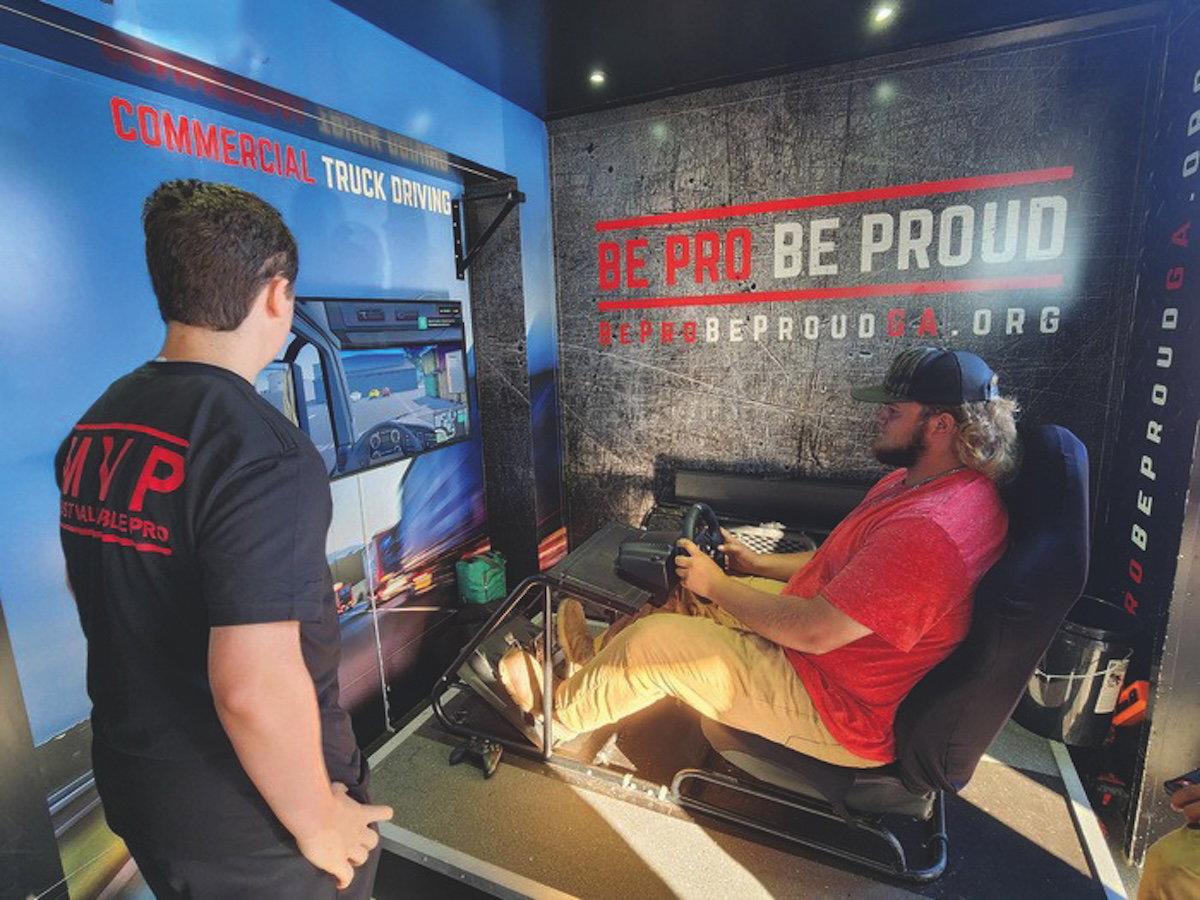
Skilled trade activity with Be Pro Be Proud.

COURTESY GEORGIA CHAMBER FOUNDATION

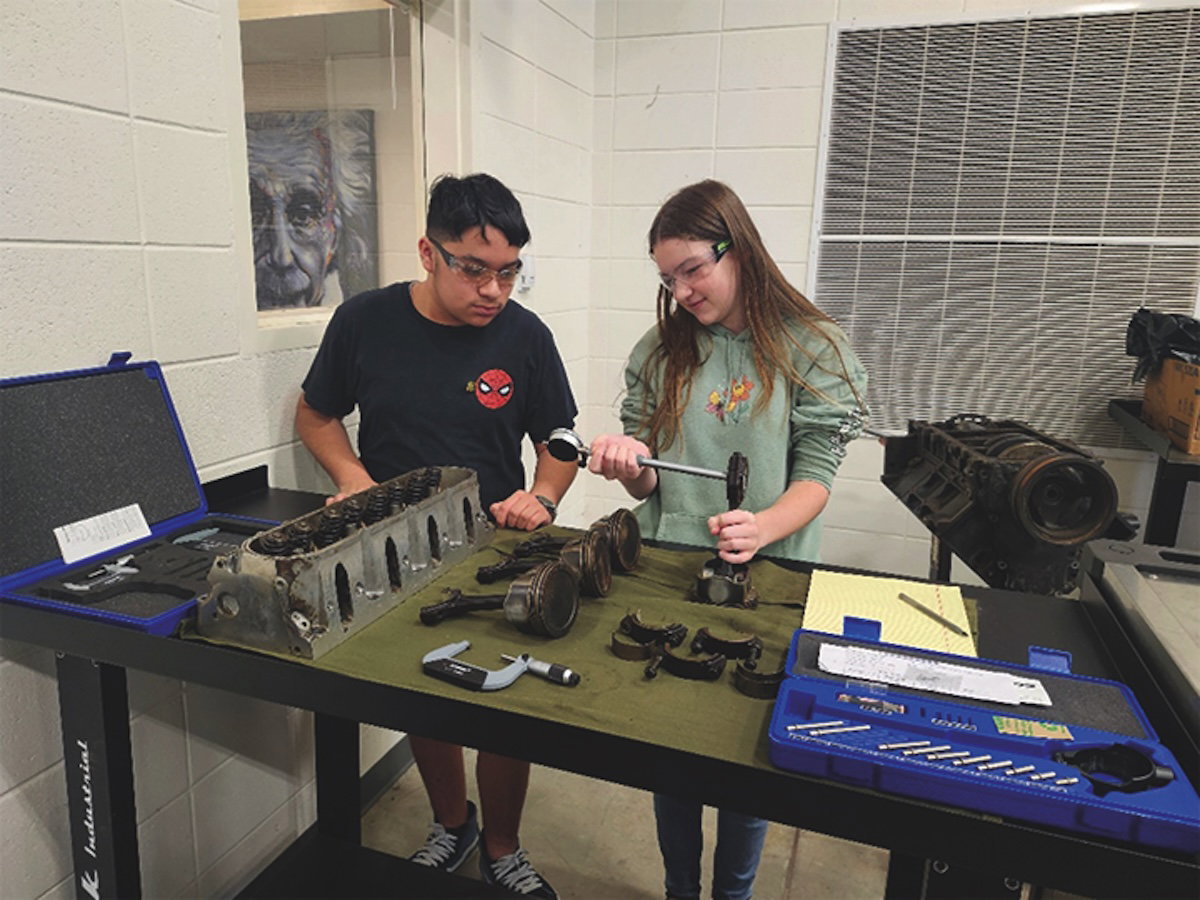
Automotive pathway in Chattahoochee County
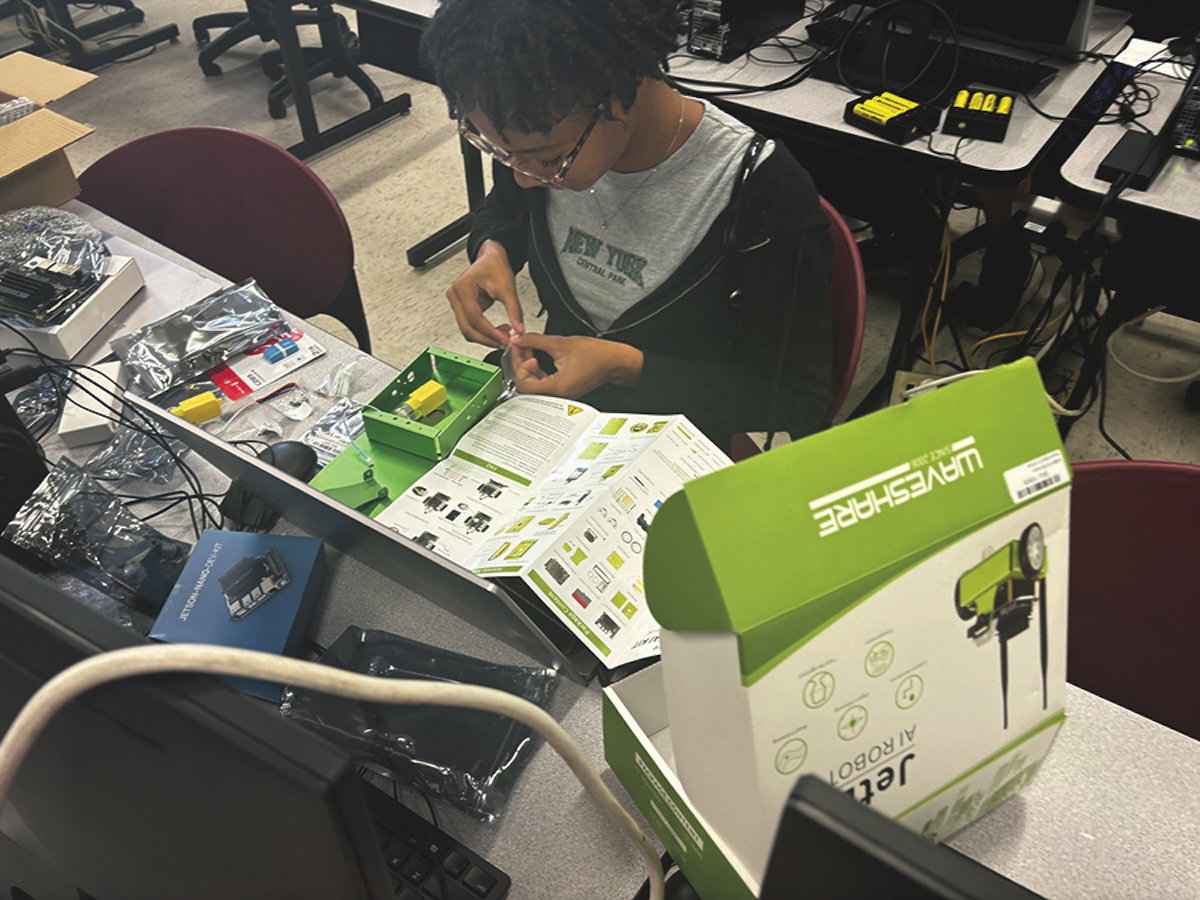
Artificial Intelligence (AI) camp in Dooly County.

How and why are early childhood education and literacy important for the health of the future workforce?

Third grade, in particular, is important because that’s the age and benchmark to make sure that students are ready to start learning material through their reading skills. Early investments are so important because you’d rather spend a little bit more time and money making sure that students are really well prepared, instead of trying to catch them up in, say, fourth or fifth grade when they’re also missing out on comprehension and content because they can’t read.

In terms of workforce development, it’s twofold for us. First, the future workforce component: If our children can do well in early grades, that drastically improves the chances they’ll do better in school and have more options. Bolstering the talent workforce pipeline is vital. The second component is working parents. If they know that their children are in school and have access to those early opportunities to learn, they can focus on their careers and jobs. That’s one less thing for that parent to worry about.

How is the Chamber encouraging member companies to invest in early childhood education initiatives?

When we have member companies that are doing things particularly well, we convene those stakeholders. Perhaps a smaller business doesn’t have the resources to provide early childcare services to the parents in its workforce. If we know another company is doing something in that space, we connect them.

This year, we partnered with Georgia Early Education Alliance for Ready Students to allow Georgia companies to take a survey for a program called “Best Place for Working Parents.” After answering a few questions, it gives them a rating and an idea of where they stand in relation to other companies of similar industry and size in terms of how they’re supporting their families with literacy and early childhood care. And then we have access to that backend data so that we can see all of the different things that companies are doing and use that to help further connect companies and give them ideas for initiatives.

The Chamber has a partnership with the Georgia Department of Education. Can you share some of the results?

Our Center for Rural Prosperity, which supports all of our rural chambers and businesses, had some federal funds and wanted to partner with us for workforce development grants for K-12 systems. The partnership awarded $2.1 million in grants that supported 17,000 students in 64 rural school districts.

One school system had a lot of students who were interested in medical tracks but weren’t performing to get into medical programs through either the Technical College System of Georgia or the University System of Georgia. They were able to pay for online training programs and equipment for the students to use in high school classrooms to better prepare them with hands-on experience. One school system did a criminal justice track, where they brought in equipment, materials, and online resources for students who were looking to pursue law enforcement. The most common grant requests were geared towards heavy equipment manufacturing or robotics. It’s a concrete way for students to get involved, both with equipment and training and then site visits with employers.

—JENNIFER BRADLEY FRANKLIN

See this entire feature in GaBiz Summer 2025 here.

Kevin Blair is Banking on Continued Success

0

KEVIN BLAIR HAS BEEN in banking for three decades, but when he joined Columbus-headquartered Synovus nine years ago, he discovered a new culture of doing business.

Kevin Blair CEO Synovus
Blair leads by example, plugging into the Georgia community by serving on the boards of Greater Columbus Georgia Chamber of Commerce, Metro Atlanta Chamber, Georgia Historical Society, and Georgia Research Alliance.

Courtesy of Synovus

“Our people care so much about each other, and that transfers over into how we relate to our clients,” says the CEO, president, and chairman of the company founded in 1888 as the Columbus Bank and Trust Company. “We’re not perfect, but [the culture] feels different than anything I’ve ever seen.”

That sentiment is not just a proud leader talking. Synovus has won numerous Coalition Greenwich awards (considered the key designation for financial institutions), including 15 Best Bank Awards this year, earning top marks for ease of doing business, relationship management, customer service, and more. Here, we chat with the dynamic leader to learn more about what keeps him inspired and how he’s leading the company into the future.

Columbus may not be the first place that comes to mind for a banking headquarters. Why is it the right fit for Synovus?

We were born here in Columbus. We’re the 39th-largest bank in the United States and the largest that’s not headquartered in a major MSA (metropolitan statistical area). Most of the large banks have migrated to major MSAs. We didn’t just grow to our size based upon starting in a MSA that had outsized growth.

We’ve had to work harder because we have 55 markets that we serve. And although Atlanta is our largest market by size today, Columbus is the second largest, and Birmingham, Alabama, is the third largest. We’ve been able to leverage growth across all five states (Alabama, Georgia, Florida, Tennessee, North Carolina, and South Carolina) within our footprint over this 136-year timeframe.

Columbus fits because, number one, it gives you a cost advantage—the cost of living is less. Number two, the city kind of follows our values in terms of who we want to be and the family-based culture we have.

Synovus consistently ranks as a top bank by customer reputation. What sets it apart?

It starts with talent selection. People in our company share our purpose to help people reach their full potential. It’s part of the fabric of the people we attract—we have a very empathetic culture. Secondly, our turnover rates are low. We just don’t have a lot of attrition from our team members. Last year, our voluntary turnover was 11 percent, the lowest it’s been in over a decade. Clients don’t want to come into our branches and see a new face every week or have a new commercial relationship manager.

Also, everybody wants immediate gratification, and technology is enabling people to access their banking services 24/7 in the comfort of their home. I truly believe that it has to be high tech for self-service with things such as money movement, checking balances, and paying bills.

But when people have a problem, they want to deal with a real person who has empathy and expertise. Big banks are trying to move everything to technology with AI and robo-type activities, and the small guys don’t have the ability to provide the same capabilities and technology.

We talk about the Goldilocks principle—we are big enough to give you all the capabilities and functionality, but we’ve remained small enough and attuned to the fact that people want personal attention. I think that’s why our service scores are so high, and we stand out relative to our peers.

Georgia’s leadership continues to focus on rural development. How do you see Synovus playing a role?

Growth is all about access to capital. We deploy a lot of capital in the state of Georgia to ensure that businesses that want to relocate here have access. For example, there’s a new electric-based aircraft facility in Covington. When they were moving here, it was important to them to have a local bank, and we serve in that capacity.

We’ve also developed a lot of specialty banking units. For example, when you talk about infrastructure, we have an alternative energy vertical that deals with things like solar or small nuclear facilities. As we’re moving in the direction of non-fossil fuel-type opportunities—as battery manufacturers move here and solar becomes more adopted across the state—we’re there to provide expertise and capital.

We also focus a lot on community service. Our bankers and executives have to sit on very active boards and show that they’re not just spending their money in a market but spending their time and energy there too.

What future Synovus initiatives are you most excited about?

For the first time in my nine years here, we are adding more sales resources across all of our markets than we’ve ever had. We think there’s an inflection point in our industry where there’s a lot of disruption, with unhappy clients and unhappy team members. We have a model that [sales resources] want to join and can thrive in. We are opening up our expense growth plan for 2025, bringing in over 100 new FTEs (full-time equivalent employees) to generate outsized growth.

Also, we have spent a lot of time and energy on our technology to better leverage it to serve our clients’ needs. We’re really focused on what we can do to continue to improve the client experience. High tech needs “high touch.” You’ve got to keep developing the high-tech stuff, coupled with having great people.

How is Synovus helping boost consumer confidence in a volatile time?

Volatility is bad for consumers, it’s bad for the markets, and it’s bad for bankers because everybody wants certainty. I tell our bankers that this is a great time to reach out to clients and have conversations because we don’t have all the answers.

I don’t know everything that’s going to happen with tariffs and the impact it’s going to have on every industry, but we understand the current situation of that client. We can talk about what their goals and objectives are and how we can best help them if something were to change. Making sure our clients have the agility and resiliency to be able to roll with the punches is important.

What keeps you engaged and excited as a leader?

Growing up in the small town of Waynesboro, Virginia, my mother was a factory worker, and my father had odd jobs. I was the first in my household to go to college.

Helping people reach their full potential is very important to me because I’m a product of that. Our bank has the ability to help people—from a consumer who’s saving for their first home to a business that’s opening their first store. If our company can live up to our purpose, we can help change people’s lives.

Changing the Game

0
GSU ESPORT TEAM
A few members of Georgia State University’s esports team: Andres Zurman, Estefany Salmeron, Ben Hoal Nguyen, Hyunjin Kim.

Photography by Gregory Miller

Atlanta has cemented itself as one of the top sports cities in the nation. The Braves, Falcons, and Hawks have called it home for more than a half-century, and the city has hosted numerous major sporting events, from Super Bowls and Final Fours to the recent College Football Playoff National Championship. Atlanta is also the epicenter of a competitive sport you might not know: esports. Each year, Atlanta hosts some of the biggest gaming and electronic sports events in the world, including DreamHack, the world’s largest digital festival, which draws nearly 40,000 esports enthusiasts to the Georgia World Congress Center every November.

In addition, Georgia State University ranks among the top 10 college varsity esports programs in the country, with teams competing in a variety of games such as League of Legends and Overwatch 2. There are currently 15 esports athletes on scholarship at GSU, which has won three national championships in Smite, an online multiplayer battle game, since the program was founded in 2017.

“We were the first university in Georgia to offer any kind of varsity esports program,” says GSU Esports Program Coordinator Lucas Bailey. Esports at the collegiate level is still very young—the first program in the country was offered by Pennsylvania’s Robert Morris University in 2014. There are now more than 300 nationwide, says Bailey.

THE NEXT BIG THING

Brennen Dicker is the executive director of the Creative Media Industries Institute at Georgia State, where the university’s varsity esports program resides. His background is in film and television, but in 2016 he attended DreamHack for the first time. “I’d never seen anything like it before,” he says. “I’d been to plenty of live sporting events and even did some sports broadcasting in Chicago. But when I saw all these young people watching their favorite esports players on these giant screens, it dawned on me that this was going to be huge.”

Brawlhalla
The Brawlhalla World Championship at the Cobb Galleria.

Photography by Gregory Miller

As chair of the Atlanta Esports Alliance, a division of the Metro Atlanta Chamber, gaming industry veteran Todd Harris has had a front-row seat to watch the growth of esports over the past decade. “Atlanta is broadly recognized as the esports capital of the nation,” says Harris. In addition to hosting major gaming and esports events, the city is home to several global game publishers and esports team franchises, including the Atlanta FaZe and Ghost Gaming. Georgia was also one of the first states to recognize and support esports as sanctioned high school competitions.

“For years now, Atlanta has led in hosting large traditional sports events,” says Harris. “Now we’re leading in this new emerging area of esports. We’re super excited that these worlds are coming together.”

A GROWING INDUSTRY

According to the Georgia Game Developers Association (GGDA), there are currently 189 game companies employing more than 5,000 workers in Georgia. The gaming industry generates more than $550 million in annual gross revenue and has an overall statewide economic impact of more than $1 billion. Meanwhile, the global gaming industry tops $200 billion, making it the largest entertainment industry in the world. “This is bigger than the film, television, and music industries combined,” says Harris.

GSU esport team
Georgia State University esports team members Ben Hoal Nguyen, Estefany Salmeron, and Hyunjin Kim demonstrate competitive gaming during an esports match.

Photography by Gregory Miller

Andrew Greenberg, a veteran game developer and president of the GGDA, attributes much of Atlanta’s leadership in gaming and esports to the large presence of game developers, including Hi-Rez Studios and Ghost Launchpad, and esports production companies like Skillshot Media. “The state legislature was also very proactive when they included gaming in the Entertainment Industry Investment Act, which provides generous tax credits for video game development as well as film and television production,” Greenberg says.

In addition, Atlanta has long hosted huge events like Dragon Con and MomoCon, two of the world’s largest multimedia and pop culture conventions. It also boasts a strong technology infrastructure thanks to universities including GSU, Georgia Tech, Emory University, and SCAD.

“These schools had a lot of students who really wanted to participate in gaming and esports,” says Dicker. This interest led Harris and Greenberg to launch the Georgia Esports League (GEL) as a college esports property in 2017. The first GEL State Championship Finals were held in October of that year with college teams competing in Paladins and Brawlhalla, two popular games developed in Georgia. The University of Georgia took first place in both competitions while Kennesaw State University came in second.

Georgia’s Got Game

Esports and gaming have a huge impact on the state:

$550 million
is the annual gross revenue the gaming industry generates, with an overall statewide economic impact of more than $1 billion.
Georgia is the first state
with comprehensive esports offerings across two-year and four-year universities, women’s colleges, and HBCUs.
5,000+
students have graduated from Georgia universities with cyber or gaming degrees.
A national esports pioneer
Georgia was one of the first states to sanction esports as a varsity high school sport and is the first state to have a Department of Education-certified esports standard.
12,000+
jobs in Georgia are directly or indirectly related to digital entertainment.

HISTORY OF GAMING

Esports has its origins in the original Atari video games of the 1970s, such as Pong, Tank, and Combat. “I remember our family getting our first Pong game, and it was fascinating,” says Dicker. “My friends and I lived at the video arcade just pouring quarters into video games.”

In 1980, Atari hosted the first Space Invaders Championship in New York City, attracting around 10,000 players. This competition is widely viewed as the precursor to today’s esports mega-competitions. “It showed that a lot of people would come together to watch organized video game competitions,” says Dicker.

Video games got more and more sophisticated throughout the ’80s and ’90s as computer speeds and capabilities advanced. When the internet and streaming came along in the 2000s, players could compete virtually without any physical boundaries. Ever-faster internet connections and platforms devoted to live-streaming esports like Twitch also played a part in ushering in the esports boom we’ve seen over the past two decades.

According to Bailey, esports really started taking off in the 2010s with online games like League of Legends and Overwatch. “These games were designed and formatted from the ground up to be played against others in esports competition,” he says. “Competitive esports teams, at both the professional and college levels, have naturally grown out of this.”

Not surprisingly, esports and gaming are dominated by young people. “Current estimates are that 85 percent of U.S. teens play video games and four in 10 consider themselves gamers,” says Bailey. “They not only enjoy playing games, but they also like watching really good players.” This is no different from traditional sports like tennis and golf. “People who play these sports like to watch the absolute best compete,” says Bailey.

CAREER OPPORTUNITIES

The career path for an aspiring young esports player is very different from most other athletes. “With esports, it’s much easier to compete directly against the world’s top players as an amateur and move your way up the ranking ladder,” Bailey explains. “If you’re that talented, you’re probably getting noticed, scouted, and recruited by professional teams before graduating high school.”

Most of GSU’s varsity esports players fall into one of two camps. “Most of them just enjoy playing,” says Bailey. “They’re very talented, but not at the level it takes to be a professional. And then there are others who want to make esports a career, but not necessarily as a player.”

Dicker compares the number of talented young gamers who become pros to the number of young basketball players who make it to the NBA. “It’s a tiny percentage and a very short career for those who do make it due to burnout and physical strain, especially repetitive strain injuries,” he says. “But there are a lot of other esports career paths these students can pursue.”

Harris tells students that while the chances of going pro and making big bucks as a gamer are very low, there are plenty of other career opportunities in esports. “There are a whole bunch of jobs supporting every LeBron James or Trae Young,” he says, referencing NBA superstars. These include coaches, agents, commentators, producers, referees, game designers, content creators, social media managers, and influencers. “We host events that help our students get experience in all aspects of esports so they can make connections that launch them into the job market,” says Bailey.

Greenberg believes that esports have paved the way for some students to pursue careers in IT, cybersecurity, game development, and other tech fields that otherwise may not have caught their attention. “Esports and game development go hand in hand,” he says. “Most of the people making games love playing them, and many players want to develop games. The growth trajectory is almost limitless.”

Meanwhile, most of the players who do make it to the pros probably don’t fit the common stereotype of a gamer. “These are real athletes,” says Dicker. “You have to be in great condition to play these games for eight to 10 hours a day.”

DreamHack Atlanta
An esports competitor plays during DreamHack Atlanta, one of the city’s largest gaming and digital entertainment events.

Courtesy of DreamHack Atlanta

ESL Challenger Atlanta tournament.
Esports Fans watch professional esports teams compete onstage during the ESL Challenger Atlanta tournament.

Courtesy DreamHack

GAMING FOR GOOD

Harris has a vision and passion for esports that he calls “gaming for good.” “When done right, gaming and esports can help develop valuable skills and character traits in young people,” he says. “In the same way parents might send their kid to basketball camp knowing they probably won’t play in the NBA, parents can get kids involved in organized esports to help develop their discipline, social, communication, and emotional skills.”

“This [esports) is bigger than the film, television, and music industries combined.”
—Todd Harris

Georgia can lead the way forward in esports in two ways, says Harris: “First, by continuing to develop the esports ecosystem we’ve built, from middle school through high school, college, and professional.” The second way revolves around the business and economic model of esports.

Harris explains: “With traditional sports, the revenue model is something like 40 percent corporate sponsorships, 40 percent media and broadcast rights, and 20 percent tickets and merchandise. But most esports content is viewed for free, so broadcast isn’t part of the equation. This means we need some of the great corporations headquartered in Georgia to help sponsor and underwrite esports competitions.”

“Our goal,” says Greenberg, “is to make sure that Georgia remains a leader in what I believe will be the media of the 21st century.”

The State of Higher Education with Sonny Perdue

MOST GEORGIANS know Sonny Perdue from his time as the state’s 81st governor from 2003 to 2011 and as the United States Secretary of Agriculture from 2017 to 2021. Today the former veterinarian may have his favorite job of his career: Since 2022 he’s served as the chancellor of the University System of Georgia (USG), leading 26 public higher education institutions around the state. “The trajectory of someone’s life, to a large degree, depends on their level of education. As we help people invest in themselves through education, it just increases their chances of personal prosperity, both for them and their family,” Perdue says. “When you see the graduation walks across the stages and the confidence these students have, it’s a thrill.” There’s lots to be proud of: In fiscal year 2024, the USG awarded an all-time high of 76,571 degrees. We spoke with Perdue to hear more.

Sonny Perdue
“I believe that the university system is really the power that drives the economy through talent.” —SONNY PERDUE

Photograph by Audra Melton

How is the University System of Georgia preparing students for the evolving job market?

We don’t know what [the] jobs of the future are, that’s why we’re trying to prepare students for critical thinking, problem-solving, problem identification, and how to create and apply the knowledge that they’ve gained at a university to the public sector. It’s all about creating a talent pipeline. We do that through everything from certificates to PhD degrees. Some examples are in AI, but not just in our research institutions. For example, Middle Georgia State University is offering a BS in applied artificial intelligence this fall. That’s really going to help address [needs in] Georgia’s key economic sectors such as agriculture, aerospace, logistics, and healthcare. Georgia State University has a new AI master’s program. Logistics is a huge component of the Georgia economy, and our state colleges have formed a new cooperative academic arrangement in supply chain and logistics to address the job creation in those sectors. Finally, we know about the demand for nurses, and we are continuing to emphasize nursing recruitment and education. We’re proud of the quality of our NCLEX (National Council Licensure Examination) pass rates and our approximately 95 percent graduate completion rate. Those are just some examples of how we’re preparing students for evolving job opportunities. I laughingly tell people that we want to graduate students with a “FIO” degree—that’s “figure it out.” That’s what we’re trying to teach students to do.

Did your former role as governor prepare you for your position as chancellor?

It gave me an appreciation for the organization. I respected the University System of Georgia as being constitutionally separate, although I was intimately involved in the funding. I think the budgeting and funding part was probably the best experience. I believe that the university system is really the power that drives the economy through talent. As governor, I learned that we had to have a talent flow that met the needs of the workplace in order to recruit companies to come here. That’s why the university system, as well as the technical college system, is so important.

How closely do you collaborate with the Technical College System of Georgia (TCSG)?

When you focus on the student, it’s not competitive, it’s cooperative. We’re continually evaluating MOU articulation agreements [which facilitate the transfer of academic credits between educational institutions] with the TCSG in order to help students progress as far as they want. Some may start out not thinking they’d ever go to college, but they surprise themselves by becoming good students. They may get their associate degree [through TCSG] and want to continue. Some of them even wind up with PhDs. We are working for better transferability of credit hours into the university system.

What role do public universities play in supporting Georgia’s economy?

I’ll give you an example. When I was governor, from 2003 to 2011, various states were competing based on tax incentives and how many monetary benefits we could give. In the last few years, it’s turned into a talent competition. That’s where our higher education entities come into play. We’re the talent flow. If you ask these companies what the limiting factor is in their decisions, it’s always people and where they can get the talent. That’s why Georgia has been so successful in attracting companies; we’ve got major universities and even smaller universities turning out top talent that is easily recruited into those companies. We work with companies and the Georgia Department of Economic Development to put forth proposals about how we would work with those industries, allowing them to tailor specific kinds of courses or degrees that they need.

The cost of college is a hot-button issue. How is your team helping make it more affordable?

We’re proud of the university system’s responsibility and affordability. In fact, this past year was the seventh time in 10 years that the board has kept overall tuition fees flat for Georgia students across most of our institutions. According to data from the state auditor, since 2017, USG tuition has declined more than 24 percent after adjusting for inflation. Most people don’t realize that because they also count the cost of living, housing, and board in the cost of college. Much of [the reduction] is because of the special institution fee that was reduced by the legislature. It eliminated anywhere from $400 to over $1,000 tuition per year for students. We’re probably among the six lowest public systems in the country for tuition, and third in the [16] Southern Regional Education Board states.

How is the USG leveraging technology to help nontraditional students thrive?

We’ve got a large number of Georgians, probably over a million, who have some college but who have not completed a degree. That’s kind of sad, because you can’t put on a resume that you attended such-and-such college. Employers look for a graduation. So we’re reaching out to them. They typically have families and jobs where they can’t leave to come to campus. So we’re reaching them through online opportunities. We have over 11,000 online courses and about 439 fully online degree programs, ranging from associate to doctorate degrees. We have to meet people where they are.

Safety Fuels Growth

See this entire feature in GaBiz Spring 2026.

Adam Forrand
Adam Forrand, president and CEO of the Greater Perimeter Chamber of Commerce.

Photography by Ben Rollins

When metro Atlanta residents, commuters, and visitors cross the border into Sandy Springs, a special message, etched into the metal under the crisp blue-and-white “Welcome to Sandy Springs” sign, greets them. It reads: “Protected by SSPD,” referring to the Sandy Springs Police Department. “It’s a testament to the pride that the city, the residents, and businesses take in their police force,” says Adam Forrand, president and CEO of the Greater Perimeter Chamber of Commerce, which represents Sandy Springs and its neighbor, Dunwoody.

Experts often refer to the three-legged stool of economic development. Business development, the first leg, includes strategies and initiatives launched by chambers of commerce, industry associations, or governments to spur economic growth. Talent development, the second leg, ensures a skilled and trained workforce in the pipeline. For the third leg, community development, “the main categorical expectation is public safety,” says Forrand. “That’s the basis which allows us to attract and train talent and build businesses around it.”

Full Support in Sandy Springs

Sandy Springs, with a population of 109,000, sits about 16 miles north of downtown Atlanta and consistently ranks as one of the wealthiest cities in Georgia and the best places to live in the U.S. It is home to several global and Fortune 500 companies, including UPS, Newell Brands, Cox Communications, Mercedes-Benz USA, and Intercontinental Exchange, a financial services provider that operates the New York Stock Exchange. Many local businesses and start-ups have clustered around the large corporations.

Public safety was the number one argument—along with local control over zoning and taxes—when Sandy Springs seceded from Atlanta and incorporated in 2005. It became the blueprint for Georgia’s city hood movement, with communities such as Johns Creek, Milton, Dunwoody, Brookhaven, and Mableton following suit.


Snapshot of the City of
Sandy Springs

Incorporated: December 2005
Population: 109,000
Largest Medical Center Cluster in Georgia: Includes Northside Hospital, Emory Saint Joseph’s Hospital, and Children’s Healthcare of Atlanta
Approximately: 38.5 square miles
Professional and Business Support Jobs: More than 90,000
Police Department Employees: 204, including 153 full-time sworn officers
Resident Participation Rate: 74%, 10 percentage points higher than state and national averages
Calls for Service (2025): 98,048
Office, Retail, and Commercial Space: Over 60 million square feet
Global Headquarters Located in Sandy Springs: UPS, Newell Brands, Cox Enterprises, and Mercedes-Benz USA
Resident Business Growth: 23% increase over the past 10 years

For full stats and illustrations, read the Spring 2026 issue.


Today, Sandy Springs has a police force with 153 full- time sworn officers and a fire department with 125 first responders. Robust law enforcement remains a key factor for businesses to flock to the suburban city, says Forrand.

Metrics that businesses look for in a public safety agency—mainly police, but also fire and emergency medical services—include fast response times and high visibility. The community also expects its police force to conduct criminal investigations swiftly and effectively, ranging from violent and property offenses to white-collar and cybercrime, adds Forrand. This requires agencies to have strong working relationships with corporate security and state and federal law enforcement, like the Georgia Bureau of Investigation and the FBI.

Sandy Springs police are well-equipped for these challenges, says Police Chief Kenneth DeSimone, a 37-year law enforcement veteran and retired U.S. Marine Corps colonel. “We provide good customer service,” he says as he sits in his bright third-floor office at the new police headquarters, a 130,000-square-foot state-of-the-art public safety hub that opened in 2025 and cost $56 million to build. The department has a SWAT team, a river patrol division, and a public order unit called Quick Response Force.

The city’s strong tax base has allowed the department to grow from 86 officers when it began operating in 2006. The force wasn’t immune to the recruitment and retention crisis that has rippled through agencies across the country since 2014. Back then, anti-police sentiments intensified after what was interpreted as an unwarranted shooting of Michael Brown by an officer in Ferguson, Missouri (later ruled by a grand jury and the U.S. Department of Justice as self-defense). The public anger surged again following the killing of George Floyd in Minneapolis in 2020, fueling the defund-the-police movement and taking a toll on officer morale.

Staff numbers shrunk in Sandy Springs as well, though not as drastically as in other jurisdictions, says DeSimone, who has been the police chief for 13 years. Now, the department is back to full strength, allowing officers to train above the minimum requirements.

“If you have barely enough officers to keep on the road, you’re jumping from 911 call to 911 call,” he says. “And you can’t spend time on extra training.”

Some police training in Sandy Springs is done in-house. There are firearms simulators and defensive tactics rooms in the new headquarters building. The department uses a simulation house in a nearby jurisdiction to practice skills such as close-quarters tactics and room clearing, and trains at live-fire ranges around North Georgia and at the new Atlanta Public Safety Training Center for vehicle pursuits.

Aerial view Sandy Springs
The Sandy Springs landscape is dotted with major corporations.

iStockphoto.com

Right On Target

Being fully staffed and well-funded also allows a police department to develop and nurture talent within its ranks, says DeSimone, which in turn boosts the force’s overall performance. “We can afford to find out what people’s strengths are and place them accordingly,” he adds, noting that some officers are great at undercover narcotics but don’t excel at traffic investigations, while others thrive as criminal intelligence detectives but wouldn’t be the best choice as patrol officers.

Another benefit for officers serving in a healthy business environment is the availability of off-duty jobs to supplement their income. Northside Hospital, for example, one of the largest employers in Sandy Springs, hires police officers for enhanced security.

Members of the department’s command staff regularly attend meetings and events organized by the Chamber of Commerce and other local business groups. DeSimone says he speaks with corporate leaders often, discussing “everything from cyber threats to workplace violence, from domestic terrorism to graffiti vandalism.”

Sandy Springs police also make sure the force remains highly visible to the community, whether that’s by its distinctly painted squad cars—black, with a bold blue stripe— patrolling the city, or by posting catchy social media videos of fast-paced pursuits and skillful vehicle interceptions (otherwise known as PIT maneuvers).

A Symbiotic Relationship

Crime, public safety, and economic development are deeply interconnected, says Sergio Gárate, professor of finance and director of the real estate program at Emory University’s Goizueta Business School in Atlanta. “Data clearly show that high crime depresses economic activity, resulting in lower tax collection.”

Strong public safety, on the other hand, fosters economic growth by attracting investment and consumers. A thriving business environment improves safety by creating opportunities and reducing poverty-driven crime, Gárate notes.

“But there’s a trade off,” he says. “Building a robust public safety landscape with a strong police force, with surveillance cameras and other technologies to deter crime, is not free, and the effectiveness of these policies isn’t always guaranteed.”

Public safety can serve as a powerful economic develop- ment tool, but strategies and formulas vary depending on an area’s geographic location, history, and social makeup.

Taking Care of Business in Troup County

In Troup County, ties between public safety and business are equally strong, yet the journey has been different. With a population of around 70,000, the county, spanning 446 square miles, is home to police departments in LaGrange, West Point, and Hogansville, as well as the sheriff’s office. There’s also a Georgia State Patrol post. Lieutenant Stewart Smith started as a frontline deputy with the Troup County Sheriff’s Office 28 years ago. “I’m a local boy. I’ve seen the area go through ups and downs,” he says. “And I’ve seen the industry landscape grow and change—and our public safety footprint change with it.”

Starting with cotton mills in the late 19th century, textile manufacturing was a major part of the economy until about 30 years ago, when the textile industry moved o shore for cheaper labor. The county has transitioned into other sectors, notably automotive part suppliers that support the Kia Motors plant in West Point and the Hyundai plant in nearby Montgomery, Alabama. Battery giant Duracell operates a large manufacturing facility in LaGrange. There are plans to build an Amazon sorting facility and a Google data center in Troup County. Tourism is also growing, mostly around Great Wolf Lodge, an indoor water park resort.

The main reasons businesses are drawn to Troup County—located in the so-called “Growth Corridor of the South” along I-85—include strong connectivity, industrial infrastructure, a skilled workforce, tax incentives, and an affordable cost of living. But safety remains the baseline, says Connie Hensler, president and CEO of the LaGrange– Troup County Chamber of Commerce, the region’s leading business network with about 750 members.

Sandy Springs Police Chief
Sandy Springs Police Chief Kenneth DeSimone.

Photography by Ben Rollins

“People want to live in an area that’s safe,” Hensler says. “That includes companies’ employees and their families.” Businesses of all sizes also want their property and assets to be secure, she adds. Low crime is a key argument for companies when making a location decision and factored into the cost of doing business, a calculation that includes real estate prices, insurance premiums, and salaries, says Emory’s Gárate.

Law enforcement agencies must deliver on this expectation, says Smith, who serves as public information officer for the Troup County Sheri ’s Office. The agency has 150 sworn deputies and detention officers who regularly interact with the broader community.

The mission includes patrolling the county, responding to 911 calls, and conducting criminal investigations. They also proactively provide safety services to citizens.

For example, Smith and his colleagues offer active shooter, self-defense, and first aid classes to local businesses, churches, and schools. They also provide safety and security assessments for business owners. And they work with security teams at companies like Kia to keep up to date on their safety and emergency management plans, so, in case of an incident, the public safety response is fast.

Going above and beyond is part of the department’s public safety playbook. “We check on our local businesses at night, making sure the locations are secure,” says Smith.

All About Access

Being present, visible, and accessible is key to the relationship between public safety and the business community. The LaGrange Police Department, with 100 sworn staff, has a dedicated community outreach officer who serves as a liaison between law enforcement and local business owners. The officer patrols the downtown business district, attends meetings hosted by the city’s economic development agency and the Chamber of Commerce, and provides regular updates on crime, potential threats, and calls for service.

“That’s hugely important, especially for smaller businesses that don’t have their own private security to handle safety issues,” Hensler says.

Public safety is also the theme of the Chamber’s annual Valor Awards. Each year, Troup County’s business community honors the area’s public safety professionals and first responders for their outstanding bravery, dedication, and teamwork during critical incidents and crises.


Troup County at a Glance

Population: 70,000
Largest Industry: Automotive and automotive supply manufacturing
Approximately: 446 square miles
Manufacturing Facilities: More than 120, up from 105 in 2014
Troup County Sheriff’s Office: 170 employees, including 150 sworn staff
Regional Manufacturing Employment: 36.8%, compared to the national average of 7.8%
Calls for Service (2025): 27,048
LaGrange Police Department: 100 sworn staff
First Troup County Sheriff Took Office: 1827
Hogansville Police Department: 25 sworn staff
Manufacturing GDP Growth: 4.4% annual increase over the last 10 years, compared to a national increase of 3.9%
West Point Police Department: 16 sworn staff


Besides the recognition, public safety agencies in Troup County reap tangible benefits from the growing business community, says Smith—just as they do in Sandy Springs.

After taking a hit during the 2020 recruitment crisis, staff levels at the sheriff’s office are back to over 80 percent. In January, the county government approved additional deputy positions, and the starting pay was bumped up by 5 percent.

“These are small steps, but they help ensure that we can stay competitive, that we can attract and retain good employees,” says Smith.

The area’s broad and diverse industry base also helps officers secure long-term contracts for off-duty work, he adds, whether that’s providing on-site security at one of the manufacturing plants and warehouses or helping with work-zone safety during road construction.

Troup County is set for growth, but Lieutenant Smith remembers more difficult times. His advice to colleagues working for public safety agencies in less thriving areas is to stay the course and deliver on the core mission to respond to 911 calls, fight crime, and provide safety for the community.

But also, he says, “Don’t just stay in your shell. Get out, shake hands, and get to know the business owners in your area, one at a time.”

Up, Up, and Away

How Zaheer Faruqi
Zaheer Faruqi turned a garage-based business into a global aviation brand.

Photograph by Todd Burandt

When Zaheer Faruqi launched Axis Aviation, a business providing spare aircraft parts, from his two-car garage in Peachtree City on September 1, 2001, he couldn’t possibly have predicted the problems or possibilities headed his way. His first inkling came 10 days later. As the American aviation industry ground to a halt in the wake of the airplane-fueled terrorist attack on September 11, Faruqi floundered. He was facing the first of many entrepreneurial hurdles—a U.S.-based business without a U.S. customer base—while simultaneously juggling a personal one: having a profile dangerously similar to the masterminds of 9/11.

“Oh, for sure it was discouraging,” says the Pakistan- born Faruqi, CEO of what is now Aventure Aviation. “I respect what was going on at the time, but they began looking for anybody with a different appearance, who had worked in the Middle East, had an aviation background, was from a faith they were looking for. It was a rough period. But in a way, it was actually an opportunity for me, because I realized I needed to branch out, look somewhere else for the business. In the United States, airlines were still recovering from the setbacks they had after 9/11.”

In late 2002, amid the mayhem, Faruqi made a decision that would change the trajectory of Aventure Aviation. He looked for help—and found it. Enter the Georgia Department of Economic Development (GDEcD) and a working relationship that has lasted almost as long as the company itself. “They guided me . . . and that’s how I branched out,” Faruqi says from his office near Atlanta.

Zaheer Faruqi
Saheer Faruqi with some of his airplane acquisitions.

Photography by Todd Burandt

Branching out is putting it lightly. From its humble beginnings inside a garage, Aventure Aviation has grown into a global behemoth, with locations in China, Pakistan, Turkey, England, Canada, and the U.S. How did Faruqi do it? Simple. The one-time aerospace engineer remembered that an airplane takes off against the wind, not with it.

LEARNING TO FLY

Faruqi always knew he’d work in aviation. As a child growing up in Karachi, Pakistan, he spent Sundays with his dad at the airport, watching planes take off and land. “It would fascinate me, watching those airplanes disappear,” he says. “The airplane would show up right there, the passengers would get on, and an hour later it would just take off. I would wonder, Wow, where did they go?” That curiosity brought him to Inglewood, California, to attend Northrop University (closed in 1991), where he earned degrees in administration management and aircraft maintenance engineering. He received a diploma in aircraft and power plant maintenance, which led him to apply for and earn a Federal Aviation Administration (FAA) airframe and power plant license. This enabled Faruqi to inspect, maintain, and repair aircraft in compliance with FAA regulations.

Aventure Aviation empoloyee
Aventure Aviation’s team member with airplane parts.

Photography by Todd Burandt

Aventure Aviation warehouse employee
Aventure Aviation’s team in the company’s 70,000-square-foot warehouse, the first phase of its new Peachtree City HQ

Photography by Todd Burandt

After graduating, Faruqi worked with an engineering company in the design and development of aviation products, for international airlines in structures engineering, with an aircraft maintenance organization and, later, for Avatar Alliance, a now-defunct aviation parts company in Fairburn, Georgia. It was there that he saw an opportunity to launch a different kind of company, one he calls “the AutoZone of aviation.” Faruqi’s vision was to source and send spare parts to ensure commercial aircraft would spend more time in the skies generating revenue than on the ground waiting for maintenance. He accepted parts on consignment, encouraging airlines to sign over their spares. It took two years before he signed his first consignment deal in September 2003.

But Faruqi is not a man who is easily deterred. When then-President Georgia W. Bush coined the term “Axis of Evil” in response to the terrorist attacks, Faruqi renamed and rebranded his business, transforming Axis Aviation into Aventure Aviation, a combination of the words “aviation” and “venture.” When opportunities dried up in the wake of 9/11, Faruqi kept at it. When business opened back up and copycat companies with deeper pockets had a competitive advantage in U.S. sales, Faruqi went looking for other opportunities. He found them with the help of GDEcD. “They were telling me that they have international offices and maybe I should contact them to find out if my product would sell overseas,” he says. “Every time they would ask me, ‘Have you tried this?’ I would always try it. They were very influential.”

GOING GLOBAL

Faruqi’s first GDEcD foray took him on an international trade trip to Toronto and Montreal. There, he filled his free time with appointments where he could sell himself and his company. “I was eager to do business,” he says. “And to solve customers’ problems.” Following that trip, he inked his first international deal with Air Canada Jazz, a company that became his best international customer and, ultimately, prompted Aventure to open its first international office in Toronto in 2005 to better service its growing customer base. After that, Faruqi was hooked. If GDEcD offered it, he used it. “I was a sponge and going after whatever they would say. It really helped,” he says.

Today, 60 percent of Aventure Aviation’s revenue comes from international customers. And much of the credit for that goes to GDEcD and the worldwide representatives they have strategically stationed around the globe, Faruqi says. Take, for example, China. It was a GDEcD representative who suggested Faruqi consider expanding Aventure Aviation to Beijing. Faruqi, who had never been to China, agreed to an exploratory visit.

When he arrived on-site, the local GDEcD representative handed him Aventure Aviation business cards and a brochure translated into Mandarin. “I couldn’t have done that myself. I had no clue how to do it, but this gentleman had done it,” Faruqi says. “And then he guided me on how to go out and meet certain people. He made appointments for me and arranged for an interpreter from his office to accompany me to the meetings. Sometimes you need those boots on the ground to help you. And the Georgia Department of Economic Development helped me.”

GDEcD gives credit back to Aventure Aviation. “They’ve been a model client for us in how they’ve made use of all our resources, been smart in using them, acted on the information, been very responsive, and just generally been a smart consumer of the free services available,” said Taube Ponce, GDEcD’s senior international trade manager.

Aventure Aviation warehouse employee
Faruqi calls the company “the AutoZone”of aviation.

Photography by Todd Burandt.

CLEAR SKIES

Growth internationally fueled growth at home. In 2003, at the insistence of Faruqi’s wife, Aventure Aviation moved from the family’s garage in Peachtree City to a shared space six miles away. Faruqi steered sales from the office, while another Georgia company, then known as Hipage, handled shipping and receiving in the shared warehouse. Just five years later, with its first international office operating in Toronto, Aventure built a new global headquarters, constructing a 16,000-square-foot, purpose-built facility with office and warehouse space near Atlanta.

In 2010, the company established a military division, opening in new markets to grow the business. And in 2014, Aventure acquired its first aircraft, a Boeing 767, dismantling it to harvest and sell the parts. The acquisition represented a considerable shift in the company’s operation. “My early model was to take on consignments, because consignments don’t cost me any money, and it was really helping the airline offload their surplus material,” Faruqi says.

Over the last decade, airlines have become more cost-sensitive. Rather than buying excess material to keep on hand, they prefer to buy what they need when they need it. Ever responsive to market shifts, Aventure’s model has changed with the times. “Anybody who has ready-to-go material has a better chance of a sale as opposed to consignment,” Faruqi says. “I don’t go after consignment. I go out and buy the airplanes that are being retired.” That change brought a historic acquisition in June 2025, when Aventure Aviation completed the largest aircraft deal in its history, purchasing 12 Boeing 737NGs from Alaska Airlines. The purchase enabled the company to “exponentially increase our spares inventory and customer base,” Faruqi says.

Just six weeks later, the company opened a 70,000-square-foot warehouse, the first phase of its new headquarters in Peachtree City. Construction of a second phase, including a 54,000-square-foot office and an additional 36,000 square feet of warehouse space, is slated to begin later this year as part of the company’s silver anniversary celebration.

SOARING AHEAD

Aventure Aviation now operates in six countries, with 70 employees around the world. Of those, 31 are based internationally. The company has earned exporting accolades aplenty, including being named the 2025 Exporter of the Year for Georgia and the Southeast Region by the Small Business Administration, receiving a 2022 Exporter of the Year Award from the Export-Import Bank of the United States, and achieving the 2021 U.S. President’s “E” Award for Export Excellence.

What else does Faruqi have planned to mark 25 years in business? “We have decided to grow our company,” he says without a hint of irony. In addition to the headquarters expansion, Faruqi completed Aventure’s first corporate acquisition: Atlanta Aviation International, an FAA-certified repair station based in Atlanta. And, of course, they’ll continue to buy airplanes, a feat that’s easier now that the 12-aircraft purchase is complete. “We’ve already been approached by several sellers,” Faruqi says.

For his part, Faruqi will continue to focus on his role as CEO, a title he says has nothing to do with being a chief executive and everything to do with his focus on the company’s customers, employees, and owners, including his three sons, Talha, Hamzah, and Osman. “Those are the three key aspects of the business that keep me excited,” he says. But they’re just part of the winning combination that has brought the company such success. GDEcD is the other, Faruqi says. “As we proudly celebrate our 25-year existence as a successful company in Georgia, we now have a strong foundation, which will help us grow exponentially,” he says.

See this entire feature in GaBiz Spring 2026.

Fired Up


DULUTH-BASED ENTREPRENEUR
Bobby Brennan built his reputation as founder and CEO of the Kamado Joe brand of ceramic grills. But after selling the company, he knew there was more to do in the grilling and outdoor living industry. With a focus on his love for cooking with fire, Brennan studied how the charcoal ovens used at the best restaurants in the world could translate from a commercial environment to a high-end grill fit for the aesthetics and architecture of coastal homes and luxury poolside kitchens. Enter Emberhaus, a “fire oven” aimed at creating a precise and memorable grilling experience.”

Grilling steaks on Emberhaus Fire Oven
Grilling steaks on Emberhaus Fire Oven.

Courtesy of Emberhaus

Cooking with fire is like therapy for me. I love getting out there after work or on the weekend. It’s how I relax and unwind,” Brennan says. “But I felt there was a gap in the market. Nobody was really providing the Sub-Zero freezer version of outdoor cooking with a live-fire grill.”

Brennan bought and tested several commercial-grade grills in 2022 and 2023 to understand the type of outdoor cooking appliance that could provide an exemplary cooking experience for homeowners. He was no stranger to this kind of competitive research. While developing Kamado Joe grills, for instance, he looked at how the design could compete with the Big Green Egg by solving one of the biggest complaints about ceramic smokers— lifting the heavy lid. Brennan worked with a manufacturer in New York to create an easy-to-maneuver hinge, which propelled early market share for the product. In recent years, he decided to do the same with a luxury fire oven by testing high-end design and craftsmanship, ultimately leading to the founding of Emberhaus in August 2025.

“Engineering drives everything. I’m a mechanical engineer by background and surround myself with great engineers,” says Brennan, who earned his degree at University College Dublin in Ireland and followed it up with an MBA at the University of Illinois. “Our appreciation for great products, craftsmanship, and being relentless in the pursuit of excellence is what really drives success.”

Hand-crafted and assembled one at a time in Athens, Georgia, Emberhaus grills are forged from marine-grade stainless steel, which is often used in luxury yachts, doesn’t rust, and carries a lifetime warranty. At the top of the 400-pound oven, the Emberflow exhaust control allows for fine-tuned temperature retention, smoke flow, and combustion efficiency. With triple-layer insulation, the grill can reach 900 degrees Fahrenheit and cook up to 24 hours on the same load of charcoal.

“There’s a primal joy when cooking with fire.” —SEAN METCALF

The grills’ engineering and manufacturing aspects are handled by Athens-based Align Machine Works, which specializes in rapid prototyping and computer-operated machining in magnesium and aluminum. The group previously worked with Brennan on Kamado Joe products and became a go-to collaborator during the design process. With Emberhaus, three people work on each unit, moving it from start to finish in two weeks.

“They’re great business partners, and I didn’t think of using anybody else,”Brennan says. “Athens is also a great city to be in as we grow. It’s a great source of talent.”

PLAYING WITH FIRE
Along with engineering and design, the Emberhaus brand story hinges on the idea of reimagining the culinary art of outdoor cooking and gathering around a fire. Patios are our sanctuaries, the Emberhaus team notes as part of their marketing push, and fire has always brought people together.

Emberhaus Fire Oven
The Emberhaus Fire Oven offers precision cooking at home.

Courtesy of Emberhaus

“There’s a primal joy when cooking with fire, along with the ritual of getting the fire started and cracking open a beverage,” says Sean Metcalf, CMO at Emberhaus. “With so many companies chasing technology and automation, we’re elevating the analog experiences of cooking with fire and connecting with others around the fire.”

Available in 10 colors—such as rose gold, sea mist, and aged oak—the oven can be tailored to fit various spaces. The Cerakote ceramic finishes are hand-mixed in the Athens studio for color accuracy, UV stability, and a luxury feel. Compared to the $1,000-$2,000 price range of ceramic grills, the inaugural Emberhaus model, named “The Founders Edition,” starts at $14,750.

Bobby Brennan
Founder of Emberhaus, Bobby Brennan.

Courtesy Emberhaus

At this high-end price point, Brennan knows brand growth comes down to relationships, especially with architects, builders, and designers who specialize in luxury lake, mountain, and coastal homes. Brennan and his team have the goal of building “100 wonderful relationships,” he says, with the aim of partnering with 50 dealers in the U.S. and another 50 abroad. The brand already has a dozen dealers, including several across the Southeast, as well as in Los Angeles, Denver, and Vancouver. In Georgia, customers can see Emberhaus models at Atlanta Grill Company in Roswell and at Fireside Kitchens & Grills with locations in Augusta and at Lake Oconee in Eatonton.”

I’ve used hundreds of ovens, and this is the best live-fire grill—and maybe the best oven in general,” says Greig McCully, owner and manager of Fireside Kitchens & Grill. “It holds the temperature well and is really easy to get comfortable with and use.”

McCully visited the manufacturing space in Athens and watched as the ninth unit was built. The oven was then shipped to his store in the same way that it would be shipped to someone’s house, with on-site installation. He says the experience has been “extremely positive” so far.

Hand crafted fire oven
Emberhaus fire oven models are handcrafted in Athens.

Courtesy of Emberhaus

“I first met Bobby at a trade show 16 years ago when he was introducing Kamado Joe. I was a huge advocate of the Big Green Egg and wasn’t happy that someone was coming after my favorite product,” he says. “But then I sold his accessories for three years and then the grill, and customers began going to Kamado Joe every single time.”

McCully was one of the first dealers to drop the Big Green Egg in favor of selling Kamado Joe, and he “never looked back.” When he saw the initial promotion for Emberhaus online, McCully reached out immediately and asked to be one of the first dealers and product testers. “With grills, I always look at weight, which can indicate how well it insulates heat. Lightweight grills can’t possibly hold temperature for a long period,” he says. “Typical ceramic grills, for instance, weigh about 150 pounds. Emberhaus weighs more than 400 pounds, and for that reason, it holds temperature astoundingly well.”

Handcrafted fire oven grills
Prototypes for Emberhaus fire ovens were made with help from Athens-based Align Machine Works.

Courtesy of Emberhaus

Looking ahead in 2026, McCully foresees exponential expansion in the outdoor kitchen industry, particularly as homeowners invest more in their living spaces. As homes become more valuable across the board, he says, people are more likely to spend 1 to 10 percent of their home value on backyard spaces, including pools, patios, and kitchens.

The U.S. grilling market—now valued around $3 billion—is expected to reach $5 billion in the next decade, according to Ken Research. As more consumers turn to outdoor leisure and outdoor cooking, they’re looking for premium features and technological innovations, the research firm says.

“For many people, outdoor cooking is the hobby they look forward to the most,” McCully says. “They go to the grocery store on Friday and cook for their family and friends throughout the weekend, enjoying the fire and people around them. I predict we’re going to see more of that.”

Robert Young III on Brewing Success at Augusta’s Tapped 33


MY JOURNEY TO
launching Tapped33 began with curiosity, not capital. While traveling throughout Europe during my Navy deployment, I fell in love with the beer culture in Prague and Germany and wanted to learn more about the process of brewing. When I returned to the U.S., I bought a home brewing kit and began experimenting as a hobby. Eventually, I realized brewing could become a long-term business venture.

The process of making beer has always fascinated me because it’s a mix between creative arts and science. I like to nerd out on the science part, get creative, and come up with ideas. Tapped33 reflects that balance in intentional ways, starting with the company’s name. It has three significant meanings: the end of Prohibition in 1933, the birth year of James Brown—my favorite musician—and Augusta’s location on the 33rd parallel.

Robert Young III Tapped33
Robert Young III inside the brewing space where he created Tapped33’s signature beers.

PHOTOGRAPH BY WILL CROOKS

In 2023, when Tapped33 began, Augusta had no Black-owned breweries. Recognizing a gap in the city’s market, I saw an opportunity for representation. It’s very rare to see a Black brewer in the industry, but I’m trying to change that narrative. I want people to see my culture behind the brand.

While my long-term goal is to open a taproom in Augusta, I’m focused on meeting demand first. I contract brew through Savannah River Brewing Company, paying for ingredients, labor, and production while managing distribution myself. This has allowed me to have a very low cost of entry to get my brand on the shelf. Tapped33 now sells out consistently, a success I credit to both the quality of my beers and the stories behind each can, many of which highlight my love for music.

Good Googly Moogly Juicy IPA, the company’s flagship flavor, plays on the Project Pat song of the same name and features tropical citrus, guava, papaya, and orange notes. 95 D’Angelo is a nod to the R&B singer of the same name and his 1995 album Brown Sugar. It has hints of chocolate, roasted caramel, and vanilla. Ricky Rosé Ale was inspired by rapper Rick Ross’s nickname (Ricky Rozay) and the drink so many women love.

As Georgia’s craft beer market matures, I see Tapped33 carving out a unique space. By blending Black culture with craft and scaling thoughtfully, I’m showing that innovation and inclusion can grow side by side.

For the Record

See this entire feature in GaBiz Winter 2026 here.

CRH staff
CRH expanded corporate services in Georgia, creating 300 jobs.

Photo credit: Courtney Linberg

ONCE AGAIN, Georgia’s business-friendly approach has helped the state break investment records. For fiscal year 2025, the Georgia Department of Economic Development’s Global Commerce team supported 423 facility expansions and new locations.

The total investment amount is $26.3 billion, with 23,200 new private sector jobs expected in the next few years. In a recent statement, Governor Brian Kemp said, “Today’s numbers are just the latest confirmation that our partnership approach and the hard work of our incredible economic development team are delivering results for Georgians that will pay off for generations. I also want to thank our partners in the legislature, whose support makes it easy to promote Georgia to both current and
prospective employers.”

While the state is attracting new companies, established companies are expanding. Of the 423 facilities, 74 percent were expansions to support 50,000 existing jobs, exemplifying Georgia’s skill at retaining companies and nurturing existing relationships.

The effects are felt statewide, with 77 percent of the projects based outside of metro Atlanta, which remains a top business hub. Mercedes-Benz, Duracell, and CRH, the leading global provider of building materials, all established or expanded corporate functions in metro Atlanta.

International investment has been key; the state created 6,500 jobs at foreign companies, accounting for $3 billion in investment. Sixty-four percent of those were expansions of companies that already have a footprint in Georgia, such as a new GreenBox Systems location in Butts County and Kiss USA in Bryan County. South Korea, Japan, and Canada were the top three sources of foreign investment. In response, the state is investing $18 million in rural site preparation through infrastructure grants to help companies set up shop efficiently and effectively in the state. The momentum is part of why Georgia has been named the No. 1 state in which to do business for the 12th year in a row by Area Development magazine.

Trail Blazing


The Atlanta Beltline, a case study in how large-scale urban planning can economically and socially impact a city, hit a milestone this year with its 20th anniversary. The 22-mile redevelopment project, which sees 2.5 million visitors annually, has driven $10 billion in economic impact over the last two decades. Sixty-four businesses have been launched through its small business accelerator, the Beltline Ventures program; more than 800 art events and installations have been showcased; and 87 acres for affordable housing preservation and community-serving development have been acquired. In tandem, more than 270 households have been enrolled in the Legacy Resident Retention Program. The program helps longtime residents stay in their homes and create wealth, resulting in a collective increase of $10.8 million in property values. So far, 12.8 miles of the main loop have been completed; the remaining 10.3 miles are expected to be completed by 2030.

The Buzz

ICON IMMORTALIZED
The Postal Service is honoring Jimmy Carter with a commemorative Forever stamp. It features a 1982 portrait of the late president by painter Herbert E.Adams and was released in October 2025, on what would have been his 101st birthday.

BEER ROOM
Anheuser-Busch will invest $9.2 million in its Cartersville brewery to upgrade the equipment responsible for Michelob Ultra, the fastest-growing beer in the country and top-selling beer in the Southeast. The location, which produces 48 different products and has been open since 1993, has undergone $230 million in upgrades in the last
five years.

Follow Us

69,386FansLike
144,836FollowersFollow
493,480FollowersFollow

NEWSLETTERS